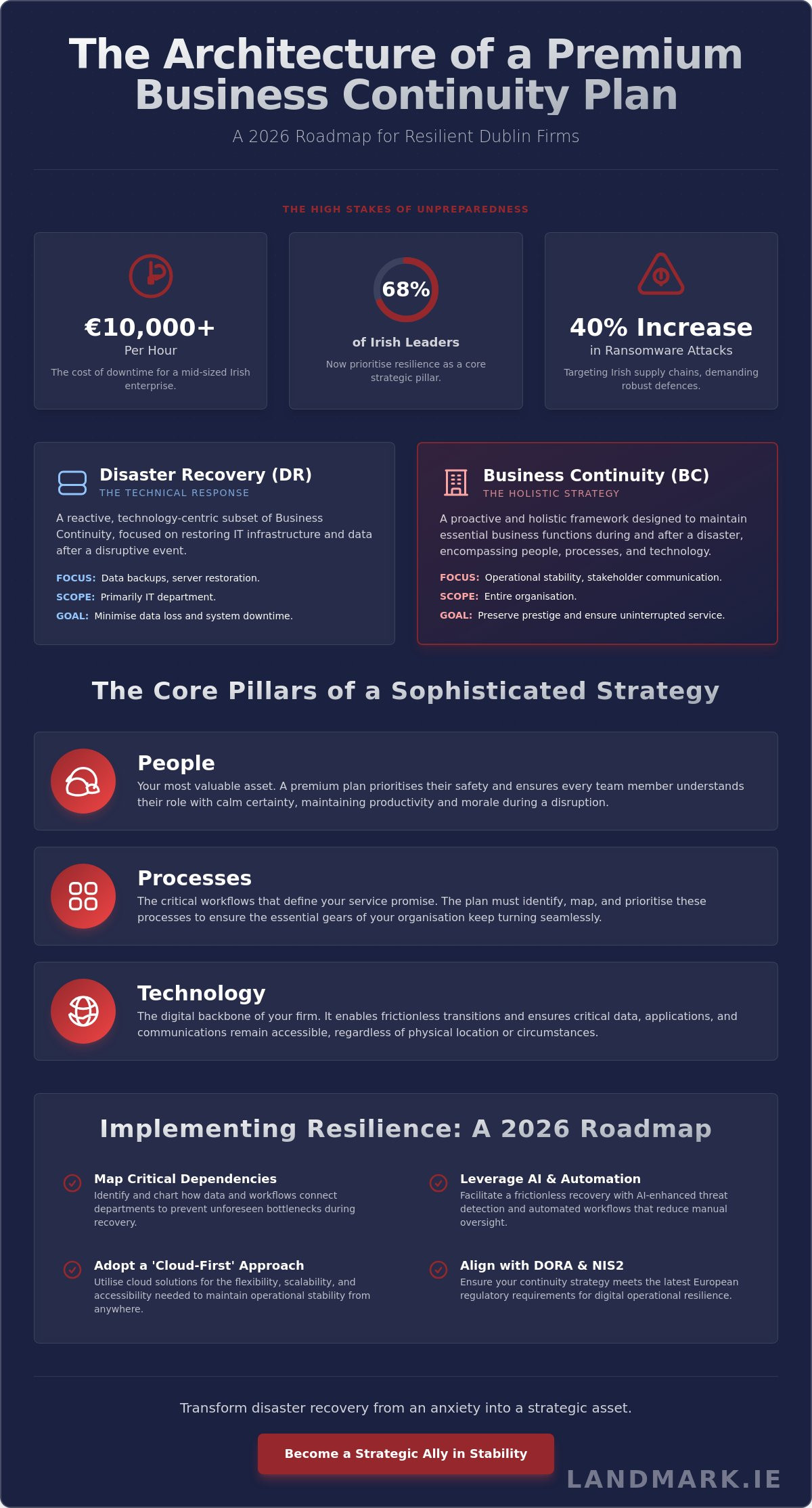
What if the true measure of your firm’s prestige wasn’t found in your quarterly growth, but in the silence of a crisis that never happened? With the cost of downtime for mid-sized Irish enterprises now exceeding €10,000 per hour, the stakes for business continuity planning Dublin have never been higher. You likely recognise that a basic backup is no longer a shield against the sophisticated cyber threats and regulatory pressures of 2026. It’s a concern shared by many, as 68% of Irish leaders now prioritise resilience as a core strategic pillar to protect their hard-earned reputations.
This guide will show you how to transform your disaster recovery from a source of anxiety into a curated IT asset that ensures operational stability and prestige. We’ll explore how to align your strategy with the latest DORA and NIS2 requirements whilst maintaining the frictionless experience your stakeholders expect. You’ll gain a clear roadmap for integrating AI-enhanced resilience and cloud solutions to create a sense of calm efficiency that persists even during unforeseen disruptions.
Key Takeaways
- Understand why sophisticated business continuity planning Dublin is now a strategic necessity for preserving your firm’s prestige and market position.
- Learn to distinguish between purely technical disaster recovery and the broader, more holistic orchestration required for true business resilience.
- Discover how to identify critical vulnerabilities and map departmental dependencies to ensure your recovery process remains impeccably organised.
- Explore how leveraging AI and business automation can facilitate a frictionless recovery without the need for manual oversight during a crisis.
- See how a ‘Cloud-First’ approach provides the flexibility needed to maintain operational stability and a sense of calm for your stakeholders.
Defining Business Continuity Planning in Dublin’s Evolving Corporate Landscape
In the heart of Ireland’s commercial capital, the definition of success is shifting. It’s no longer enough to simply grow; one must endure. Defining Business Continuity Planning in this context means more than just having a backup server in the basement. It’s the strategic ability of an organisation to maintain its essential functions during and after a disruption, ensuring that the service promise remains unbroken. For the discerning Irish firm, resilience has become the hallmark of a premium, well-organised business. It signals to partners and clients that your operations aren’t left to chance, but are instead curated with meticulous care.
By 2026, we’ve seen a definitive transition amongst Dublin’s elite firms. They’ve moved away from being reactive disaster fixers who scramble when things go wrong. Instead, they’ve embraced the role of proactive continuity curators. This shift is driven by a complex interplay of digital threats and environmental variables. From the rising frequency of intense weather events to the 40% increase in ransomware attacks targeting Irish supply chains reported by the NCSC in 2025, the need for a robust national strategy is undeniable. Effective business continuity planning Dublin ensures that when the unexpected occurs, your response is a choreographed performance rather than a chaotic scramble.
To better understand how these elements integrate to protect your organisation, watch this helpful overview:
The Core Pillars of a Sophisticated Continuity Strategy
A truly robust framework rests on three distinct yet interconnected pillars. First, there are your People. They’re your most valuable asset, and their safety and productivity must be the absolute priority. A sophisticated plan ensures every team member knows their role with calm certainty. Second are your Processes. This involves identifying and prioritising the critical workflows that define your service. It’s about knowing exactly which gears must keep turning to keep the engine running. Finally, Technology provides the digital backbone. It allows for frictionless transitions, ensuring that data and communications remain accessible regardless of physical circumstances.
Why Prestige Demands Persistence
For high-achieving organisations, the cost of a service outage is measured in more than just euros. Whilst downtime can cost mid-sized firms upwards of €10,000 per hour, the emotional toll on stakeholders and the potential damage to your prestige can be far more enduring. A rapid, graceful recovery reinforces your reputation as a reliable strategic ally. It demonstrates an impeccable level of organisation that your competitors may lack. This persistence is intrinsically linked to your digital safety. Aligning your continuity goals with the Cyber Security standards expected in 2026 ensures your firm remains a bastion of stability in an increasingly volatile world.
The Architecture of a Premium Business Continuity Plan
A document gathering dust on a shelf isn’t a plan; it’s a liability. For the prestigious Dublin firm, the architecture of resilience must be as functional and refined as the office spaces they inhabit. True business continuity planning Dublin involves more than just listing emergency contacts. It requires a deep understanding of how data flows amongst your departments and where the friction points lie. By mapping these dependencies, you ensure that recovery isn’t a chaotic scramble but an organised, choreographed transition that maintains your operational rhythm.
Designing bespoke recovery strategies allows your organisation to reflect its unique values even during a disruption. This isn’t a one-size-fits-all exercise. It’s about creating a “Continuity Culture” where every member of the workforce understands that resilience is part of the firm’s excellence. Regular testing and fire-drills turn these strategies into a well-oiled machine, ensuring that when a crisis occurs, your team responds with the calm efficiency that stakeholders expect from a market leader.
Step 1: The Business Impact Analysis (BIA)
The BIA serves as the foundation of your strategy, allowing you to quantify the impact of downtime on both your revenue and your hard-earned reputation. It’s the cornerstone of any Strategic IT Consultancy engagement. The official definition of a business continuity plan highlights the importance of documented procedures, but the BIA is where you identify your “Maximum Tolerable Downtime.” Knowing exactly how long your most critical services can remain offline before prestige is permanently damaged allows for a prioritised and graceful recovery.
Step 2: Developing Recovery Strategies
Once vulnerabilities are identified, you must choose recovery strategies that mirror your prestige requirements. This often involves choosing between hot, warm, and cold recovery sites. A “hot” site offers near-instantaneous failover, which is essential for firms where even a few minutes of outage is unacceptable. Integrating Microsoft 365 as a cloud-based resiliency hub ensures your team remains productive from any location. Simultaneously, unified communications must remain active whilst your physical office is inaccessible, maintaining the professional front your clients depend upon. If you’re looking to refine your firm’s resilience, starting with a bespoke continuity assessment is a logical first step towards total operational stability.
Disaster Recovery vs. Business Continuity: Navigating the Nuance
It’s easy to mistake a technical fix for a total business solution. To understand the distinction, imagine you’re hosting a prestigious gala at a historic Dublin landmark. Disaster recovery is the team rushing to repair a burst pipe in the kitchen. Business continuity, however, is the grace that ensures the music keeps playing and the champagne continues to flow in the ballroom whilst those repairs happen behind the scenes. One is about fixing what broke; the other is about ensuring the guest experience remains flawless. For any high-achieving firm, business continuity planning Dublin must encompass both to maintain a reputation for effortless reliability.
By 2026, the integration of AI and business automation has blurred the lines between these two disciplines. Sophisticated systems now detect a server failure and trigger an automated failover to the cloud before a human even notices a flicker. This evolution means that technical restoration is becoming a silent, background process. However, the need for a holistic strategy remains. A modern Irish firm requires a plan that addresses not just the servers, but the people and the prestige of the service they provide to their clients.
Disaster Recovery: The Technical Restoration
Disaster recovery focuses strictly on the digital engine room. It’s the process of restoring servers, data, and connectivity after a catastrophic event. In this technical defence, two metrics reign supreme: Recovery Time Objective (RTO) and Recovery Point Objective (RPO). These determine how quickly you can return to operation and how much data you can afford to lose. Achieving a premium RTO requires a robust infrastructure where Business Broadband redundancy is non-negotiable. Without a secondary, high-speed connection, even the most sophisticated recovery protocols will stall at the first sign of a local outage.
Business Continuity: The Holistic Endurance
Business continuity is the broader, more resilient ecosystem that surrounds your technology. It’s the strategy that allows your firm to endure, ensuring that client relations and core operations continue even when the primary office is offline. This involves managing the human element and maintaining clear internal communications during a crisis. True resilience means your team can transition to remote working with such calm efficiency that your clients never sense a disruption. It’s about protecting the prestige of your brand by proving that your organisation is impeccably organised and capable of thriving amongst any level of uncertainty.
Implementing Resilience: A 2026 Roadmap for Irish Firms
Transitioning from a theoretical plan to an active, resilient operation requires a shift in mindset. In 2026, the most successful organisations in the capital don’t rely on manual intervention during a crisis. Instead, they leverage AI and business automation to trigger recovery protocols the moment a deviation is detected. This modern roadmap for business continuity planning Dublin prioritises a ‘Cloud-First’ architecture. By moving critical workloads to distributed environments, you ensure that regional physical disruptions, such as extreme weather or local power outages, no longer pose a terminal threat to your prestige.
Cybersecurity remains the primary antagonist to operational stability. With the National Cyber Security Centre reporting a 40% rise in ransomware attacks targeting Irish supply chains in 2025, your roadmap must treat digital defence as the foundation of continuity. A plan that doesn’t account for data integrity and secure access is merely a delay of the inevitable. Integrating robust security measures ensures that your recovery is not just fast, but safe. To begin building your own resilient future, you can explore our bespoke business continuity solutions designed for the unique needs of Dublin’s corporate leaders.
AI-Driven Continuity: The Future of Resilience
AI has transformed resilience from a reactive effort into a predictive science. Modern systems now analyse patterns to predict potential hardware or software failures before they manifest as downtime. When a risk is identified, automated failover systems transition your operations to redundant environments without a single second of lag. This creates a frictionless experience for your clients, who remain entirely unaware of the technical hurdles being cleared in the background. By reducing the ‘labour’ of recovery through smart, pre-programmed responses, your leadership team can focus on strategic decisions rather than technical firefighting.
The Role of Unified Communications
A mobile, resilient workforce depends entirely on the strength of its connection. VoIP and cloud-based collaboration tools are the heart of any sophisticated continuity plan. These technologies ensure that your team can provide the same ‘warm hospitality’ and professional service from a remote location as they would from a Georgian office in Dublin 2. Protecting the flow of information amongst stakeholders during a transition is vital. When your communications are decentralised, your organisation remains impeccably organised, ensuring that every client call is answered and every strategic alliance is maintained, regardless of the physical circumstances.
Landmark Technologies: Your Strategic Ally in Operational Stability
Landmark Technologies acts as the refined host for your organisation’s digital future. We understand that the complexities of modern IT resilience can feel overwhelming whilst you focus on the growth of your firm. Whether your office overlooks the historic charm of St. Stephen’s Green or the modern pulse of the Silicon Docks, our role is to manage those intricacies with a quiet confidence. By choosing a partner that values heritage and professional excellence, you ensure that your business continuity planning Dublin is handled with the same level of craftsmanship you apply to your own client services. This isn’t merely about technology; it’s about protecting the legacy you’ve built in the heart of the capital.
We take immense pride in our ability to nurture success through stability and attentive service. Our team doesn’t just implement software; we build environments where your prestige is protected by default. This sense of calm efficiency is the result of a well-oiled machine working tirelessly behind the scenes. We’ve moved beyond the era of simple backup solutions to a state of absolute operational assurance. It’s a strategic alliance that allows you to focus on your long-term vision, knowing that the foundation of your firm is impeccably organised and resilient amongst any challenge.
A Tailored Approach to Continuity
Generic, off-the-shelf plans often fail the unique needs of high-achieving Irish professionals because they lack the nuance required for a premium corporate operation. Our approach is entirely bespoke, tailored to the specific rhythm of your workplace. We align your resilience strategy with our broader suite of managed services, including Cyber Security, Cloud Solutions, and AI & Business Automation, to create a holistic ecosystem. This integration ensures a frictionless, premium IT experience where every component of your infrastructure is designed to support uninterrupted service and stakeholder confidence.
Begin Your Journey to Absolute Resilience
The transition from digital uncertainty to a state of calm, assured continuity begins with a clear understanding of your current posture. We offer a comprehensive audit of your existing continuity and security frameworks to identify exactly where your organisation can be strengthened. This isn’t just a one-time fix; it’s the start of a long-term partnership with a dedicated strategic ally committed to your success. We invite you to Experience the peace of mind that comes with a Landmark continuity strategy. and discover how true resilience can become your greatest competitive advantage.
Cultivating a Future of Uninterrupted Excellence
The corporate landscape of 2026 demands more than just a survival instinct; it requires a deep commitment to endurance. We’ve explored how sophisticated business continuity planning Dublin transforms a technical necessity into a lasting mark of corporate prestige. By distinguishing between simple recovery and holistic continuity, your firm can maintain its reputation for excellence even amongst the most complex digital disruptions. A truly resilient organisation is one where the guest experience never falters, regardless of the challenges occurring behind the scenes.
Founded in 2004, Landmark Technologies brings over two decades of Irish IT expertise to your boardroom. We specialise in premium, AI-driven managed IT solutions that ensure your operations remain frictionless and your stakeholders remain calm. As a strategic ally, we’re dedicated to protecting the heritage and future of your business with an impeccably organised approach to resilience. It’s time to move beyond reactive fixes and embrace a state of permanent operational stability.
Secure your organisation’s future with Landmark’s bespoke continuity planning.
Your journey toward absolute resilience is an investment in the permanence of your brand. We look forward to helping you nurture a professional environment where success is never interrupted and your prestige remains untarnished.
Frequently Asked Questions
What are the four main elements of a business continuity plan?
The four essential elements are people, processes, technology, and communication. Your plan must first ensure the safety and clarity of roles for your staff. It then prioritises critical processes, secures the digital infrastructure required to run them, and establishes a clear flow of information amongst all stakeholders. This structured approach ensures that the organisation remains impeccably organised even during a period of transition or crisis.
How often should a business continuity plan be updated in 2026?
You should review your plan at least once a year or whenever there’s a significant change to your IT infrastructure or business model. In the fast-moving corporate environment of 2026, many firms perform quarterly audits of their digital assets to ensure total alignment. Regular testing through simulations is vital to ensure your business continuity planning Dublin remains a well-oiled machine that’s ready for immediate activation.
Is business continuity planning a legal requirement for Irish companies?
Yes, for many organisations, it’s now a mandatory obligation. The Digital Operational Resilience Act (DORA) became fully enforceable in January 2025, and the NIS2 Directive was transposed into Irish law in late 2025. These regulations require essential and important entities to adopt strict risk management measures. Additionally, the Central Bank of Ireland expects regulated firms to maintain robust operational resilience frameworks to protect the wider financial ecosystem.
What is the difference between a business continuity plan and a disaster recovery plan?
Disaster recovery is a technical subset of business continuity that’s focused specifically on restoring IT systems, servers, and data. Business continuity is a much broader, holistic strategy for the entire organisation. Whilst disaster recovery ensures your data is safe and accessible, business continuity ensures your staff can work and your clients receive a premium service level even if your primary office is unavailable.
How can AI improve my organisation’s business continuity efforts?
AI improves resilience by shifting the focus from reaction to prediction. Modern AI tools can analyse system patterns to identify potential hardware failures or cyber threats before they manifest as downtime. When a disruption occurs, automated failover systems can transition workloads to the cloud without manual intervention. This creates a frictionless experience for your clients and reduces the recovery burden on your internal leadership team.
What are the biggest threats to business continuity for Irish SMEs today?
Cybersecurity incidents and supply chain disruptions are the leading threats in the current landscape. The National Cyber Security Centre highlighted a 40% increase in ransomware attacks targeting Irish supply chains in 2025. Beyond digital threats, firms must also account for physical disruptions caused by increasingly intense weather events. A sophisticated plan addresses these variables to ensure your firm’s prestige and operational stability remain intact regardless of external pressures.
How much does it cost to implement a professional business continuity plan?
The investment required depends on the complexity of your organisation’s workflows and the volume of data that requires protection. Professional plans are typically bespoke, reflecting the unique rhythm and prestige requirements of your firm. Costs generally involve an initial strategy development phase followed by ongoing managed service fees. You should consult with a dedicated strategic ally to receive a tailored assessment that aligns with your specific operational standards.
