
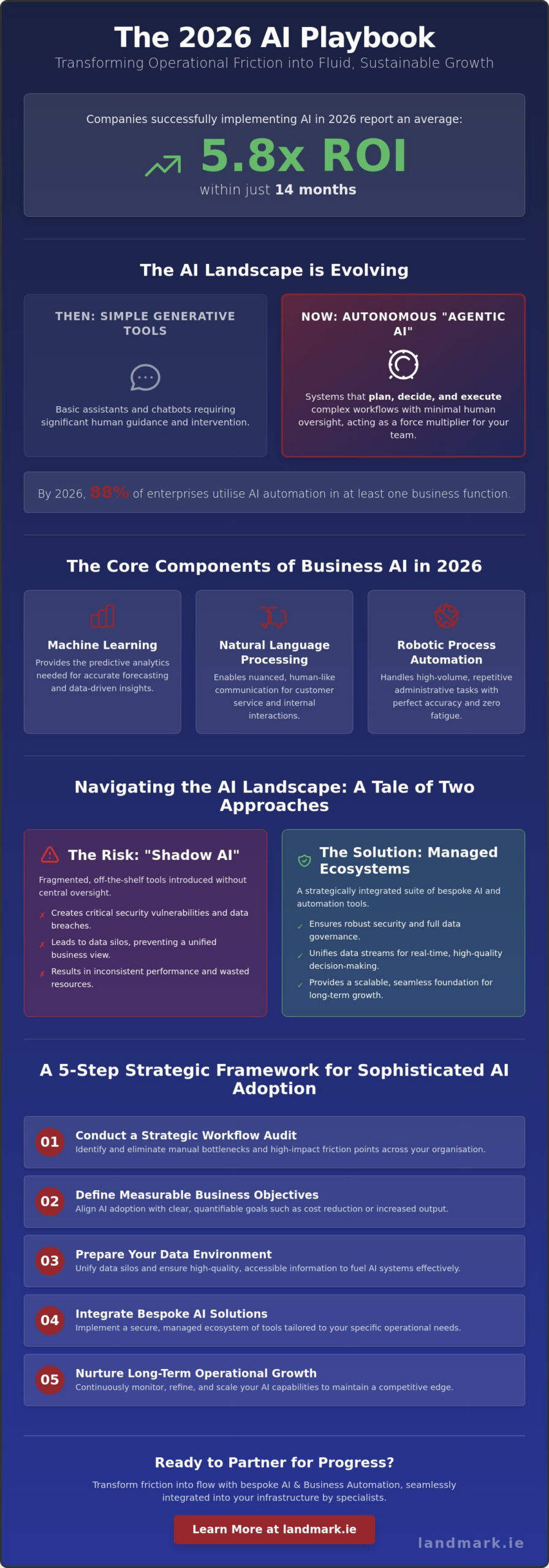
Did you know that companies successfully implementing AI in 2026 report an average ROI of 5.8x within just 14 months? For many high-achieving leaders, the question is no longer whether to adapt, but how to improve business efficiency with AI without compromising the security or prestige of their operations. You likely recognise the pressure to evolve whilst managing rising costs and the bottlenecks created by manual data entry.
This strategic guide provides the clarity you need to transform operational friction into fluid, sustainable growth. We’ll move beyond the noise to focus on a sophisticated roadmap for 2026, exploring how to transition from simple assistants to autonomous agentic systems. You will discover how to reduce manual workloads for your staff and sharpen decision-making through high-quality data, ensuring your business remains a refined environment where success is nurtured and efficiency is effortless.
Key Takeaways
- Understand the 2026 shift from simple generative tools to autonomous “Agentic AI” that executes complex workflows with minimal intervention.
- Discover how to improve business efficiency with AI by conducting a strategic workflow audit to identify and eliminate manual bottlenecks.
- Learn why integrated managed ecosystems are essential for avoiding the security risks associated with fragmented, “shadow” AI tools.
- Follow a sophisticated five-step framework to prepare your data environment and align AI adoption with measurable business objectives.
- Explore how bespoke AI & Business Automation can be seamlessly integrated into your infrastructure to nurture long-term operational growth.
##Table of Contents
-
The 2026 AI Landscape: From Experimental Hype to Operational Necessity
-
Navigating the AI Landscape: Off-the-Shelf Tools vs Managed Ecosystems
-
Partnering for Progress: AI & Business Automation with Landmark Technologies
##The 2026 AI Landscape: From Experimental Hype to Operational Necessity
The year 2026 represents a definitive watershed moment for corporate productivity. We’ve moved beyond the era of generative AI as a mere novelty. For most mid-sized organisations, the transition from experimental curiosity to operational necessity is complete. According to recent data, 88% of enterprises now utilise AI automation in at least one business function. This widespread adoption marks the point where staying competitive requires more than just hard work; it requires a sophisticated digital foundation.
True efficiency in this era is defined by the seamless blend of speed, accuracy, and scalability. When leaders consider how to improve business efficiency with AI, they are increasingly looking toward "Agentic AI." Unlike the simple chatbots of the past, these autonomous agents can plan, make decisions, and execute complex workflows with minimal human intervention. This technology acts as a force multiplier for your existing talent, liberating your most creative minds from the weight of administrative drudgery so they can focus on high-value strategy.
To better understand how these technologies are reshaping the modern workplace, watch this helpful video:
Why Traditional Efficiency Methods are No Longer Enough
Manual process mapping and legacy systems often lead to "efficiency debt." This is the cumulative cost of maintaining slow, fragmented workflows whilst your competitors move at the speed of light. In a digital-first economy, relying on human-only data entry creates bottlenecks that prevent real-time decision making. The cost of inaction is no longer just a missed opportunity. It’s a risk to your market position as automated rivals achieve an average ROI of 5.8x within 14 months of implementation.
The Core Components of Business AI in 2026
Modern Industrial AI applications rely on a triad of sophisticated technologies. Machine Learning provides the predictive analytics needed for accurate forecasting, whilst Natural Language Processing (NLP) enables nuanced, human-like communication across your client base. To tie it all together, Robotic Process Automation (RPA) handles high-volume administrative tasks with zero fatigue. When these elements are integrated into a secure, managed ecosystem, they don’t just save time. They create a frictionless environment where your business can flourish.
##Identifying High-Impact Friction Points for AI Intervention
Transforming your organisation begins with a meticulous gaze into its daily operations. To truly understand how to improve business efficiency with AI, you must first identify where friction resides. These friction points are often hidden in plain sight, disguised as "the way things have always been done." A rigorous workflow audit reveals the repetitive, low-value manual tasks that quietly drain your team’s energy. By pinpointing these areas, you can transition from a reactive posture to a proactive strategy that nurtures growth.
Data silos represent another significant barrier to excellence. When information is trapped within individual departments, real-time decision making becomes impossible. This fragmentation creates a lag that high-achieving professionals simply cannot afford. Research from IBM highlights how AI improves efficiency by unifying these disparate data streams, allowing for sophisticated demand forecasting and quality control. Engaging with an IT consultancy specialist can help you pinpoint these friction points with surgical precision, ensuring your technology aligns with your premium brand values.
Automating the ‘Invisible’ Back-Office Workflows
The administrative overhead in finance and HR departments often creates a heavy burden of "invisible" work. AI-driven invoice processing and expense management can turn days of manual entry into seconds of automated verification. Leadership teams can benefit immensely from automated diary management, where AI agents coordinate complex schedules whilst respecting personal preferences. This level of organisation ensures that internal reporting is no longer a chore of data aggregation, but a source of immediate, actionable insight. It creates a calm, well-oiled machine behind the scenes, allowing your staff to focus on the craftsmanship of their core roles.
Enhancing Client-Facing Operations
In a premium service environment, your reputation rests on the quality and speed of your response. Customer service bottlenecks don’t just slow you down; they harm your brand’s prestige. By deploying AI agents for first-line support, you provide 24/7 assistance that feels both attentive and immediate. These systems don’t replace the human touch; they enhance it by handling routine enquiries and providing staff with the context needed for high-level interactions. Hyper-personalisation in sales outreach ensures that every client feels like your only client, maintaining a welcoming atmosphere whilst operating at an unprecedented scale. This balance of technology and hospitality is the hallmark of a truly modern, efficient business.
##Navigating the AI Landscape: Off-the-Shelf Tools vs Managed Ecosystems
Selecting the right technology is much like choosing the foundation for a prestigious office; it must be enduring, secure, and impeccably organised. Many leaders find themselves enticed by the sheer volume of standalone SaaS tools promising instant results. This often leads to the rise of "Shadow AI," where team members adopt unauthorised applications in a well-intentioned bid to stay productive. Whilst these tools offer a quick fix, they frequently create disconnected islands of data that hinder the very growth they were meant to support.
True mastery of how to improve business efficiency with AI lies in moving away from fragmented apps toward a unified, managed ecosystem. Microsoft 365 and Copilot often serve as the ideal foundational layer, providing a familiar yet powerful environment where AI is a built-in feature rather than an afterthought. When considering the Total Cost of Ownership (TCO), it’s vital to look beyond simple subscription fees. A managed approach ensures that your investment delivers a consistent ROI, transforming technology from a recurring expense into a strategic asset that nurtures your firm’s success.
The Critical Importance of AI Security and Governance
In 2026, the intersection of innovation and safety is where the most successful businesses reside. You cannot afford to feed proprietary data into public AI models, as this risks exposing the unique craftsmanship of your business processes. Ensuring your tools are GDPR compliant and data-sovereign is a non-negotiable standard for any premium brand. By integrating these tools into your broader cyber security strategy, you protect your heritage whilst embracing the future. This structured approach prevents leaks and ensures that your digital environment remains a sanctuary of calm efficiency.
Choosing the Right Integration Partner
Implementing sophisticated automation is not a task for a simple software vendor. It requires a dedicated strategic ally who understands that AI needs a robust network infrastructure to function at its peak. Without high-speed, reliable connectivity, even the most advanced agents will falter. This is where the distinction between a vendor and a high-end IT consultancy becomes clear. A partner provides the managed support necessary to ensure uptime and performance, allowing you to lead with confidence whilst the technical complexities are handled with expert care behind the scenes.
##A 5-Step Strategic Framework for Implementing AI
Moving from the theoretical potential of automation to a functioning, high-performance system requires a structured approach. Understanding how to improve business efficiency with AI is not about a sudden overhaul; it is about the intentional integration of technology into your unique culture. To ensure your transition is as seamless as a well-managed workspace, we recommend following this refined five-step framework.
-
Step 1: Define specific, measurable efficiency goals. Start by identifying the Key Performance Indicators (KPIs) that matter most. Whether you seek a 30% reduction in administrative time or a faster client response rate, clarity at the outset ensures your AI strategy remains focused on value.
-
Step 2: Prepare your data environment. AI is only as effective as the information it consumes. Organise your internal data, remove redundancies, and ensure your digital filing is as impeccable as your physical office.
-
Step 3: Run a controlled pilot programme. Select one department, such as finance or client relations, to test a specific automation tool. This allows you to refine the process in a low-risk environment before a wider rollout.
-
Step 4: Train staff to co-work with AI. Shift the internal narrative from replacement to empowerment. When your team understands how to use AI as a personal assistant, they can focus on the creative craftsmanship of their roles.
-
Step 5: Monitor, refine, and scale. Use the insights from your pilot to adjust your approach. Once the ROI is proven, scale the automation across the firm to create a unified, efficient ecosystem.
Preparing Your Infrastructure for the AI Shift
A sophisticated AI strategy cannot rest on a fragile foundation. You must assess whether your current cloud solutions possess the necessary compute power to handle modern AI workloads without lag. Real-time processing demands high-speed business broadband; any latency here will disrupt the calm efficiency you’ve worked hard to build. It is also vital to update your business continuity plan to account for AI dependencies, ensuring your operations remain resilient whilst you innovate. If you’re unsure where to begin your technical audit, you can book a strategic IT consultation to evaluate your readiness.
The Human Element: Training and Adoption
True progress is only possible when your team feels inspired rather than intimidated. Overcoming resistance requires radical transparency about why you are adopting these tools. By upskilling your employees to become "AI orchestrators," you elevate their professional standing, allowing them to manage digital agents whilst they focus on high-level strategy. Establishing ethical AI usage policies provides a reassuring sense of stability, ensuring that technology always serves your brand’s heritage and values. This human-centric approach ensures that your workspace remains an environment where talent is nurtured and success is sustained.
##Partnering for Progress: AI & Business Automation with Landmark Technologies
Landmark Technologies approaches the digital landscape with the same level of care and attention to detail that a dedicated host brings to a prestigious estate. We understand that discovering how to improve business efficiency with AI is a journey that requires a trusted strategic ally. Our sophisticated approach to AI & Business Automation isn’t about merely deploying tools. It is about nurturing a professional environment where success is sustained and operational friction is replaced by a calm, rhythmic growth.
We believe that technology should feel effortless. This is why we integrate intelligent automation directly into our core Managed IT Support services. By using AI to proactively monitor and optimise your systems, we ensure that potential disruptions are resolved before they ever reach your desk. This hospitality-first service mindset means your team experiences a workspace that is impeccably organised and consistently reliable. It is a premium experience that allows you to focus on the high-level strategy that defines your firm’s heritage.
Security remains the cornerstone of every solution we provide. As we have explored throughout this guide, the intersection of innovation and safety is paramount. Our Cyber Security experts ensure that as you adopt new automations, your proprietary data remains within a secure sanctuary. We protect your information with the same pride we take in our service, driving your growth whilst maintaining the absolute privacy and data sovereignty your clients expect.
Bespoke Automation Solutions for Modern Firms
Every organisation possesses its own unique rhythm and set of challenges. We don’t believe in one-size-fits-all software; instead, we tailor AI workflows to your specific industry requirements. Our team provides ongoing proactive monitoring of your automation systems to ensure peak performance at all times. Through our IT Consultancy, we provide the strategic foresight needed to ensure your tech stack evolves alongside the market, maintaining your competitive edge with quiet confidence.
Taking the First Step Toward a More Efficient Future
The transition to a more automated, fluid operation begins with a clear understanding of your current position. Requesting an AI readiness audit for your organisation is the first step toward this transformation. During this audit, our specialists evaluate your infrastructure and identify the most impactful friction points for intervention. When you partner with Landmark Technologies, you can expect a relationship built on stability, expertise, and a deep commitment to your success. Efficiency is the foundation of prestige, and we are here to ensure your foundation is as solid as the landmarks that ground our community.
##A Future of Effortless Operational Excellence
The transition from experimental AI to operational necessity is no longer a distant prospect; it’s the current standard for prestigious organisations. By moving beyond fragmented tools and embracing a secure, managed ecosystem, you ensure your business remains a sanctuary of calm efficiency. You now have the framework to identify friction points and the strategic steps required to implement autonomous workflows that nurture your team’s talent. Mastering how to improve business efficiency with AI is ultimately about reclaiming time for high-level craftsmanship and strategic growth.
Since 2004, we’ve provided national coverage across Ireland, supporting firms as they navigate the complexities of digital transformation. Our specialised AI & Business Automation division is dedicated to tailoring these advanced technologies to your unique heritage and goals. Discover how Landmark Technologies can transform your business efficiency with AI through a partnership built on stability and professional authority. Let us help you curate a workspace where technology serves your vision with impeccable reliability. Your journey toward a more refined, automated future starts today.
##Frequently Asked Questions
How can AI specifically improve business efficiency for an SME?
AI automates repetitive administrative tasks such as complex data entry and scheduling, allowing your team to focus on high-value client work. By integrating these systems into your daily operations, you reduce the manual bottlenecks that often hinder small and medium-sized firms. This creates a more fluid workflow where information moves seamlessly between departments, ensuring your business operates with the calm precision of a well-oiled machine.
Is AI expensive to implement for a smaller firm in Ireland?
Implementation costs vary based on the complexity of your needs, but the shift towards consumption-based pricing has made sophisticated tools more accessible. Smaller firms can start with foundational layers like Microsoft Copilot before scaling to bespoke automations. Whilst there is an initial investment in infrastructure and consultancy, the long-term reduction in administrative overhead often provides a sustainable financial path for growing Irish businesses looking to maintain a premium service level.
What are the biggest security risks when using AI for business automation?
The primary risks involve data privacy and the potential for proprietary information to be leaked into public AI models. Without a secure, managed environment, your firm’s sensitive intellectual property could be at risk. It’s essential to use private, enterprise-grade instances of AI tools and ensure all automations are integrated into a robust cyber security strategy. This protects your brand’s heritage whilst allowing you to innovate with confidence.
Do I need to hire an AI specialist to start improving my efficiency?
You don’t necessarily need to hire an in-house specialist if you partner with a dedicated IT consultancy. Professional managed service providers offer the expertise required to design and maintain your automation strategy without the overhead of a full-time hire. This approach allows you to access high-level strategic advice and technical support, ensuring your technology stack remains sophisticated and aligned with your long-term business objectives.
How long does it take to see a return on investment (ROI) from AI?
Many businesses begin to see measurable improvements in productivity and cost reduction within the first year of implementation. By focusing on how to improve business efficiency with AI through high-impact friction points, you can achieve quick wins that build momentum. Success depends on clear KPIs and a structured framework, allowing you to track time saved and the increased capacity of your team to handle premium client interactions.
Can AI help with my GDPR compliance and data management?
AI excels at organising vast amounts of information and identifying sensitive data that requires specific protection. Automated systems can help you categorise files, manage access permissions, and ensure that your data handling remains consistent with current regulations. This structured approach to data management nurtures a sense of stability and permanence, providing peace of mind that your organisation meets the highest standards of digital governance and privacy.
What is the difference between AI and simple business automation?
Simple automation follows rigid, pre-defined rules to execute tasks, whilst AI uses machine learning to adapt and make sophisticated decisions. Whilst a basic script might move a file, an AI agent can analyse the content of that file and determine the next best action. This distinction is crucial for leaders exploring how to improve business efficiency with AI, as it allows for the automation of complex, non-linear workflows that previously required human intervention.
How do I ensure my staff are comfortable with new AI tools?
Transparency and thoughtful training are the keys to successful adoption within any professional environment. By positioning AI as a supportive ally that handles drudgery, you empower your staff to focus on the craftsmanship of their core roles. Providing clear ethical policies and upskilling opportunities ensures that your team feels valued and inspired. This human-centric approach transforms technology from a source of anxiety into a celebrated component of your workplace culture.
