
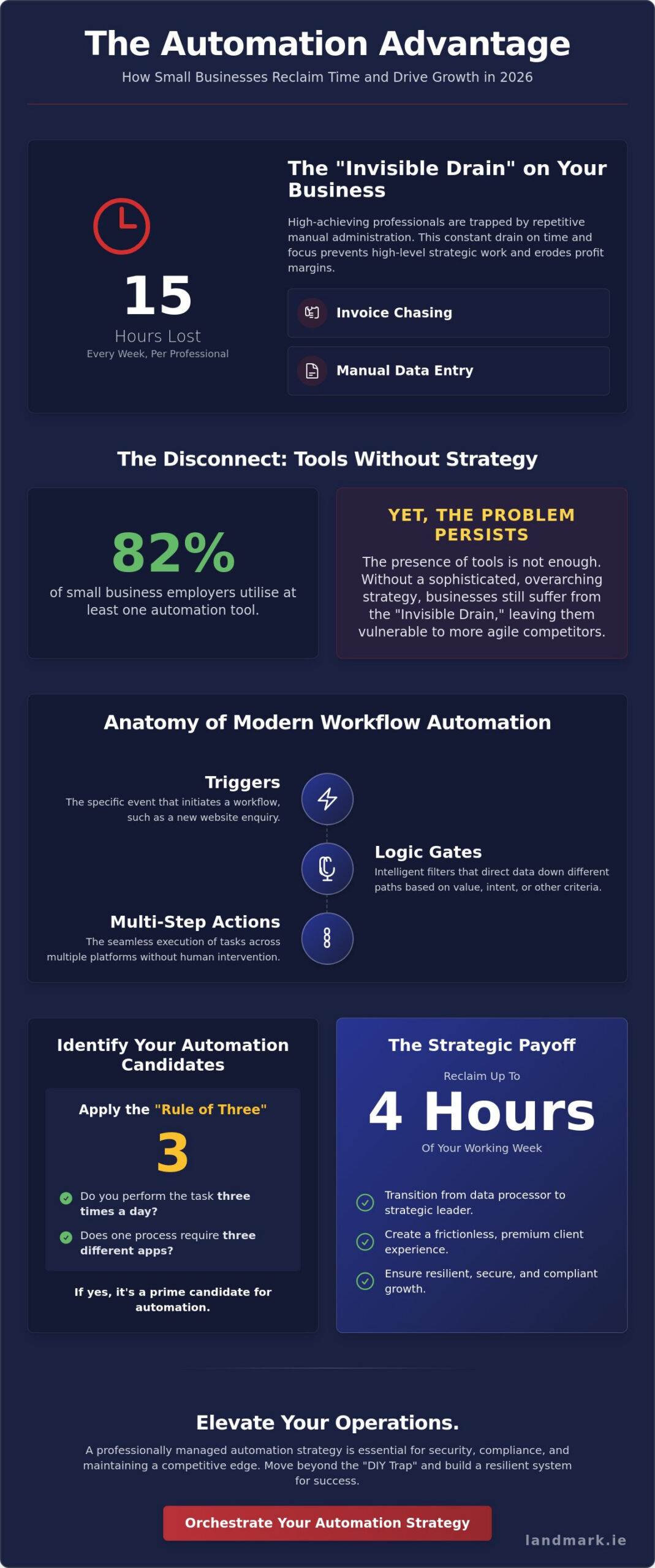
Recent data reveals that 82% of small business employers were utilising at least one automation tool by 2025, yet many high-achieving professionals still lose up to 15 hours every week to the manual labour of invoice chasing and data entry. This persistent drain on your focus suggests that whilst the tools are present, the overarching strategy often remains elusive. Implementing sophisticated workflow automation for small business is not merely about replacing human effort. It’s about elevating your team from data processors to strategic leaders within a frictionless, premium environment that nurtures success.
You likely recognise that inconsistent client journeys and the pressure of AI-driven competition are barriers to the prestige your brand deserves. We promise that by adopting this strategic approach, you can reclaim four hours of your working week and cultivate a truly lean, efficient operation. This guide provides a composed overview of the 2026 landscape for AI and business automation; we will cover verified pricing for essential platforms and navigate new regulatory frameworks like the Small Business AI Advancement Act to ensure your growth remains both secure and inspired.
Key Takeaways
- Identify the “invisible drain” of manual administration that erodes profit margins and prevents your business from achieving a truly premium scale.
- Learn how sophisticated workflow automation for small business serves as the connective tissue between your tools to ensure every client interaction is flawlessly executed.
- Discover how to automate high-impact touchpoints like lead management and onboarding to provide a warm, responsive experience whilst reclaiming hours of your working week.
- Recognise the risks of the “DIY Trap” and understand why a resilient, professionally managed automation strategy is essential for maintaining security and compliance.
- Position your team for success by transitioning from manual data processing to high-level strategic leadership through curated AI & Business Automation solutions.
The Efficiency Gap: Why Manual Workflows Stifle Small Business Growth
True prestige in business is rarely born from frantic activity. It emerges from a state of calm, composed oversight where every detail is handled with effortless precision. Yet, many high-achieving professionals find themselves trapped in a cycle of reactive firefighting, anchored by the “Invisible Drain” of manual administration. These repetitive tasks, whilst seemingly small, quietly erode your profit margins and consume the mental energy required for high-level strategy. When your day is dominated by chasing invoices or cross-referencing spreadsheets, you aren’t just losing time; you’re losing the opportunity to nurture your most ambitious ideas.
The “hustle culture” of manual labour is often mistaken for dedication, but in reality, it’s a significant barrier to scalability. A business that relies on the sheer willpower of its founder to function cannot grow without eventually fracturing. By viewing your operations as a systematic organization of resources, you can transition from a chaotic environment to one of frictionless efficiency. This shift allows you to move beyond the fatigue of admin and reclaim your role as a visionary leader.
To visualise how these digital connections come to life and begin reclaiming your time, watch this brief overview of modern automation tools:
Identifying Your “Automation Candidates”
Not every task requires the nuance of a human touch. To find the best opportunities for workflow automation for small business, apply the “Rule of Three”. If you perform a task three times a day, or if it takes three different apps to complete one process, it belongs in an automated workflow. Focus on high-volume, low-complexity actions such as data entry between your CRM and accounting software. Mapping the friction points in your client journey often reveals where manual delays are dampening the professional experience you strive to provide.
The 2026 Competitive Landscape
The business environment has shifted significantly. With 82% of small business employers now utilising at least one automation tool, the ability to operate as a “lean machine” is no longer an advantage; it’s a requirement for survival. Smaller firms are currently outmanoeuvring larger organisations by using AI and business automation to provide faster, more personalised service. Waiting to modernise your internal systems is no longer just an efficiency issue. It’s a business continuity risk that leaves your firm vulnerable amongst more agile, automated competitors who have already embraced this digital evolution.
Beyond Simple Triggers: How Modern Workflow Automation Operates in 2026
Modern workflow automation for small business has evolved from simple linear paths into a sophisticated digital connective tissue. It unifies your disparate tools, ensuring that your CRM, email platforms, and accounting software function as a single, organised entity. This structure creates a rhythmic quality to your operations, allowing your business to move with the steady, composed pace of a well-oiled machine. The anatomy of a contemporary workflow consists of three core elements:
- Triggers: The specific event, such as a website enquiry, that initiates the process.
- Logic Gates: The intelligent filters that decide which path the data should take based on value or intent.
- Multi-step Actions: The seamless execution of tasks across multiple platforms without human intervention.
The defining shift in 2026 is the rise of agentic AI within these sequences. Unlike the rigid rules of the past, modern systems can now handle nuanced “judgment calls” that previously required manual oversight. However, true prestige is maintained by keeping a human-in-the-loop for tasks that demand empathy or high-level discretion. Automation shouldn’t replace the warmth of your service; instead, it should clear the administrative clutter so your team can focus on the bespoke interactions that define a premium client journey.
The Role of AI & Business Automation
We are moving beyond basic task execution toward predictive, intelligent management. By integrating workflow automation for small business with advanced AI, systems can now analyse the sentiment in incoming customer emails to escalate urgent tickets or identify high-value opportunities instantly. AI-enhanced workflows represent the intelligent evolution of traditional robotic process automation (RPA), moving from rote repetition to context-aware execution. This level of sophistication ensures your business remains agile amongst competitors whilst maintaining a reassuring sense of stability.
Integrating with Your Existing Tech Stack
A resilient strategy relies on making your existing tools speak the same language with effortless functionality. When exploring Top 12 small business automation ideas, it becomes clear that native integrations are far superior to fragile third-party workarounds that often break under pressure. Every automated transfer of sensitive client data must be fortified by rigorous cyber security protocols to maintain the trust and prestige of your brand. For firms seeking a tailored roadmap to efficiency, our IT Consultancy provides the strategic clarity needed to orchestrate these complex systems with total confidence.
High-Impact Automation: 5 Essential Workflows for Lean Teams
Implementing workflow automation for small business is about more than just software; it is about curating a professional experience that feels both effortless and intentional. By selecting the right sequences, you can transform your operations into a lean, efficient machine that reflects the high standards of your brand. These five essential workflows are designed to eliminate friction and provide your team with the space to lead with confidence.
- Lead Management: Ensure high-value prospects receive an immediate, sophisticated response whilst they are still engaged with your website.
- Client Onboarding: Create a welcoming first impression by automating the delivery of welcome packs and access credentials without manual intervention.
- Financial Operations: Remove the burden of “the chase” by automating signature requests and internal invoice approvals.
- Internal Reporting: Sync closed deals directly from your CRM to your accounting software to maintain real-time visibility over your profit margins.
- Talent Acquisition: Streamline the employee journey from application to day one, ensuring your internal culture matches your external prestige.
Selecting the correct tools is the foundation of this transformation. Industry leaders often consult curated lists of the best workflow management software to find platforms that offer both power and aesthetic simplicity. Once the tools are in place, the true value lies in how they are orchestrated to serve your unique business goals.
Sales and Marketing Synchronisation
Modern growth requires a seamless handoff between marketing efforts and sales execution. By routing leads to specific representatives based on industry expertise or potential account value, you ensure that every prospect feels understood. Automating follow-up sequences allows for a cadence of communication that feels personal rather than robotic, capturing data from web forms directly into your CRM. This eliminates the need for tedious re-typing and ensures no high-value opportunity is ever overlooked.
Operational Excellence and Finance
Speed is a hallmark of premium service. Generating instant quotes and contracts reduces the time-to-close, allowing you to welcome new clients whilst their enthusiasm is at its peak. For your leadership team, automated expense tracking and approval notifications provide a steady, composed rhythm to financial oversight. Identifying these high-ROI opportunities is a core component of strategic IT consultancy, where the focus remains firmly on bespoke solutions that nurture long-term success. This structured approach ensures your business stays organised, reliable, and prepared for future expansion.
Building a Resilient Automation Strategy: Avoiding the DIY Trap
The accessibility of modern no-code tools has empowered many leaders to experiment with their own digital sequences. However, this often leads to the rise of “Shadow IT”, where critical business processes rely on fragile, undocumented automations created in isolation. Whilst these DIY solutions might offer a temporary reprieve from admin, they frequently break during system updates or when the original creator leaves the organisation. A truly premium operation requires a resilient strategy that prioritises stability and long-term reliability over quick, temporary fixes.
Ensuring GDPR compliance amongst automated data transfers is another significant hurdle for the unguided professional. With the regulatory landscape becoming increasingly complex, as seen with the patchwork of new AI-specific frameworks emerging throughout 2026, the risk of data mishandling is a serious threat to your brand’s prestige. Documentation is the bedrock of a secure system. Knowing exactly who “owns” each digital process and how it scales as you double in size ensures that your workflow automation for small business remains a strategic asset rather than a hidden liability.
Security and Governance for Small Businesses
Protecting sensitive client data within your workflows is paramount. Automated systems require more than just a “set and forget” mindset; they need regular health checks and rigorous security audits to identify potential vulnerabilities. Implementing multi-factor authentication (MFA) and end-to-end encryption across your automation layer ensures that your digital connective tissue is as secure as it is efficient. This organised approach to governance transforms your IT environment into a nurtured space where success can flourish without the fear of a security breach or data leak.
How to Choose the Right Automation Partner
A sophisticated business deserves more than a software vendor; it requires a strategic ally. When selecting a partner to manage your AI and business automation, look for those who prioritise your overarching business goals rather than just technical execution. The right partner handles the underlying complexity, allowing you to enjoy the results of a frictionless operation whilst avoiding the frustration of vendor lock-in. By choosing flexible, open-standard platforms, you maintain individual agency and the autonomy to pivot as your market evolves and your team grows.
If you are ready to move beyond the limitations of DIY setups and build a future-proof operation, our team is here to provide the expert guidance you require. Explore how our IT Consultancy can orchestrate a bespoke automation strategy tailored to your firm’s unique ambitions.
Partnering for Progress: How Landmark Technologies Orchestrates Business Automation
At Landmark Technologies, we act as the refined host of your digital transformation. We understand that for a high-achieving firm, technology should be an invisible, nurturing force rather than a source of constant friction. Our bespoke approach to AI & Business Automation ensures that your systems are not merely functional but truly aspirational, mirroring the prestige and calm efficiency of your physical workspace. By positioning ourselves as your strategic ally, we handle the underlying technical complexity so you can enjoy the results of a perfectly organised operation.
True operational stability is rarely achieved through isolated tools. This is why we integrate workflow automation for small business into your broader Managed IT Support framework. This holistic approach addresses the common gap where automation exists in a silo, often disconnected from vital Cyber Security protocols or Cloud Solutions. When your automated sequences are managed alongside your network infrastructure, you create a resilient environment where data flows securely and effortlessly amongst your team, ensuring that your business remains a well-oiled machine even as you scale.
The Landmark Advantage
With over two decades of heritage in delivering premium IT solutions, we bring a level of craftsmanship to digital workflows that few can match. We take pride in our ability to design systems that evoke a sense of stability and permanence, providing national coverage with a sophisticated, attentive service model. Our commitment to excellence means we don’t just implement software; we curate a professional experience that values your time and rewards your ambition. This dedication to quality ensures that every automation we deploy is backed by a robust strategy for business continuity and long-term growth.
Your Next Steps Toward a Leaner Business
The journey toward reclaiming your focus begins with a composed, methodical assessment of your current operations. We start with a comprehensive audit of your manual processes to identify the friction points that are quietly eroding your productivity. From there, we design a tailored roadmap that delivers immediate time-savings whilst building long-term value for your firm. This structured path ensures that your transition to a more automated future is graceful, steady, and entirely aligned with your brand’s high standards.
If you are ready to eliminate repetitive administration and elevate your team to new levels of strategic leadership, we invite you to begin the conversation. Enquire about our AI & Business Automation services today and discover how a curated approach to technology can nurture your ongoing success.
Stepping into Your New Operational Rhythm
The transition from manual administration to a state of frictionless oversight is the hallmark of a modern, successful enterprise. By identifying high-impact tasks and moving toward intelligent sequences, you protect your team’s mental energy and ensure every client journey is flawlessly executed. A resilient strategy for workflow automation for small business doesn’t just save time; it establishes a foundation of stability that allows your firm to grow with confidence and prestige.
Since our founding in 2004, Landmark Technologies has operated as a national managed service provider and specialists in AI & Business Automation. We take pride in handling the intricate details of your digital infrastructure, allowing you to enjoy the benefits of an impeccably organised environment. By choosing a partner that values heritage whilst focusing on modern innovation, you secure a reliable, long-term solution that scales alongside your ambitions.
Discover how Landmark Technologies can automate your success. The future of your firm is one of calm efficiency and effortless functionality; we look forward to helping you build it.
Frequently Asked Questions
What is workflow automation for small businesses exactly?
It is the process of using technology to execute repetitive tasks and synchronise data across disparate tools without manual intervention. For a growing firm, this means creating a frictionless environment where leads, invoices, and client data flow effortlessly through a predefined sequence of digital actions. It acts as the connective tissue that allows your separate software applications to function as a single, organised entity.
Is workflow automation expensive to implement for a small team?
Implementation costs are remarkably accessible for lean teams. Whilst sophisticated orchestration requires a strategic investment, entry-level platforms like Make.com begin at approximately $9 per month for their Core plan when billed annually. The primary cost for a professional operation is often the time required for design and governance, which is why many firms choose a managed approach to ensure a high return on investment.
How much time can my business really save with automation?
Most high-achieving professionals reclaim at least four hours of their working week by eliminating repetitive manual admin. Data from 2025 indicates that organisations implementing these tools see an average productivity increase of 66% across various business tasks. This reclaimed time allows leaders to pivot from reactive firefighting to the high-level strategy that nurtures long-term success.
Will I lose the “personal touch” with my customers if I automate?
Automation actually enhances the personal touch by ensuring your responses are immediate, reliable, and consistent. By removing the administrative clutter from your desk, your team is free to focus on the bespoke interactions that require empathy and discretion. A well-designed workflow feels like a warm, attentive welcome rather than a robotic encounter, maintaining the prestige of your brand.
Is workflow automation secure for sensitive financial or legal data?
Yes, provided it is built within a robust cyber security framework. Modern workflow automation for small business utilises end-to-end encryption and multi-factor authentication to protect sensitive data during transfers. It is essential to ensure your automation layer complies with regional regulations like GDPR or the Small Business AI Advancement Act to maintain your brand’s integrity and client trust.
What is the difference between simple automation and AI?
Simple automation follows rigid “If This Then That” rules, whereas AI can make nuanced judgment calls within a sequence. In 2026, we see a shift toward agentic workflows where AI agents can analyse sentiment in emails or formulate plans to solve specific goals. This evolution allows your systems to handle complex tasks that previously required constant human oversight.
Do I need a developer to set up my business workflows?
You don’t necessarily need a developer thanks to the rise of sophisticated low-code and no-code platforms. These tools feature visual interfaces that allow for relatively rapid deployment of basic sequences. However, for complex orchestrations that require high levels of security and cross-platform reliability, partnering with an IT consultancy ensures your systems are professionally governed and truly scalable.
How do I know which processes I should automate first?
Start with high-volume, low-complexity tasks that follow a predictable path every time. Apply the “Rule of Three”: if you perform a task three times a day, or if it involves three different apps, it is a prime candidate for automation. Common starting points include lead routing from your website, client onboarding sequences, and financial approval notifications that currently stall your operational rhythm.
