
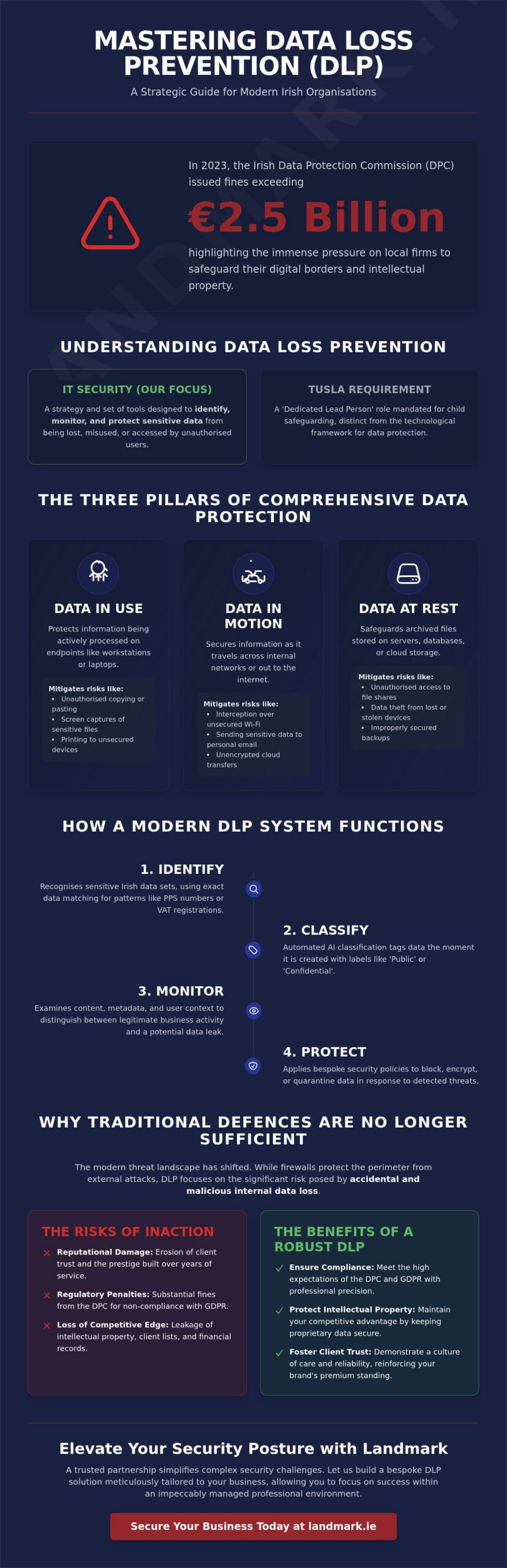
In 2023, the Irish Data Protection Commission issued fines exceeding €2.5 billion, a figure that highlights the immense pressure on local firms to safeguard their digital borders. Whether your team is collaborating from a prestigious office in Dublin 2 or working remotely across the country, the risk of a sensitive leak is a constant reality. Implementing a robust dlp strategy is no longer just a technical requirement; it’s a foundational element of a sophisticated, secure business environment.
It’s understandable to feel a sense of unease regarding how hybrid work patterns impact your security, or even to feel confused by the various meanings of the DLP acronym within the Irish market. You deserve the confidence that comes with knowing your intellectual property is meticulously protected. This guide provides a clear roadmap to master Data Loss Prevention, offering you the tools to ensure regulatory compliance and a seamless professional experience for your entire team. We will explore everything from initial risk assessment to the final steps of a bespoke implementation.
Key Takeaways
- Navigate the critical distinctions between technical security and Irish regulatory requirements to ensure your organisation’s compliance is handled with professional precision.
- Understand how automated AI classification seamlessly organises your data, providing a frictionless experience whilst protecting your most sensitive information.
- Discover why traditional defences are no longer sufficient and how a bespoke dlp solution mitigates the significant risks posed by accidental internal data loss.
- Master a structured framework for prioritising digital assets, allowing you to build a security strategy that is both robust and meticulously tailored to your business needs.
- Learn how a trusted partnership simplifies complex security challenges, allowing you to focus on nurturing success within an impeccably managed professional environment.
Understanding Data Loss Prevention (DLP) in the Modern IT Landscape
Protecting your organisation’s most valuable assets requires more than just a standard firewall. Data Loss Prevention, or dlp, is a meticulously designed strategy to identify, monitor, and safeguard sensitive information from leaving your secure environment. For Irish professionals, it’s vital to distinguish this IT framework from the ‘Dedicated Lead Person’ (DLP) role mandated by Tusla for child safeguarding. While both prioritise protection, our focus here is on the digital architecture that keeps your proprietary intelligence secure. By implementing Data Loss Prevention software, businesses can ensure that their bespoke client lists and financial records remain within their control.
To better understand this concept, watch this helpful video:
As we move through 2026, the threats facing Dublin’s vibrant business community have shifted from simple email blunders to sophisticated AI-driven data scraping. Information is the new currency for Irish enterprises; a single breach can devalue your brand’s reputation instantly. When data is leaked, the cost isn’t just a potential fine from the Data Protection Commission, it’s the erosion of the prestige you’ve built over years of service. A robust dlp framework acts as a silent guardian for this digital wealth.
The Three Pillars of Data Protection
A seamless security strategy addresses three distinct states of information. Data in Use focuses on protecting files while employees are actively working on them, preventing unauthorised copying or screenshots. Data in Motion secures files as they travel across your network or into the cloud, ensuring they aren’t intercepted. Finally, Data at Rest safeguards your archived files stored on servers or endpoint devices. This holistic approach ensures your business remains a sanctuary for sensitive information.
Why DLP Matters for Irish SMEs Today
The Data Protection Commission (DPC) continues to set high expectations for local firms, and compliance is now a baseline for any prestigious brand. Beyond the legalities of GDPR, protecting your intellectual property is essential for maintaining a competitive edge in the national market. We believe that providing a premium workspace goes hand in hand with digital security. Maintaining the Landmark Experience means fostering a culture of trust where your clients feel their data is handled with the same care as the meticulously designed offices they inhabit. Reliability is the ultimate luxury in 2026.
How DLP Systems Function: The Mechanism of Protection
Modern data protection relies on a sophisticated blend of content inspection and contextual analysis. It’s no longer enough to scan for a specific keyword; a robust dlp system must understand the intent behind a file transfer. By examining the metadata, the sender’s history, and the destination, these systems distinguish between a standard client update and a potential data leak. This shift mirrors the evolution of data loss prevention over the last two decades, moving from rigid rules to fluid, intelligent oversight. For businesses operating out of premium spaces like Landmark’s Dublin offices, this level of technical sophistication ensures that high-level strategy remains confidential and secure.
Identification and Classification
At the heart of the system lies the ability to recognise sensitive Irish data sets. Advanced tools use exact data matching to identify specific patterns, such as the eight-character structure of a PPS number or Irish VAT registrations. Automated classification is the foundation of modern data governance, ensuring every document is tagged the moment it’s created. This process removes the burden of manual sorting from your team. You can apply bespoke labels tailored to your specific industry, whether you’re managing legal briefs in Dublin 2 or financial portfolios in the Docklands. This ensures that “Public” documents move freely whilst “Confidential” files remain under strict control.
Monitoring and Alerting
Effective monitoring provides total visibility into data movement without compromising employee privacy. The system tracks who is accessing files and where they are sending them, creating a transparent audit trail. When a policy violation occurs, the system responds in real-time based on the severity of the risk:
- Soft Block: A gentle nudge that warns the user their action might be risky, allowing them to provide a business justification before proceeding.
- Hard Block: An immediate cessation of the transfer that prevents the breach before the data leaves the secure network.
The role of a CISO is critical here, as they oversee these alert patterns to refine security protocols and mentor staff on better data habits.
Integration with cloud ecosystems like Microsoft 365 allows these protections to follow the data, even when employees work remotely or across different devices. This creates a seamless experience where security doesn’t hinder productivity. By 2026, 85% of Irish enterprises are expected to have fully integrated their dlp protocols with their cloud productivity suites to maintain a frictionless and professional workflow.
Why Traditional Security is No Longer Sufficient for Data Integrity
Traditional security measures like antivirus software and firewalls were designed for a static era. They functioned as digital doormen, ensuring that malicious actors stayed outside the perimeter. However, for a prestigious Dublin firm in 2026, the perimeter no longer exists. Data doesn’t just sit behind a desk; it flows through vibrant coworking spaces, home offices, and mobile devices. This fluid environment requires a shift from defending the border to protecting the data itself. Relying solely on legacy tools leaves a gap that only a bespoke dlp strategy can fill.
Antivirus vs. DLP: A Vital Distinction
Antivirus programmes are essential for stopping the “bad guys” from entering your system. They scan for signatures of known malware and block intrusive code. In contrast, dlp is designed to stop the “good stuff” from leaving. A firewall is often blind to a well-meaning employee uploading a sensitive financial report to a personal Dropbox account or sending an unencrypted client list to a private email. To truly prevent data loss, organisations must adopt a layered defence-in-depth strategy. This approach ensures that even if a threat bypasses the initial gatekeeper, the sensitive information remains anchored within the authorised environment.
The Challenge of Hybrid Work and Cloud
The modern Irish professional values flexibility, often moving between an iconic city centre office and a quiet home setup. This mobility introduces complexity. Securing data when the “office” is a kitchen table requires more than just a VPN. It demands a system that understands the context of data usage. Many growing businesses are now leveraging the native capabilities of Microsoft 365 to maintain control over their intellectual property regardless of where the work happens.
The rise of “bring your own device” (BYOD) policies has further complicated this. When personal and professional lives overlap on a single smartphone, the risk of accidental exposure increases. Data loss isn’t always a result of a sophisticated cyberattack. In fact, research from the Ponemon Institute indicates that 56% of security incidents are caused by employee negligence rather than external malice. It’s often a simple case of a tired professional clicking the wrong name in an autocomplete field or misconfiguring a cloud storage link. A robust security framework acts as a safety net for these human moments, providing:
- Real-time alerts when sensitive patterns, such as IBANs or PPS numbers, are detected in outgoing traffic.
- Automated encryption for files containing intellectual property.
- Seamless blocking of unauthorised file transfers to external hardware.
- Detailed audit logs that help managers refine internal training and protocols.
At Landmark, we believe that success is nurtured in environments where every detail is meticulously managed. Your data security should reflect that same level of care, providing a seamless experience that protects your reputation without stifling the vibrant, collaborative spirit of your team.
Implementing a Robust DLP Strategy: A Framework for Success
Building a secure digital environment requires the same level of meticulous planning as designing a flagship office in Dublin 2. It’s about creating a space where productivity flows without friction while ensuring every asset remains protected. A successful dlp strategy isn’t a rigid barrier; it’s a sophisticated framework that evolves alongside your business. According to the 2024 Cyber Ireland State of the Sector report, 83% of Irish organisations increased their security investment, yet the most successful firms are those that prioritise precision over blanket coverage.
You cannot protect everything equally from day one. High-achieving professionals understand that resources must be concentrated on the “crown jewels” first. This involves:
- Prioritising assets: Identifying which data sets are critical for operational continuity and competitive advantage.
- Defining clear policies: Collaborating with department heads to understand the organic flow of data through different teams.
- Choosing the right partner: Selecting a technology provider capable of managing the prestigious complexity of modern data security.
Step 1: Data Discovery and Inventory
Sensitive information often hides amongst legacy servers, forgotten databases, and disparate cloud applications. Effective dlp requires creating a bespoke data map that reflects your actual business operations, tracking information from the moment it’s created to its eventual archiving. You cannot protect what you do not know exists. This discovery phase reveals hidden pockets of risk, ensuring your inventory is as organised as a premium workspace.
Step 2: Policy Creation and Governance
Crafting rules that are seamless ensures that security protocols never hinder daily productivity. These policies must align IT requirements with Irish employment law and GDPR standards to protect the firm’s integrity. The goal is graceful enforcement. This approach uses systems that educate users in real-time when a policy is triggered, rather than simply blocking their workflow. The 2024 Hiscox Cyber Readiness Report indicated that Irish firms face an average cost of €16,000 per incident, making this educational governance a financial necessity.
Training your people transforms employees from a potential risk into a vibrant line of defence. When staff understand the logic behind the protocols, they become active participants in your security culture. Remember that a robust strategy is a living programme, not a one-time setup. Regular testing and refinement ensure your defences stay sharp as new threats emerge in the Irish market. A comprehensive business continuity plan Ireland firms rely upon should sit alongside your DLP policies, ensuring that if a breach does occur, your operations can recover swiftly and your reputation for calm efficiency remains intact. Pairing this with robust disaster recovery solutions Dublin businesses depend on ensures your organisation can withstand even a sudden 48-hour outage without losing client trust or operational momentum. Working with a specialist IT consultancy Dublin firms trust can provide the expert guidance needed to keep your policies current and effective.
Elevating Your Security Posture with Landmark’s Bespoke DLP Solutions
Landmark Technologies operates as your trusted partner, transforming the intricate challenge of data protection into a seamless, prestigious experience. We believe that security shouldn’t feel like a burden. Instead, it should act as the silent foundation upon which your Irish firm’s success is built. By managing the full lifecycle of your dlp strategy, we allow your leadership team to focus on innovation and growth whilst we curate a secure digital environment. Our bespoke managed services are designed to handle the technical complexities of 2026, ensuring your sensitive information remains within your control at all times.
The Landmark Experience is defined by a sense of calm efficiency. We move away from the frantic nature of traditional IT support, offering instead a premium service that feels both proactive and hospitable. Our team takes pride in creating a meticulously designed security infrastructure that reflects the high standards of your own business. This isn’t just about software; it is about a commitment to excellence that mirrors the frictionless experience of a world-class workspace.
Managed Security with a Human Touch
We reject the idea of faceless IT support. Our approach pairs sophisticated AI and business automation tools with a deeply personal, consultative partnership. These advanced tools enhance data leak detection by identifying unusual patterns in real time, yet they are always overseen by experts who understand your unique business context. This combination provides a level of protection that automated systems alone cannot achieve. You receive the peace of mind that comes from knowing your digital assets are being protected by a team that values your success as much as you do.
Your Journey to Data Resilience
Reactive security is a gamble that no modern Irish firm can afford to take. Waiting for a breach to occur is the most expensive strategy available, as recovery costs and reputational damage can be devastating. A professional IT consultancy provides immediate value by identifying hidden risks before they manifest into crises. We invite you to begin a new chapter in your firm’s security journey by requesting a comprehensive audit. Our experts will assess your current posture and provide a clear, elegant roadmap toward total data resilience. Explore our Cyber Security solutions and protect your future today to ensure your business remains a beacon of stability and success in an unpredictable digital world.
Securing Your Digital Legacy in the 2026 Landscape
Protecting your organisation’s most sensitive assets requires more than just reactive measures. As we navigate 2026, the shift from traditional firewalls to intelligent dlp frameworks is no longer optional for Irish firms. You’ve seen how modern mechanisms provide a seamless shield, ensuring data integrity across every digital touchpoint whilst maintaining the frictionless flow your team expects. A robust strategy isn’t merely a technical requirement; it’s the foundation of a sophisticated, resilient business culture.
Landmark has been a trusted partner for Irish enterprises since 2004. With over two decades of refined IT expertise, we’ve crafted a premium approach to security that pairs AI-driven threat detection with the bespoke, proactive support high-achieving professionals deserve. We don’t just secure your data; we nurture an environment where your success remains uninterrupted and your professional prestige is protected. Our commitment to excellence ensures your digital workspace remains as organised and reliable as your physical one.
Secure your business data with Landmark’s bespoke Cyber Security solutions and experience the peace of mind that comes from a meticulously designed security posture. Your journey toward a more resilient, inspired workplace starts today.
Frequently Asked Questions
What is the main difference between DLP and a standard firewall?
A standard firewall acts as a digital perimeter guard to block unauthorised external access, whilst a DLP solution monitors the actual content of the data leaving your network. Think of a firewall as the secure entrance to a prestigious Dublin office and DLP as the sophisticated system ensuring no confidential documents are removed from the premises. One focuses on who enters, whereas the other focuses on what information is being shared.
Is Data Loss Prevention a requirement for GDPR compliance in Ireland?
GDPR does not explicitly mandate “DLP” by name, but Article 32 requires businesses to implement appropriate technical measures to ensure a level of security appropriate to the risk. Since the Data Protection Commission reported 5,828 data breaches in 2022, adopting a DLP strategy is often the most seamless way to demonstrate compliance. It provides a reassuring layer of protection for your client’s sensitive personal information.
Can DLP software monitor employee emails and private messages?
DLP software can monitor professional email accounts and corporate messaging platforms to prevent the accidental sharing of sensitive client information. However, Irish employers must adhere to the Data Protection Commission’s guidelines on workplace monitoring to remain ethical. It’s essential to maintain a transparent policy that respects staff privacy whilst safeguarding the integrity of your bespoke business data and intellectual property.
How much does it cost to implement a DLP solution for a small Irish business?
Implementation costs for small Irish firms typically range from €5 to €15 per user, per month for cloud-based subscriptions according to 2024 industry benchmarks. This allows growing enterprises to access premium security features without the heavy capital expenditure of on-site hardware. Total investment depends on the depth of the bespoke configuration required for your specific sector and the volume of data stored.
Does DLP slow down computer performance or internet speeds?
Modern DLP solutions are designed to operate with a light footprint, ensuring your team’s workflow remains seamless and uninterrupted. Whilst legacy systems occasionally caused latency, 2026 technology uses intelligent endpoint agents that process data locally. This prevents performance dips, allowing your professionals to stay focused on high-level tasks in a vibrant and efficient environment without technical friction.
What is the difference between “Data Loss” and “Data Leakage”?
Data loss occurs when information is permanently destroyed or becomes inaccessible, whereas data leakage involves the unauthorised transmission of sensitive files to an external party. A lost laptop without a backup represents a loss. Conversely, an employee accidentally emailing a client list to a competitor constitutes a leak. Both scenarios require a robust dlp strategy to mitigate financial and reputational risk.
How does DLP handle encrypted files or password-protected documents?
Advanced dlp systems can inspect encrypted files by temporarily decrypting them at the gateway or using endpoint agents to scan content before it is locked. If a document is password-protected and cannot be read, the system can be configured to block the transfer entirely to maintain security. This ensures that your most prestigious and confidential assets remain protected from prying eyes at all times.
Can a DLP strategy help prevent ransomware attacks?
A well-configured DLP strategy helps prevent ransomware by identifying the unusual movement of large data volumes, which often precedes the encryption phase of an attack. Research from IBM’s 2023 Cost of a Data Breach Report shows that organisations with high levels of security automation identify breaches 108 days faster than those without. This proactive approach provides a sense of stability and permanence for your business operations.
