
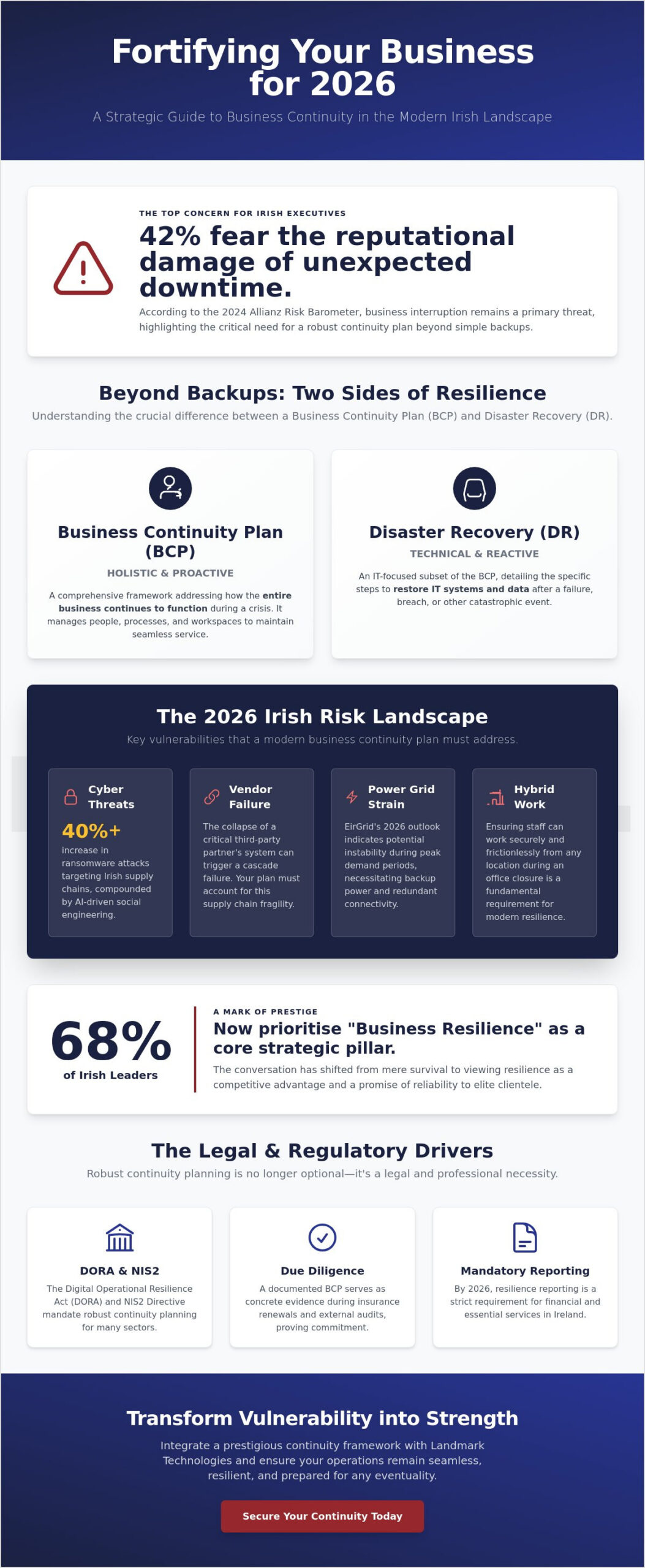
Could your business maintain its reputation for calm efficiency if a sudden digital disruption or regulatory shift occurred tomorrow? According to the 2024 Allianz Risk Barometer, business interruption remains a top concern for 42% of Irish executives who fear the reputational damage of unexpected downtime. You likely recognise that a robust business continuity plan Ireland is no longer just a document; it’s a mark of prestige that ensures your service remains seamless. The complexity of hybrid work security and the evolving nature of EU digital standards often leave even the most organised leaders feeling uncertain.
By implementing a meticulously designed framework for 2026, you can transform these vulnerabilities into a pillar of strength. This guide reveals how to safeguard your operations with bespoke protocols that ensure an always-on environment for your clients and staff alike. We’ll examine the specific compliance standards and communication strategies necessary to keep your business resilient, vibrant, and prepared for any eventuality.
Key Takeaways
- Learn how to elevate your operational resilience by moving beyond simple backups to a bespoke roadmap designed for the modern Irish business.
- Navigate the 2026 risk landscape with confidence, addressing sophisticated AI-driven cyber threats and critical infrastructure vulnerabilities before they impact your success.
- Discover how to define a robust business continuity plan ireland by identifying your most critical operations through meticulous Business Impact Analysis.
- Cultivate a culture of readiness by assembling a dedicated continuity team and refining your response through regular, immersive tabletop exercises.
- Explore how integrating prestigious Managed IT Support ensures your continuity framework becomes a seamless, invisible part of your daily professional excellence.
What is a Business Continuity Plan in the Irish Context?
For professionals operating from the historic streets of Dublin 2 or the vibrant business hubs of Cork, a What is a Business Continuity Plan represents far more than a technical manual. It’s a bespoke roadmap designed to ensure that the heartbeat of your organisation remains steady when the unexpected occurs. In the Irish market of 2026, the conversation has moved beyond mere survival. We’ve seen a significant shift where 68% of Irish leaders now prioritise “Business Resilience” as a core strategic pillar, viewing it as a mark of prestige and a promise of reliability to their elite clientele.
A common misconception amongst growing enterprises is that a nightly data backup constitutes a complete strategy. Whilst backups are vital, they’re static. A true business continuity plan ireland is a comprehensive framework that manages people, processes, and physical workspaces. It provides a sense of calm efficiency during a crisis, ensuring your team knows exactly how to maintain high-end service levels even if their primary environment is temporarily unavailable. This emotional value cannot be overstated; it transforms potential chaos into a curated professional experience for your stakeholders.
To better understand the foundations of this concept, watch this helpful video:
BCP vs. Disaster Recovery: Understanding the Difference
Disaster Recovery is inherently technical, focusing on the restoration of IT systems and data after a breach or failure. In contrast, a BCP is holistic, addressing how the entire business functions whilst those systems are being restored. The two work in tandem to create a seamless safety net. It’s essential to define your “critical functions” before a crisis occurs. This involves identifying the services that must remain frictionless to protect your brand’s reputation and financial health. By categorising these functions early, you ensure that your response is organised and reliable. Organisations seeking to minimise downtime should also explore disaster recovery solutions Dublin businesses rely on to complement their broader continuity framework.
The Legal and Regulatory Drivers in Ireland
The regulatory landscape in Ireland has become increasingly sophisticated. The full implementation of the Digital Operational Resilience Act (DORA) on 17 January 2025, alongside the NIS2 Directive, has made robust continuity planning a legal necessity for many sectors. Beyond compliance, a business continuity plan ireland serves as concrete evidence of due diligence during insurance renewals and external audits. In 2026, mandatory resilience reporting is no longer a suggestion for financial and essential services; it’s a requirement. Demonstrating this level of preparation reflects a commitment to excellence that resonates with high-achieving partners and clients alike.
The 2026 Risk Landscape for Businesses in Ireland
The threats facing Irish firms have matured significantly. Whilst traditional risks remain, the 2026 landscape is dominated by sophisticated AI-driven social engineering that bypasses legacy filters. A 2025 report from the National Cyber Security Centre (NCSC) highlighted a 40% increase in ransomware attacks specifically targeting Irish supply chains. This fragility means your business continuity plan ireland strategy must account for the failure of third-party partners. If a critical vendor’s system collapses, your operations shouldn’t follow suit. Power grid stability also remains a concern; EirGrid’s 2026 outlook suggests that peak demand periods require businesses to have immediate access to backup power and redundant connectivity to maintain their prestigious standards.
Hybrid work has introduced a permanent layer of complexity to these security requirements. Ensuring staff can work securely from any location during an office closure is no longer a luxury, but a fundamental requirement for resilience. Your team needs a frictionless transition between environments without compromising the integrity of your data or the privacy of your clients. Choosing a meticulously designed workspace with built-in redundancies can provide the stability your brand requires during these periods of uncertainty.
Digital Threats and Data Integrity
Protecting your intellectual property is a vital pillar of brand hospitality. Implementing Data Loss Prevention (DLP) ensures that sensitive client information remains secure, even when staff work across various locations. Modern resilience relies on a Zero Trust architecture where every access request is verified. This proactive threat hunting shields your reputation from the fallout of a breach. High-achieving teams deserve an environment where security feels seamless rather than restrictive, allowing success to be nurtured without the constant fear of digital intrusion.
Physical and Environmental Disruptions
Environmental factors are increasingly volatile in Ireland. With Met Éireann reporting a rise in extreme weather events throughout 2025, local infrastructure risks like urban flooding or grid instability are tangible threats. Your business continuity plan ireland must ensure that client hospitality never wavers. Redundant VoIP systems and unified communications allow your team to provide a consistent service from any location. Even if a physical office becomes temporarily inaccessible, your business should operate as a centre of excellence through distributed, secure hubs. This approach ensures your professional presence remains vibrant and reliable, regardless of external conditions.
Key Components of a Prestigious Continuity Framework
Resilience in the Irish market requires more than a standard template; it demands a sophisticated understanding of your operational DNA. A robust business continuity plan ireland for 2026 focuses on maintaining a sense of calm efficiency, even when external factors shift. This starts with the Business Impact Analysis (BIA), a process that identifies which functions are the heartbeat of your enterprise. You must define your Recovery Time Objective (RTO), the maximum duration your business can stay offline, and your Recovery Point Objective (RPO), which dictates how much data loss is tolerable. For a premium service provider, these metrics are often measured in minutes, ensuring that the client experience remains untarnished. Pairing your BIA with bespoke disaster recovery solutions for Dublin organisations ensures your RTO targets are backed by a technically robust and tested recovery infrastructure.
Conducting a Bespoke Business Impact Analysis
Every workflow is meticulously mapped to reveal potential bottlenecks before they manifest. We assign a “prestige value” to client-facing services, ensuring that the elements your partners value most remain untouched by disruption. Robust ICT Services provide the essential foundation for this analysis, offering the technical clarity needed to protect your reputation. It’s about securing the legacy you’ve built in iconic Dublin locations, ensuring that your digital infrastructure is as stable as the heritage buildings you inhabit. By categorising services based on their impact on brand perception, you can prioritise resources where they matter most.
Automation: The Secret to Frictionless Recovery
In 2026, manual intervention is a luxury you can’t afford during a crisis. High-achieving professionals rely on AI to detect anomalies and initiate failover processes instantly. This reduces the risk of human error during high-stress events, maintaining the “Landmark Experience” of composed, quiet confidence. When your systems transition seamlessly to backups, your customers don’t feel the friction; they only see your unwavering reliability. Automation ensures that recovery protocols are triggered the moment a deviation is detected, allowing your leadership team to focus on strategy rather than technical troubleshooting.
The final, vital component of your business continuity plan ireland is the human element. Clear communication channels that reassure staff and clients are non-negotiable. This involves:
- Pre-scripted, elegant communication templates that maintain your brand voice during a crisis.
- Dedicated emergency notification systems that bypass cluttered email inboxes.
- Transparent updates that foster a sense of community and shared resilience.
By blending technological precision with a focus on human connection, your framework becomes more than a safety net. It becomes a testament to your organisation’s stability and its commitment to providing a vibrant, secure environment for success, regardless of the challenges that arise in the coming years.
How to Organise and Test Your Continuity Plan
A resilient business continuity plan ireland requires more than just a digital file on a secure server; it demands a dedicated ensemble of leaders. You should assemble a Continuity Team where every member understands their bespoke responsibilities. This team typically includes a Crisis Coordinator, a Communications Lead, and heads of IT and Operations. By assigning clear ownership, you replace panic with professional poise when disruptions occur. This structure ensures that decisions are made with the same calm efficiency that defines your daily operations.
Testing shouldn’t be a once-a-year box-ticking exercise. In 2024, the PwC Global Crisis and Resilience Survey found that 76% of businesses with high resilience scores performed tabletop exercises at least twice annually. These sessions involve walking through a “worst-case” scenario in a boardroom setting to identify gaps in your strategy. Quarterly updates are equally vital. Staff turnover in the Irish professional services sector remained steady at approximately 11% in 2024, meaning contact lists and access permissions can become obsolete within months. You must also audit your third-party suppliers. If your cloud provider or logistics partner lacks a robust strategy, your own resilience is compromised.
Effective Testing Strategies
Move beyond simple checklists and embrace immersive simulation drills. The true measure of success is the gap between your Recovery Time Objective (RTO) and your actual recovery time. If your RTO is four hours but your team takes eight to restore core services, your plan needs refinement. Use these drills to gather raw data and polish your response until it feels like second nature. It’s about building muscle memory so your team remains composed under pressure.
Communication Protocols: The Perfect Host Mentality
During a crisis, you must embody the role of the Perfect Host. This means providing calm, authoritative updates that reassure stakeholders whilst maintaining a sense of prestige. Draft pre-approved templates for clients and partners before a crisis hits. Unified communications tools ensure your team stays connected even if your physical office is inaccessible. Transparency is your greatest asset. High-achieving professionals value honesty over silence, provided that honesty is paired with a clear path forward and a steady hand.
Explore how Landmark’s prestigious workspaces provide the infrastructure and support to keep your business running seamlessly through any challenge.
Strategic Continuity with Landmark Technologies
True resilience isn’t a static document tucked away in a drawer. It’s a living, breathing component of your organisation’s identity. Landmark Technologies serves as the trusted partner for Irish firms, ensuring your business continuity plan ireland remains a vibrant, active asset. We’ve spent years perfecting a model where managed IT support isn’t just a reactive service. It’s a proactive integration of stability into your daily operations. This bespoke approach allows high-achieving professionals to focus on their craft whilst we maintain the invisible, impeccable architecture of their digital world.
Our consultancy services offer clarity in an increasingly complex 2026 regulatory environment. With the full implementation of the NIS2 Directive and the Digital Operational Resilience Act (DORA), the stakes for Irish businesses have never been higher. We provide the expert oversight needed to navigate these mandates with grace. You’ll find that our team doesn’t just solve technical problems; we nurture success by creating a frictionless environment where your business can flourish without fear of interruption. It’s about providing the prestige of a perfectly managed office within your digital infrastructure.
Expert Oversight for Absolute Stability
Stability requires a steady, experienced hand. There is a distinct advantage in having a dedicated CISO oversee your resilience strategy. This level of leadership ensures that your security proposition is both modern and rooted in a deep understanding of the Irish corporate heritage. Landmark creates bespoke solutions that grow alongside your aspirational goals. We recognise that a growing firm in Dublin 2 has different needs than a multi-national hub in the Docklands. Our strategies are meticulously designed to scale with you, providing a sense of prestige and calm efficiency as you expand.
- Strategic alignment with 2026 Irish and EU compliance standards including NIS2 and DORA.
- Proactive threat hunting that identifies vulnerabilities before they impact your workflow.
- Seamless integration of backup systems that require zero manual intervention from your team.
- Bespoke disaster recovery protocols tailored to specific industry requirements.
Next Steps: Securing Your Future
The journey toward a more resilient future begins with a comprehensive business continuity audit. This isn’t a clinical checklist; it’s an invitation to experience the peace of mind that professional, high-end management provides. Transitioning to Landmark’s managed resilience model is remarkably simple. We pride ourselves on being the perfect host for your data and infrastructure, ensuring the migration is as smooth as entering a premium workspace.
By choosing a managed business continuity plan ireland, you’re investing in a vibrant, uninterrupted professional future. We handle the technical complexities so you can enjoy the quiet confidence that comes with absolute preparedness. Let’s organise a consultation today to ensure your legacy remains protected, regardless of what the future holds. Your business deserves a home that is as secure as it is inspiring.
Securing Your Legacy in a Resilient Ireland
The 2026 risk landscape demands more than just a reactive strategy. It requires a sophisticated framework that integrates AI-driven business automation with a deep understanding of the local market. Since 2004, Landmark has cultivated the expertise needed to provide stability for prestigious firms across Ireland. By meticulously organising your response protocols and testing them against modern disruptions, you’ll ensure your operations remain seamless and your reputation stays intact. Developing a robust business continuity plan ireland is an investment in your company’s permanence. Our bespoke resilience strategies allow you to focus on growth whilst we manage the complexities of risk. It’s time to elevate your preparedness from a basic requirement to a competitive advantage. We’re here to guide you through every step of this journey with the quiet confidence of a trusted partner who understands that success thrives in environments where resilience is nurtured. Your future deserves the security of a meticulously designed strategy.
Discover the Landmark Experience in Business Continuity
Frequently Asked Questions
Is a business continuity plan a legal requirement for Irish SMEs in 2026?
No, a business continuity plan isn’t a universal legal requirement for every Irish SME, but it’s mandatory for specific sectors. Under the Digital Operational Resilience Act (DORA), which became fully enforceable in January 2025, financial entities must maintain robust recovery frameworks. The CSRD also requires 2,000 large Irish companies to disclose their risk management strategies. For most firms, it remains a matter of professional excellence rather than a strict legal mandate.
How often should our company test its business continuity plan?
You should test your business continuity plan at least once every 12 months to ensure it remains effective. Fast-growing firms in Dublin’s tech hubs often increase this frequency to every six months to account for rapid infrastructure changes. Regular testing transforms a static document into a living strategy. It’s the only way to guarantee your team stays calm and capable when a genuine disruption occurs.
What is the difference between RTO and RPO in a recovery plan?
RTO, or Recovery Time Objective, measures the duration your business can afford to be offline before operations become critical. RPO, or Recovery Point Objective, defines the maximum amount of data you can lose, measured in time. If your RPO is four hours, you must back up data at least every four hours. Balancing these two metrics allows you to design a bespoke recovery strategy that protects your most vital assets.
Can cloud solutions replace the need for a formal business continuity plan?
Cloud solutions provide excellent infrastructure, but they don’t replace a formal business continuity plan Ireland requires for holistic resilience. While 94% of Irish enterprises now use cloud services, technology alone cannot manage staff safety or client communications. A true plan integrates your digital tools with human processes and physical workspace alternatives. It’s about ensuring your entire ecosystem remains vibrant and operational, regardless of the platform you use.
How does hybrid work change the way we approach continuity planning?
Hybrid work shifts the focus from a single office location to a decentralised network of home and satellite hubs. You must now account for residential power outages and home broadband reliability as potential points of failure. Successful firms provide staff with clear protocols for transitioning to a prestigious, fully serviced workspace if their primary home or office environment fails. This flexibility ensures your team stays productive and connected in any scenario.
What are the first three steps to take if our business suffers a major disruption?
Your first priority is the immediate safety and wellbeing of your employees. Once people are secure, you must formally activate your business continuity plan and notify your designated recovery team. Third, initiate your communication strategy to inform clients and stakeholders of the situation. Taking these steps within the first 30 minutes prevents confusion and maintains your professional reputation during the most challenging moments.
How can AI help in maintaining business continuity for smaller firms?
AI enhances continuity by providing predictive analytics that identify potential system failures before they occur. Smaller firms use AI-driven tools to automate data backups and manage 24/7 customer enquiries via sophisticated chatbots during a physical office closure. By 2026, 60% of Irish SMEs are expected to integrate AI into their risk management. These intelligent systems offer a seamless layer of protection, allowing you to focus on high-level strategic recovery.
