
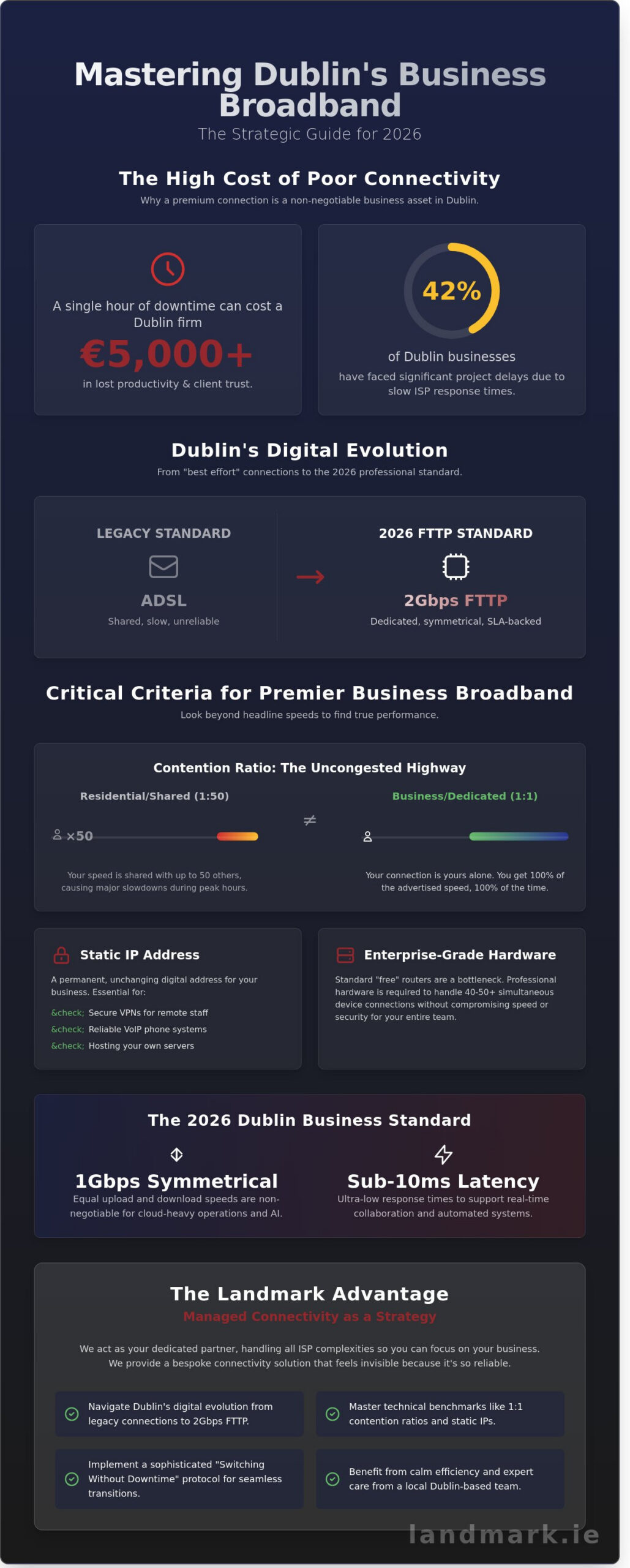
A single hour of digital silence in a prestigious Dublin 2 office can cost a firm upwards of €5,000 in lost productivity and client trust. Selecting the right business broadband provider in Ireland is no longer a back-office utility decision; it’s a strategic move to safeguard your professional reputation. Recent 2024 industry data suggests that 42% of Dublin businesses have faced significant delays due to slow ISP response times. You’ve likely felt the frustration when a national provider treats your urgent outage with a generic script. It’s exhausting to translate complex fibre jargon when you simply need a connection that works as hard as you do.
At Landmark Technologies, we agree that your business deserves a bespoke connectivity solution that feels invisible because it’s so reliable. This 2026 guide promises to help you master the complexities of the Irish business broadband market and discover the ideal partner for your Dublin-based operations. We’ll explore how to achieve uninterrupted high-speed connectivity and ensure your broadband provider understands the nuances of local infrastructure for a truly seamless experience.
Key Takeaways
- Navigate Dublin’s digital evolution from legacy connections to 2Gbps FTTP to ensure your infrastructure reflects the prestige and ambition of your brand.
- Master the technical benchmarks, such as 1:1 contention ratios and static IPs, required to select the premier business broadband provider ireland for your growing team.
- Compare the regional strengths of Ireland’s top ISPs to secure a reliable, high-speed connection that spans from the heart of Dublin City to the wider county.
- Implement a sophisticated “Switching Without Downtime” protocol that guarantees a seamless transition and maintains your firm’s professional momentum.
- Discover the Landmark advantage of managed connectivity, where we act as your dedicated partner to handle all ISP complexities with calm efficiency and expert care.
The Landscape of Business Broadband in Dublin for 2026
The telecommunications landscape in Ireland has matured, placing Dublin at the center of European data exchange. Selecting a provider with a local Dublin presence isn’t just a matter of convenience; it’s a strategic decision. Local providers understand the specific ducting routes and exchange locations that influence latency. When your provider is physically present in the city, support is proactive rather than reactive, mirroring the hospitable and attentive service Landmark clients expect in their workspaces.
Dublin’s Connectivity Hubs: Sandyford, Silicon Docks, and Beyond
Infrastructure advantages in Dublin are often dictated by geography. The Grand Canal Dock area, or Silicon Docks, boasts some of the highest fibre density in Europe, offering a vibrant environment where tech giants and startups share seamless connectivity. However, the prestigious heritage buildings of Dublin 2 and Dublin 4 require a more bespoke approach. The thick granite of Georgian Dublin often hinders wireless signals, necessitating meticulously designed internal wiring to ensure the 2026 standard reaches every desk. Reliability in these historic districts often depends on proximity to the GPO and key local exchanges, which remain the sturdy anchors of the city’s network reliability.
The 2026 Standard: What “High Speed” Actually Means
Critical Criteria for Evaluating Irish Business Broadband Providers
Selecting the right business broadband provider ireland involves looking far beyond the headline download speeds advertised on colorful billboards. For a Dublin office to function with the prestige and efficiency your clients expect, you must look at the contention ratio. Most residential connections share bandwidth with up to 50 other users, but a premium business service should offer a 1:1 ratio. This ensures your 500Mbps connection remains 500Mbps even during peak hours in busy districts like the Docklands or Sandyford.
A static IP address is another non-negotiable asset for the modern firm. Unlike dynamic IPs that change periodically, a static IP provides a permanent digital identity. It’s vital for hosting your own web servers, managing secure VPNs for remote staff, and maintaining seamless connections to VoIP systems in Dublin and wider VoIP phone systems. Without it, your remote team will likely face frustrating authentication hurdles that disrupt the flow of a productive workday.
The physical hardware delivered by your provider often acts as a silent bottleneck. While “free” routers might suffice for a home office, they rarely possess the processing power to manage 40 or 50 simultaneous device connections. Upgrading to enterprise-grade hardware allows your team to experience the true potential of your high-speed fibre. If you’d prefer to step into an environment where these technical complexities are already expertly managed, you might explore a serviced office solution that prioritizes high-end connectivity.
SLA Deep-Dive: Response Times vs. Fix Times
Service Level Agreements (SLAs) are the bedrock of professional trust. You’ll often see a “4-hour response” guarantee, but you shouldn’t mistake this for a resolution. A response simply means an engineer has acknowledged the ticket. You need to demand a 4-hour fix time. According to 2023 industry benchmarks, top-tier providers in the Leinster region now offer 99.9% uptime guarantees with clear compensation structures.
Pay close attention to “Workday” versus “Clock” hour definitions. A 6-hour fix time on a “Workday” basis might mean a Friday afternoon outage isn’t resolved until Monday morning. For businesses that operate outside the traditional 9-to-5, a 24/7 “Clock” hour guarantee is the only way to ensure total peace of mind.
Connectivity Architecture: FTTP vs. Dedicated Leased Lines
Fibre-to-the-Premises (FTTP) is an excellent, cost-effective choice for smaller teams, but it remains a shared medium. High-growth firms often find the business case for Dedicated Internet Access (DIA) much stronger. DIA provides a private, symmetrical pipe where upload speeds match download speeds. This is crucial for firms regularly uploading large architectural files or hosting high-definition video conferences.
Eir and Vodafone: The Infrastructure Giants
Eir remains the custodian of the most extensive legacy network in the country. Their ongoing €1 billion investment in fibre infrastructure has modernized their offering, particularly in high-density areas like Dublin 2 and Dublin 4. While their reach is unparalleled, businesses often weigh this against a customer service reputation that has faced public scrutiny. Vodafone, by contrast, excels in providing a converged experience. They pair fixed-line solutions with robust 5G mobile data, creating an environment where success is nurtured through constant connectivity.
Both providers typically require 24-month commitments. It’s vital to account for the standard annual price increase. Most national carriers now implement a price hike every April, calculated as the Consumer Price Index (CPI) plus an additional 3%. This can lead to a significant shift in your monthly overheads over a two-year period. While these giants offer stability, the lack of flexibility in their long-term contracts can be a hurdle for rapidly scaling firms.
Virgin Media and SIRO: The High-Speed Alternatives
Virgin Media operates on its own independent cable network. This provides a level of redundancy that’s highly valued by tech-heavy firms in the Dublin suburbs. Their reliability in residential-turned-commercial areas is a significant draw for professionals who value a quiet, efficient workspace outside the city centre. SIRO takes a different approach by leveraging the existing ESB network to deliver 100% fibre-to-the-building connectivity. This partnership allows smaller, agile providers to offer bespoke packages that often feel more personal and attentive than the big three.
When reviewing these high-speed alternatives, look closely at installation fees. While many providers waive these for standard setups, bespoke fibre builds in older Georgian buildings can incur one-off costs. These fees often range from €200 to over €1,500 depending on the complexity of the site and the proximity to the nearest exchange point. Choosing between them often comes down to your specific Dublin Eircode and the level of personalized support your team requires to maintain a vibrant, productive atmosphere.
- Eir: Best for wide-reaching legacy footprints and established Dublin 2 offices.
- Vodafone: Ideal for firms requiring integrated 5G mobile and fixed-line bundles.
- Virgin Media: A reliable choice for high-bandwidth needs in Dublin’s suburban hubs.
- SIRO Providers: Excellent for businesses seeking modern fibre paths and flexible service terms.
Implementation Strategy: Ensuring a Seamless Transition
The Managed Migration Process
Installing new fibre in iconic Dublin locations requires careful coordination. For offices in Dublin 2 or Dublin 4, the timeline for a new installation typically spans 10 to 15 working days. This includes physical site surveys and coordinating with building management or landlords for wayleave agreements. We recommend an overlap period where your old service remains active for at least 7 days after the new line is live. This period allows for rigorous testing under ComReg’s business switching regulations, which are designed to protect enterprises from service loss during provider migrations.
Redundancy and Business Continuity
By 2026, a secondary failover line is no longer a luxury; it’s a non-negotiable standard for professional operations. We implement SD-WAN technology to manage automatic failover between your primary fibre and a secondary source. If the main line experiences an issue, the system shifts traffic instantly without user intervention. A 5G fixed-wireless connection serves as a cost-effective and highly reliable backup, offering speeds that can sustain essential operations during an outage. Landmark Technologies secures this connection, providing a curated environment where your digital infrastructure is as resilient as your business strategy.
Experience a workspace where technology and hospitality meet. Discover our bespoke office solutions today.
The Landmark Advantage: Managed Connectivity as a Strategy
Selecting a business broadband provider ireland represents only half of a successful connectivity strategy. The real challenge lies in ensuring that your connection remains a silent, powerful engine for growth rather than a source of constant friction. Landmark Technologies serves as your dedicated single point of contact, eliminating the frustration of managing multiple ISP relationships. We bridge the gap between raw bandwidth and professional performance, acting as the protective layer for your digital operations. Finding the right business broadband provider ireland is the first step; managing that connection is how you cross the finish line.
Our approach integrates high-speed fiber with your wider digital ecosystem. We don’t just provide a line; we orchestrate a bespoke environment where every digital tool works in harmony. Our managed services include:
- Cyber Security: Protecting your data at the very point of entry.
- Cloud Solutions: Ensuring low-latency access to essential business applications.
- VoIP Integration: Prioritizing voice traffic for uninterrupted, professional meetings.
For Dublin firms planning to scale, we conduct meticulous connectivity audits. These assessments identify potential bottlenecks and ensure your infrastructure is ready for expansion before you even hire your next ten employees. We provide the roadmap so your growth isn’t limited by your hardware.
Unified Communications and Your Broadband
Your Premier Partner in Dublin
Future-Proof Your Dublin Business Connectivity
In 2026, selecting your business broadband provider ireland is no longer a mere utility choice; it’s a foundational pillar of your corporate strategy. High-achieving Dublin firms now require more than just raw bandwidth. They need a resilient ecosystem that anticipates demand and eliminates downtime. Landmark leverages over 20 years of experience serving the city’s most prestigious professionals to deliver exactly that. Our strategic partnerships with all major Irish infrastructure providers ensure you aren’t tied to a single point of failure. We protect your productivity with proactive 24/7 monitoring and a dedicated Irish-based helpdesk that offers immediate, expert support. This managed approach transforms connectivity from a technical hurdle into a seamless advantage that lets your team focus on what they do best. By prioritizing a bespoke infrastructure, you create an environment where success isn’t just possible; it’s inevitable. We invite you to experience the calm efficiency of a truly optimized workspace.
Request a Bespoke Connectivity Audit for Your Dublin Office
Your journey toward a more reliable and inspiring digital home starts today.
Frequently Asked Questions
What is the average cost of business broadband in Dublin in 2026?
In 2026, standard high-speed business broadband in Dublin typically ranges from €55 to €95 per month for Fibre to the Premises (FTTP) connections. If your firm requires a dedicated leased line, monthly costs generally start from €350 depending on your specific location within the Silicon Docks or the wider Dublin area. These figures reflect the ongoing infrastructure investment by every major business broadband provider ireland relies on for digital growth.
How is business broadband different to a high-end residential package?
Business broadband prioritizes professional reliability and service level agreements (SLAs) that residential packages don’t offer. While a home connection often shares bandwidth with up to 50 other households, a business line features significantly lower contention ratios and guaranteed fix times. You’re investing in a premium commitment to uptime and a dedicated support team that understands the true cost of a lost hour of productivity.
What is a good contention ratio for a Dublin office with 20+ staff?
A contention ratio of 1:1 is the gold standard for an office of 20 or more professionals, ensuring your speeds never dip during peak afternoon hours. If a dedicated line isn’t feasible for your budget, you should look for a ratio no higher than 10:1. This ensures that your video conferencing remains crisp and cloud uploads stay fast, even when the rest of the street is online.
Do I need a dedicated leased line or is FTTP sufficient?
FTTP is often sufficient for small, agile teams, but a dedicated leased line is essential if your Dublin business handles large data transfers or requires symmetrical upload and download speeds. Leased lines provide a private, uncontested pipe directly to your desk. It’s the aspirational choice for firms where a 99.9% uptime guarantee is a non-negotiable requirement for daily operations.
How long does it typically take to install new business fibre in Dublin?
Standard FTTP installations usually take between 10 and 15 working days if the building is already pre-wired for fibre. Dedicated leased lines involve more complex engineering and typically require a lead time of 30 to 90 days for full delivery. We recommend beginning your search for a business broadband provider ireland businesses trust at least three months before your move-in date to ensure a seamless transition.
What happens if my business broadband goes down during office hours?
Your Service Level Agreement (SLA) dictates the response time, which is typically a four to six hour fix window for premium business accounts. Most providers offer 24/7 technical support and provide an automatic 4G or 5G failover solution to keep your team connected while the primary line is repaired. It’s this safety net that separates professional connectivity from standard residential services.
Can Landmark Technologies manage my relationship with providers like Eir or Virgin?
Landmark acts as your trusted partner, handling the technical complexities and communication with providers so you can focus on your core business. We manage the installation, monitoring, and troubleshooting of your connectivity within our prestigious Dublin locations. This bespoke service ensures your office environment remains a place of calm efficiency without the stress of managing multiple vendor contracts or technical jargon.