
What if the most significant barrier to your firm’s next stage of growth isn’t a lack of talent, but the quiet friction of the mundane tasks currently occupying your team’s day? You likely recognise the weight of repetitive administrative cycles and the lingering anxiety that a single human error in a critical file could compromise your reputation. With over 66% of organisations now automating at least one process, the transition to a more efficient model is no longer optional for those seeking to lead. By exploring strategic business process automation examples, you can discover how to transform your manual workflows into a seamless, rhythmic engine of growth and operational excellence.
We understand that your time is your most valuable asset, best spent on high-value strategic thinking rather than navigating the intricacies of manual data entry. This article provides a curated look at how modern firms are leveraging hyperautomation and AI-native platforms to create a frictionless environment where success is nurtured. We’ll preview high-impact workflows that secure your data, enhance compliance, and empower your team to focus on the art of the client relationship whilst maintaining a prestige-level experience for every guest and partner.
Key Takeaways
- Distinguish between simple task-based automation and a holistic digital transformation that begins with a comprehensive process audit.
- Identify high-impact business process automation examples that allow leadership teams to reclaim time by eliminating manual errors in critical departments.
- Discover how removing administrative friction enhances the client experience by allowing your team to provide a more attentive and personalised service.
- Learn to orchestrate technology as a rhythmic engine of growth, turning disjointed workflows into a seamless and unified operation.
- Explore the importance of a bespoke automation strategy that avoids generic software in favour of solutions tailored to your firm’s specific heritage and goals.
The New Standard of Operational Excellence: What is Business Process Automation?
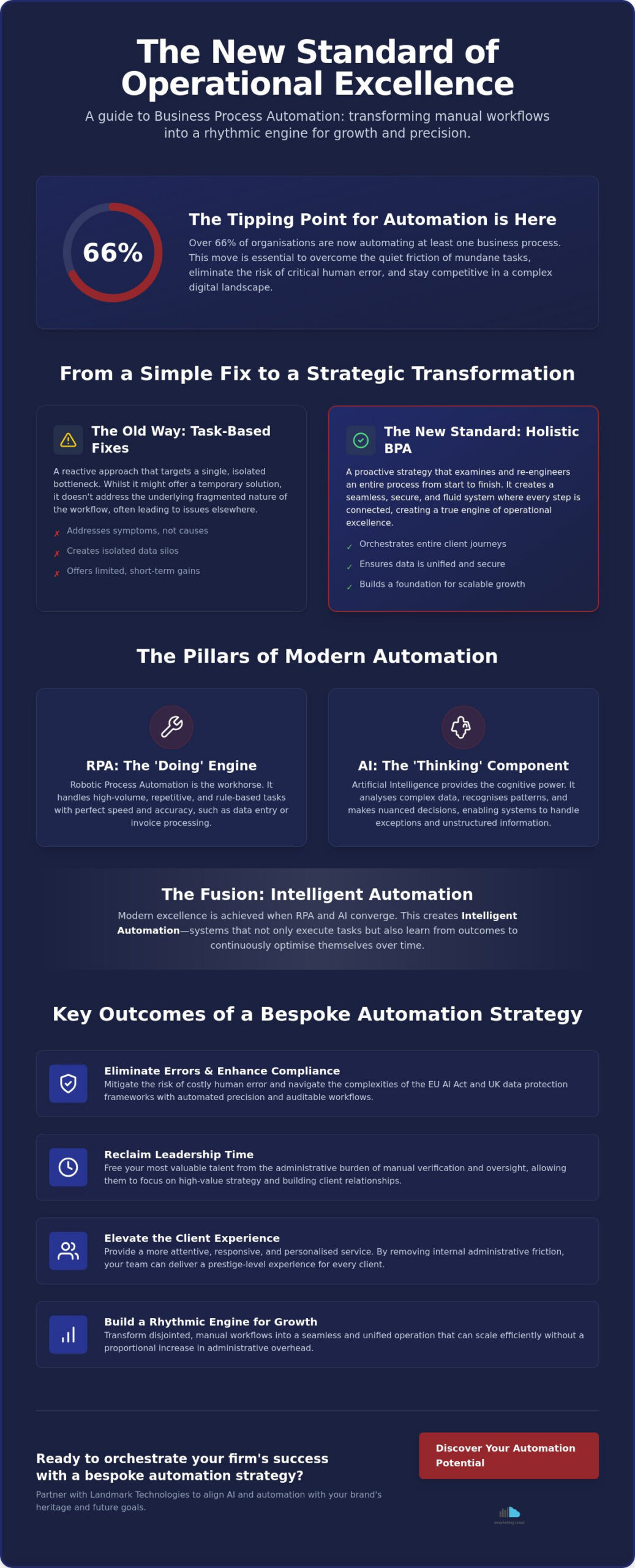
Operational excellence in the modern era is rarely about working harder; it is about working with a refined sense of rhythm. Business Process Automation (BPA) represents the rhythmic orchestration of technology to execute recurring tasks without manual intervention. It is the transition from a reactive state, where your team is constantly extinguishing fires, to a proactive environment that moves like a well-oiled machine. Whilst many look for simple business process automation examples to fix a single bottleneck, true excellence lies in holistic transformation that reshapes how value is created within your firm.
There is a fundamental distinction between simple task automation and this holistic approach. A task-based fix might involve a script that moves a file from one folder to another. In contrast, holistic BPA looks at the entire lifecycle of a client journey or a financial report. It ensures that every step is connected, secure, and fluid. This technology acts as a Strategic Ally, supporting human ambition by handling the heavy lifting of administrative cycles. It allows your most talented professionals to step away from the keyboard and into the roles they were meant for: leading, creating, and building relationships.
The Interrelation of BPA, RPA, and AI
To understand the power of modern automation, one must look at how different technologies collaborate. Robotic Process Automation (RPA) is the engine of “doing,” handling repetitive, rule-based actions like data entry or invoice processing with absolute precision. Artificial Intelligence (AI) serves as the “thinking” component, capable of analysing patterns and making nuanced decisions based on data. In 2026, these technologies have converged to create a new standard of performance. Intelligent Automation is the fusion of machine learning and workflow orchestration, allowing systems to not only follow instructions but to learn from outcomes and optimise themselves over time.
Why 2026 is the Year of the Automated Firm
The digital landscape across Ireland has reached a level of complexity that demands more than manual oversight. With the implementation of the EU AI Act transparency obligations and the new UK data protection framework, the margin for error has vanished. Firms that rely on manual workflows risk falling behind in speed, accuracy, and compliance. Maintaining a premium edge now requires the ability to scale service quality without a proportional increase in administrative overhead. Navigating these transitions requires more than just software; it demands expert IT consultancy to ensure your automation strategy aligns with your brand’s heritage and future goals. By integrating sophisticated business process automation examples into your core operations, you ensure that your firm remains a bastion of calm efficiency in an increasingly fast-paced market.
High-Impact Business Process Automation Examples for Modern Firms
Leadership teams within prestigious firms often find themselves anchored by administrative minutiae that detract from high-level strategy. By identifying and implementing high-impact business process automation examples, you can reclaim hours previously lost to manual verification and repetitive oversight. This transition isn’t merely a matter of speed; it’s about the absolute integrity of your data. When you begin automating sensitive data flows, ensuring robust cyber security becomes a non-negotiable priority to protect both your reputation and your clients’ privacy.
The beauty of a well-orchestrated system is that it works silently in the background, allowing your office to remain a centre of calm productivity. It’s about creating a frictionless environment where every document moves exactly where it needs to be, when it needs to be there. This level of organisation doesn’t just improve the bottom line; it fosters a sense of professional pride amongst your staff, who are no longer burdened by the weight of the mundane.
Financial and Accountancy Workflows
The financial heart of a firm requires meticulous precision. Automated invoice processing now moves beyond simple scanning, using sophisticated OCR to extract data and intelligent routing to manage approvals based on specific department budgets. Expense management has also evolved, offering real-time tracking and categorisation that ensures fiscal transparency without the need for manual spreadsheets. Ultimately, automated reconciliation reduces month-end stress for finance directors by providing a clear, real-time view of the firm’s fiscal health and ensuring every penny is accounted for with digital certainty.
Human Resources and Talent Onboarding
Attracting top-tier talent is only the first step; the experience of joining your firm should reflect your commitment to excellence. When considering business process automation examples that impact culture, HR is often the most visible. Our ‘First-Day Excellence’ workflow automates the procurement of equipment, provides immediate software access, and schedules essential training before the new associate even arrives. Leave requests and attendance tracking are similarly refined, removing the friction of fragmented email chains through unified, self-service portals. For ongoing development, AI-driven performance tracking gathers objective data points throughout the year, allowing for more meaningful and rewarding reviews. To see how these systems can be tailored to your specific culture, you might explore our bespoke AI & Business Automation solutions.
Beyond Efficiency: Automating for a Premium Client Experience
A common reservation amongst high-achieving professionals is the fear that technology might make a firm’s service feel cold or impersonal. However, when executed with a sense of craftsmanship, these systems actually enhance the human element of your business. By removing the distractions of manual data entry and document chasing, your team is free to act as a refined host. They can focus entirely on the client’s strategic needs whilst the technology handles the complex business process automation examples that keep the operation running smoothly behind the scenes. This creates a frictionless experience where the client feels prioritised, not processed.
True hospitality in a professional context is about anticipation. It’s about knowing what a client needs before they have to ask for it. Automation allows you to build this level of attentiveness into your core service model. When your staff aren’t drowning in administrative cycles, they have the mental space to provide the prestige-level care that your brand promises. This strategic use of technology doesn’t replace the human touch; it provides the quiet, reliable foundation that allows it to flourish.
Intelligent Client Onboarding
First impressions are permanent, and the onboarding phase is your opportunity to signal a commitment to excellence. An intelligent onboarding sequence ensures that the moment a client signs, they receive instant, personalised engagement that feels premium rather than programmed. Instead of a series of fragmented email attachments that clutter an inbox, secure portals allow for the graceful gathering of sensitive documents in a single, organised location. Whilst your client feels nurtured and welcomed, background systems can simultaneously run essential KYC and compliance checks. This ensures that the professional relationship begins on a foundation of absolute trust and composed efficiency.
Proactive Support and Communication
Reliability is the hallmark of a prestige-level experience. Sophisticated business process automation examples in the realm of support include AI-driven ticketing systems that categorise and route urgent requests to the most qualified expert instantly. This ensures that no query ever lingers in a generic inbox or feels neglected. Additionally, automated reporting provides clients with regular, high-level insights into their projects without requiring manual effort from your senior staff. Integrating VoIP and unified communications into these workflows ensures that every client call is handled with grace and that no message goes unanswered, reinforcing a brand voice that is consistently available and attentive to every detail.
Designing Your Automation Strategy: A Framework for Digital Transformation
Moving from a manual environment to an automated one is a transition that requires grace, precision, and a clear architectural vision. It’s not about replacing the nuanced judgement of your senior team; it’s about creating a “human-in-the-loop” philosophy where technology acts as a tireless assistant. This approach ensures that whilst the machine handles the repetitive cycles, your professionals remain the final arbiters of quality and strategy. By grounding your strategy in robust cloud solutions, you provide the scalable infrastructure necessary for these tools to evolve alongside your firm’s ambitions.
Success in digital transformation is rarely found by simply layering software over existing chaos. It requires a dedicated audit of your current workflows to ensure that you aren’t just automating an inefficient process. This period of discovery is where the most successful business process automation examples are born, as it allows you to identify exactly where friction exists and where technology can provide the greatest relief. To begin crafting a bespoke roadmap for your firm, you can consult with our strategic automation experts today.
Step 1: The Process Audit and Identification
The first stage involves identifying tasks that act as bottlenecks; those repetitive, high-volume actions that are time-sensitive and prone to human fatigue. By mapping your current manual flow, you can pinpoint exactly where delays occur and where data integrity is most at risk. This isn’t just about finding what can be automated, but determining what should be. Prioritising processes with the highest potential for return on investment ensures your initial steps into automation build immediate confidence and momentum across the organisation.
Step 2: Tool Selection and Integration
Once your needs are defined, the focus shifts to choosing between specialised, best-of-breed tools and unified platforms. It’s vital that any new automation software integrates seamlessly with your existing Microsoft 365 environment or ERP systems to avoid creating new data silos. API connectivity plays a critical role here, acting as the digital connective tissue that allows information to flow fluidly between departments. This structural clarity ensures that your automation engine feels like a natural extension of your firm rather than a disjointed addition.
Step 3: Security and Compliance Guardrails
In a prestige-level firm, security is the foundation of trust. Every automated data transfer must be protected by multi-factor authentication and high-level encryption to maintain the sanctity of your client files. It’s essential that GDPR compliance is baked into the automated logic from the outset, ensuring that data handling always aligns with current regulatory standards. Regular auditing of your automated scripts is also necessary to prevent “process drift,” where a system might slowly deviate from its intended security path or create new vulnerabilities over time. Using these business process automation examples as a guide allows you to build a secure, reliable, and impeccably organised digital home.
Landmark Technologies: Your Strategic Partner in AI and Business Automation
At Landmark Technologies, we view ourselves as more than just a service provider; we are your Strategic Ally in an increasingly digital world. Our role is to handle the intricate technical complexities of modern systems so that you can focus on the leadership and creative vision that define your firm. We understand that for a prestigious business, technology must be a silent, reliable partner that enhances your reputation rather than a source of noise or frustration. Our bespoke approach ensures that we never offer generic, out-of-the-box solutions that fail to respect your firm’s unique brand and heritage.
We take immense pride in our roots in Ireland and our commitment to providing operational stability for the country’s most ambitious professionals. By integrating the business process automation examples discussed throughout this guide into a wider, more robust infrastructure, we create an environment where excellence is the standard. It’s about more than just software; it’s about a curated professional experience that allows your team to flourish in a space designed for success. We invite you to experience a more organised, prestigious way of working where every digital interaction is as refined as your physical workspace.
Our Holistic Approach to Managed IT
We don’t believe in isolated fixes. Instead, we integrate automation directly into our broader Managed IT Support packages to ensure a seamless ecosystem. This holistic strategy means your automation tools aren’t just standalone scripts but are part of a unified environment that benefits from constant monitoring and proactive maintenance. We focus on ensuring your infrastructure is always future-ready, adapting to new regulatory requirements and technological shifts before they become challenges. This provides you with the ultimate peace of mind, knowing that your digital foundation is being managed by experts who value precision and stability as much as you do.
Begin Your Transformation
The journey toward a more frictionless, rhythmic engine of growth begins with a bespoke IT and automation audit. During this discovery phase, we work closely with your leadership team to prioritise the business process automation examples that will drive the most immediate and significant value for your specific operation. We help you identify the high-impact workflows that will reclaim the most time and provide the highest level of security for your sensitive data. Our goal is to move your firm from a state of manual friction to one of prestige, calm, and effortless functionality. Let us help you design a digital environment where your human talent is free to pursue its highest ambitions whilst the technology handles the rest with absolute grace.
Cultivating a Future of Effortless Growth
The transition to a fully automated firm is more than a technical upgrade; it’s a commitment to a higher standard of professional life. By observing these strategic business process automation examples, it becomes clear that technology is the ultimate ally of human ambition. You’ve seen how refined workflows in finance and HR can reclaim precious hours for your leadership team, whilst intelligent client onboarding ensures your brand remains a bastion of premium service. This journey requires a secure foundation where every automated step is protected by the highest standards of cyber security and cloud resilience.
Landmark Technologies has been a pillar of stability for Irish firms since our founding in 2004. We bring specialised AI and Business Automation expertise to every partnership, providing comprehensive national coverage that ensures your infrastructure is always future-ready. It’s time to move beyond the friction of the mundane and embrace a more organised, prestigious way of working. Discover how Landmark Technologies can organise your business for success through strategic automation. Your firm’s next chapter of calm efficiency and nurtured success is ready to begin.
Frequently Asked Questions
What are the most common business process automation examples for small firms?
Common business process automation examples for smaller firms include automated appointment scheduling, basic invoice generation, and email marketing sequences. These tools allow boutique firms to maintain a high-end experience without the overhead of a large administrative team. By automating these recurring cycles, small business owners can focus on bespoke client service and strategic growth whilst the technology handles the routine.
Can business process automation help with GDPR compliance in Ireland?
Automation significantly aids GDPR compliance by ensuring data is handled consistently and according to predefined rules. In Ireland, the data protection framework requires accessible mechanisms for concerns; automated systems can track these within mandated timeframes. This removes the risk of human oversight and provides a clear, reliable audit trail for the Information Commissioner’s Office (ICO).
How long does it typically take to implement a new automated workflow?
The timeline for implementing a new automated workflow typically ranges from a few weeks for simple tasks to several months for complex, end-to-end transformations. A phased approach is best, starting with a thorough audit before moving into design and testing. This ensures the transition is graceful and doesn’t disrupt the firm’s daily operations or prestige-level service.
Is business process automation different from Robotic Process Automation (RPA)?
Business process automation is the holistic orchestration of workflows, whilst Robotic Process Automation (RPA) focuses on specific, repetitive tasks. Think of RPA as the digital hands that enter data, and BPA as the conductor that ensures every department moves in harmony. These technologies often converge to create Intelligent Automation, blending execution with AI-driven decision-making.
Will automating my client communications make my service feel less personal?
Automating client communications often makes your service feel more personal by ensuring timely, relevant interactions that never fall through the cracks. It handles the routine updates and document requests, which allows your staff to spend their time on nuanced, high-value conversations. This approach ensures your firm acts as a refined host, anticipating needs without the friction of manual follow-ups.
What is the expected ROI of business process automation for a professional services firm?
The ROI for professional services firms is measured through reclaimed leadership time and the ability to scale without increasing headcount. Whilst initial projects require a focused investment, the long-term value lies in reduced error rates and a more reliable client experience. Firms often see a frictionless operational environment that supports higher profit margins and more strategic focus.
Do I need a custom software developer to start with business process automation?
You don’t necessarily need a custom software developer, as modern AI-native platforms allow operations teams to build their own tools. However, partnering with an IT consultancy ensures these solutions are integrated securely and align with your existing infrastructure. This professional oversight prevents disjointed systems and ensures your automation strategy is bespoke to your firm’s heritage.
How does automation improve cyber security within a business?
Automation improves cyber security by enforcing strict protocols like multi-factor authentication and encryption across every data transfer. It eliminates the human error element, such as sending sensitive files to the wrong recipient or using weak passwords. By building security into the automated logic, your firm maintains a fortress-like digital environment that protects your prestige and client trust.