
With global IT spending projected to reach $6.31 trillion in 2026, the stakes for your digital infrastructure have never been higher. Yet, for many technology leaders, the walk into the boardroom still feels like an uphill battle against the perception that IT is merely a cost centre to be managed rather than an engine for growth. Learning how to justify IT spending to the board is no longer just a technical requirement; it’s an invitation to act as a strategic ally in your organisation’s success.
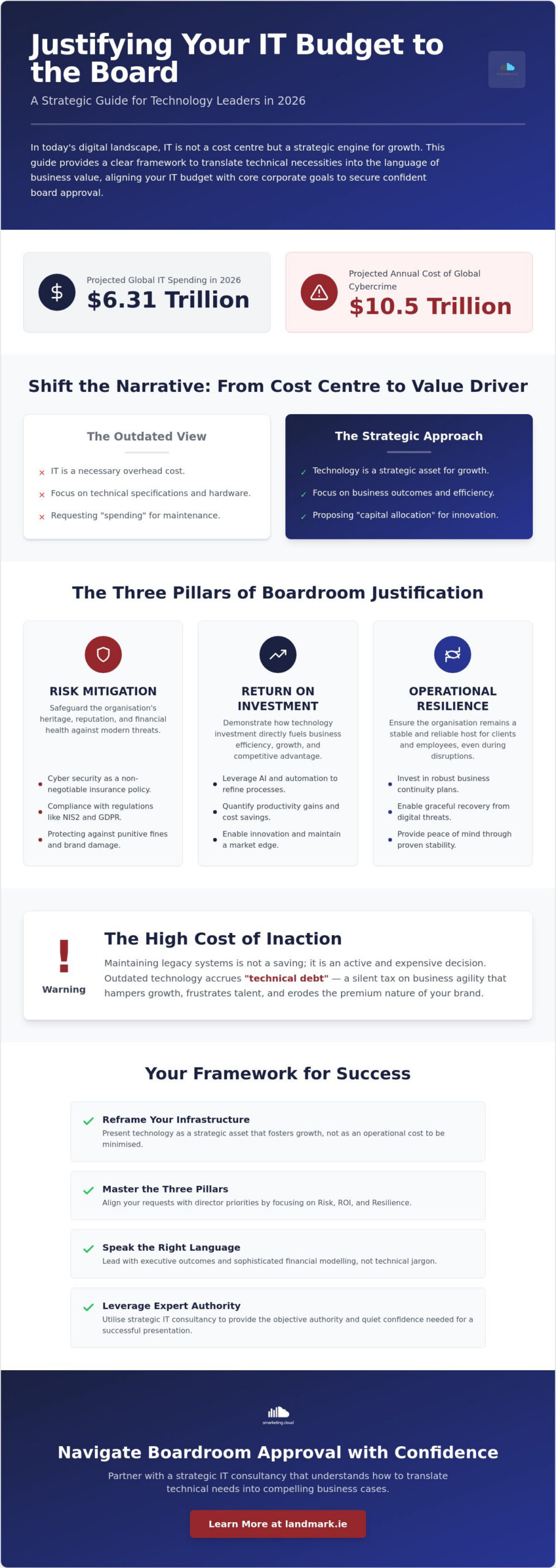
It’s frustrating when complex cyber security risks or the nuances of AI automation are met with blank stares or budget cuts. You understand that the cost of doing nothing often far outweighs the initial investment, particularly when global cybercrime costs are expected to hit $10.5 trillion this year. This guide promises to refine your communication, providing a clear framework to translate technical jargon into the language of business value. We will explore how to align your 2026 IT budget with overarching corporate goals, ensuring your next presentation is met with a confident approval rather than a request for further savings.
Key Takeaways
- Reframe your technology infrastructure as a strategic asset that fosters growth rather than a mere operational cost.
- Master the three pillars of boardroom persuasion: Risk, ROI, and Resilience, to align your requests with director priorities.
- Discover exactly how to justify IT spending to the board by leading with executive outcomes and sophisticated financial modelling.
- Quantify the value of AI and automation to demonstrate how modern systems refine business efficiency and maintain a competitive edge.
- Leverage the objective authority of strategic IT consultancy to provide the quiet confidence required for successful budget presentations.
Shifting the Narrative: From IT Cost Centre to Strategic Value Driver
In the high-end professional landscape of 2026, the traditional view of IT as a necessary evil or a frustrating overhead cost has become entirely obsolete. High-achieving professionals and growing businesses understand that technology is no longer just a set of tools; it’s the very foundation of a curated professional experience. To succeed in the boardroom, you must pivot away from technical specifications and towards the language of prestige and calm efficiency. When the digital environment is seamless, it reflects a brand that is impeccably organised and deeply committed to excellence.
Understanding how to justify IT spending to the board requires a fundamental shift in perspective. You aren’t merely asking for funds to maintain hardware; you’re proposing an investment in the business’s capacity to innovate and lead. In 2026, where global IT spending is projected to grow by 13.5%, a proactive approach to infrastructure is the only way to ensure your organisation remains a refined host for both clients and employees. Technology should feel like a premium service, providing the frictionless experience that modern professionals expect.
The Psychology of Boardroom Decision-Making
Directors are driven by a desire for stability, predictability, and a clear competitive edge. They value environments where success is nurtured through reliable, high-quality operations. When presenting your 2026 strategy, frame your IT department as a strategic ally that protects the brand’s heritage whilst enabling modern innovation. It’s helpful to shift your vocabulary from “spending” to “capital allocation.” This subtle change in language signals that you’re managing assets designed to yield a long-term return, positioning you as a dedicated partner in the firm’s financial health. Directors are far more likely to approve budgets that promise to enhance the prestige and efficiency of the entire organisation.
The Cost of Inaction: A Potent Justification
The risk of maintaining legacy systems is often the most compelling argument for new investment. Outdated technology creates a friction-filled environment that hampers growth, frustrates talent, and invites unnecessary risk. Whilst the board might focus on the initial price of new solutions, they must also understand the tangible price of technical debt. Technical debt is the silent tax on business agility. When you explain how to justify IT spending to the board, you must highlight that “doing nothing” is actually an expensive decision that erodes the premium nature of the brand and slows down every department. By quantifying the drag on productivity, you transform a technical upgrade into a vital business necessity.
The Three Pillars of Boardroom Justification: Risk, ROI, and Resilience
Securing approval for your 2026 budget requires a structured approach that resonates with a director’s sense of responsibility. By anchoring your proposal in three core pillars, you provide the clarity and stability the board craves. This is the most effective way to understand how to justify IT spending to the board whilst positioning yourself as a dedicated strategic ally. You aren’t just buying software; you’re safeguarding the firm’s future and ensuring its continued prestige.
Risk mitigation is the first and perhaps most critical pillar. In 2026, cyber security must be presented as a non-negotiable insurance policy rather than a discretionary expense. With global cybercrime costs projected to reach $10.5 trillion this year, the board needs to see technology as the primary shield for the organisation’s heritage and reputation. Similarly, compliance with regulations like NIS2 and GDPR provides a mandatory baseline for investment. These aren’t just legal hurdles; they’re benchmarks for operational excellence that protect the business from punitive fines and reputational damage.
Operational resilience ensures that your business remains a reliable host, even during unforeseen disruptions. Investing in business continuity plans allows for a graceful recovery from digital threats, maintaining the calm efficiency that defines a premium brand. When you can demonstrate that the organisation will remain functional and composed during a crisis, you provide the board with the ultimate peace of mind.
Quantifying Cyber Risk in Financial Terms
Directors respond best to data that translates abstract threats into balance-sheet realities. Instead of discussing malware types, focus on the potential downtime costs per hour. If a breach occurs, the financial impact isn’t just the recovery fee; it’s the lost productivity and the erosion of a prestigious reputation. Advanced threat detection acts as a silent guardian, ensuring the brand’s integrity remains untarnished. Many firms find that partnering with an expert for managed security can even lead to more favourable insurance premiums, providing a direct financial offset for the investment.
Calculating ROI Beyond the Spreadsheet
Return on investment in 2026 is about more than just cost-cutting; it’s about nurturing an environment where high-achieving professionals can flourish. Measuring productivity gains from modern Microsoft 365 environments reveals how much time is reclaimed through automation and collaboration. Frictionless workflows are also a primary differentiator in attracting and retaining top-tier talent who expect a high-end digital experience. At the heart of this is a robust business broadband solution, which serves as the central nervous system for your national operations. If you’re looking to refine your strategy, our team offers strategic IT consultancy to help you map these gains to your specific business goals.
Quantifying the Intangible: Leveraging AI and Automation for Business Growth
In 2026, AI has transitioned from an experimental luxury to the primary differentiator for high-achieving professionals. It’s the engine behind the calm efficiency that defines modern market leaders. When considering how to justify IT spending to the board, it’s essential to present AI and business automation not as speculative ventures but as essential components of a high-performance environment. You’re proposing a system that liberates your team from the mundane, allowing them to focus on the strategic innovation that nurtures long-term success. According to the BCG AI Radar Survey, companies are expected to spend an average of 1.7% of their revenue on AI in 2026, highlighting that this is now a standard pillar of corporate investment.
Justifying the initial cost of business automation is often a matter of demonstrating how it replaces fragmented manual tasks with a seamless, unified experience. By integrating AI into your VoIP and unified communications, you create a frictionless flow of information that empowers every department. This isn’t just about saving time; it’s about providing the board with AI-driven insights that allow for faster, more confident decisions. When data is curated and presented with precision, the board can lead with the quiet confidence that comes from total clarity.
The Efficiency Dividend of Automation
To secure approval, start by identifying “low-hanging fruit” within your current manual workflows. These are high-volume, repetitive tasks where automation can provide an immediate proof-of-concept. For instance, reducing human error in financial reporting through automated data entry offers a clear, tangible benefit that directors instantly respect. Beyond internal metrics, AI enhances the “refined host” experience for your clients. Whether it’s through more responsive service or personalised interactions, automation ensures that every touchpoint reflects the premium nature of your brand.
Future-Proofing the Business Model
Waiting for “perfect” AI technology is a strategic mistake that risks leaving your organisation behind. The most successful firms in 2026 are those that build a scalable foundation today, ensuring they can seamlessly integrate tomorrow’s innovations. When explaining how to justify IT spending to the board, emphasise that AI readiness is a prerequisite for 2026 market leadership. By investing now, you’re not just buying a tool; you’re securing a permanent place at the forefront of your industry. This proactive stance is exactly what a board needs to see to feel reassured about the firm’s long-term stability and prestige. The goal is to create an infrastructure that is both flexible and robust, capable of supporting the high-end professional experience your clients expect.
Crafting the Business Case: Metrics and Language the Board Will Respect
A successful proposal is a masterclass in translation. It requires moving beyond the technical “what” of infrastructure to the strategic “why” of business performance. When you consider how to justify IT spending to the board, your presentation must mirror the calm efficiency of the solutions you propose. A well-structured business case doesn’t just ask for permission; it demonstrates a deep commitment to the organisation’s long-term prestige and stability.
- Step 1: Executive Summary. Lead with the business outcome, not the technology. If a new network infrastructure project promises to increase operational capacity by 15%, that should be your opening statement.
- Step 2: Financial Modelling. Use Total Cost of Ownership (TCO) comparisons to provide a transparent view of the investment. Boards value the honesty of seeing the full lifecycle of an asset, from procurement to decommissioning.
- Step 3: Strategic Alignment. Link every IT euro to a specific board-level goal. Whether it’s expanding into new markets or enhancing client service, your technology must be seen as the enabler of these ambitions.
- Step 4: Risk Assessment. Clearly illustrate the impact of “doing nothing” against the proposed project. Frame technical debt as a risk to the brand’s heritage and a barrier to future agility.
- Step 5: Implementation Roadmap. Present a composed, well-oiled plan for rollout. A roadmap that accounts for minimal disruption signals that you are an impeccably organised strategic ally.
Vocabulary for the Boardroom
The language you choose can either build a bridge or a wall. Avoid technical terms like “bandwidth,” “latency,” or “firewalls,” which can feel alienating to non-technical directors. Instead, use evocative descriptors such as “capacity,” “responsiveness,” and “asset protection.” This shift focuses the conversation on agility, scalability, and the prestige of the organisation. Using parallel structures in your speech, such as “we are protecting our assets, empowering our people, and delighting our clients,” creates a rhythmic quality that suggests reliability and quiet confidence.
Visualising Value: Beyond the Slide Deck
Directors often process information through the lens of risk and return. Use simple, benefit-driven charts to show the “before and after” of your proposed IT investment. High-achieving professionals are particularly responsive to case studies that demonstrate a clear, frictionless experience for the end-user. If you need assistance in refining these metrics to learn exactly how to justify IT spending to the board, our strategic IT consultancy services can help you articulate the value of your technology in a way that resonates with even the most traditional directors. By showing that you understand the holistic needs of the modern professional, you turn a budget request into a shared vision for success.
Strategic IT Consultancy: Your Ally in Navigating Boardroom Approval
Reaching the final stage of your 2026 budget proposal often requires a final touch of external authority. When you’re determining how to justify IT spending to the board, you don’t have to carry the burden of proof alone. A dedicated strategic ally, such as an impeccably organised Managed Service Provider, provides the quiet confidence needed to turn a complex request into a definitive approval. Landmark Technologies acts as a refined host for your digital transformation, ensuring every detail is attended to with precision and care.
By bringing in a third-party perspective, you offer the board an objective, expert-level justification that internal reports might lack. This external validation signals that your strategy has been rigorously vetted against industry standards and global trends. It moves the conversation from a list of technical requirements to a professionally curated roadmap for business success. When the board sees that your plan is backed by a partner committed to excellence, their confidence in the investment grows naturally.
The Power of Expert Validation
Directors often place a high degree of trust in external strategic allies who can validate internal budget requests with impartial data. Landmark’s heritage in the sector and deep technical expertise ground your proposal in reality, transforming it from an internal wishlist into a professionally audited business case. We provide customised solutions that reflect the unique needs of your specific professional environment, ensuring that the technology suggested is a perfect fit for your firm’s culture and long-term goals. This level of tailoring demonstrates a commitment to individual agency and autonomy that boards find deeply reassuring.
Seamless Integration and Peace of Mind
Positioning Managed Support as a core part of your strategy allows you to frame IT spending as a way to free up internal teams for high-level, strategic work. It’s about creating an environment where success is nurtured because the routine tasks are handled with frictionless efficiency by a reliable partner. This partnership offers the long-term stability and permanence that directors look for when committing to significant capital allocations. When your infrastructure is managed by a team that values craftsmanship and detail as much as you do, the board can focus on growth whilst we handle the complexity.
If you’re ready to secure your 2026 budget, the first step is a thorough evaluation of your current position. Organise a strategic IT audit to build your board-level business case today and discover how to justify IT spending to the board with total clarity and confidence. We are here to ensure your technology serves as a prestigious foundation for everything your business achieves.
Securing Your Strategic Vision for 2026
Success in the boardroom depends on your ability to translate technical necessity into business prestige. By anchoring your proposal in the pillars of risk and resilience, you move beyond the role of a service provider to become a strategic ally. You’ve discovered that the secret of how to justify IT spending to the board lies in presenting technology as a curated environment where success is nurtured and growth is protected through calm efficiency.
Landmark Technologies has spent over two decades refining a heritage of excellence that supports high-achieving professionals. Since our founding in 2004, we have specialised in AI, Cyber Security, and Business Continuity, delivering a premium service model that is impeccably organised and attentive to detail. We invite you to partner with Landmark Technologies to secure your strategic IT future and ensure your organisation leads with quiet confidence.
The path to 2026 is an opportunity to redefine your infrastructure as a foundation for excellence. With a composed plan and the right expertise, your next board presentation will be the start of a transformative and prosperous year for your entire firm.
Frequently Asked Questions
What is the most important metric for justifying IT spending?
The most important metric is strategic alignment with core business objectives. Boards value how an investment drives revenue or mitigates risk rather than technical performance. You should focus on metrics like Total Cost of Ownership (TCO) or the reduction in operational friction. This demonstrates a deep commitment to the firm’s long-term stability and prestige whilst ensuring every pound spent serves a specific corporate goal.
How do I explain cyber security risk to a non-technical board?
Explain cyber security risk by translating threats into potential downtime costs and reputational damage. Avoid technical jargon like “firewalls” or “encryption.” Instead, frame it as a non-negotiable insurance policy that protects the brand’s heritage. Use the projected global cost of cybercrime, which is reaching $10.5 trillion in 2026, to ground the conversation in financial reality and highlight the price of inaction.
Is it better to present IT as a capital expense or an operating expense?
The choice depends on your organisation’s specific financial strategy and tax structure. Many high-achieving businesses prefer an Operating Expense (OpEx) model for cloud solutions to ensure predictable cash flow and flexibility. However, a Capital Expense (CapEx) approach may be suitable for long-term infrastructure assets that reinforce the permanent nature of your digital foundation. A refined host will always balance these models to support sustainable growth.
How can I demonstrate the ROI of AI and automation?
Demonstrate the ROI of AI by quantifying the time reclaimed from manual workflows and the reduction in human error. Focus on the “efficiency dividend” where automation allows your team to focus on strategic innovation. According to the BCG AI Radar Survey, firms are allocating 1.7% of revenue to AI in 2026. This highlights its role as a standard driver of business growth rather than an experimental cost.
What should I do if the board rejects my IT budget proposal?
If the board rejects your proposal, listen to their concerns and refine your case by highlighting the cost of inaction. Reframe the discussion around the tangible price of technical debt and how legacy systems create a friction-filled environment. Understanding how to justify IT spending to the board often involves a second, more targeted presentation that links the investment directly to a specific director priority or a high-level risk.
How often should I update the board on IT strategic progress?
You should update the board on IT strategic progress at least once a quarter to maintain the narrative of technology as a value driver. Regular updates ensure that digital infrastructure remains a top-of-mind priority rather than a once-a-year budget conversation. This steady cadence builds a sense of stability and allows you to demonstrate the composed, well-oiled progress of your 2026 strategic roadmap.
Can I justify IT spending based on employee satisfaction?
Yes, justifying IT spending based on employee satisfaction is a powerful way to highlight the importance of attracting and retaining top-tier talent. High-achieving professionals expect a frictionless, premium digital experience that mirrors the quality of their physical workspace. Modern tools and infrastructure can be positioned as essential for nurturing a high-performance culture and reducing the operational friction that often leads to talent churn.