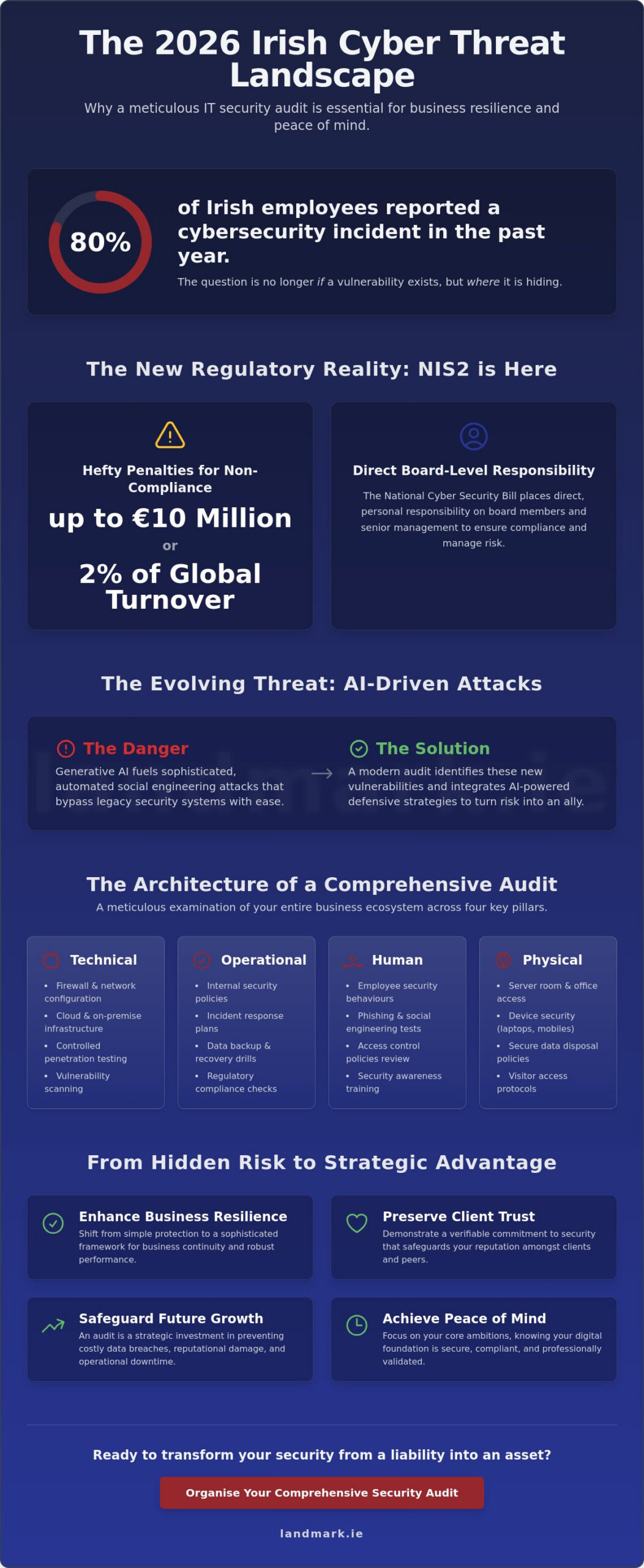
With 80 per cent of Irish employees reporting a cybersecurity incident within the last year, the question for Dublin’s business leaders is no longer if a vulnerability exists, but where it is currently hiding. You have likely invested significant resources into your digital infrastructure, yet the looming complexity of the National Cyber Security Bill 2024 and the strict mandates of NIS2 can feel like a shifting landscape. It is natural to feel a sense of unease, especially if you suspect your current IT arrangements lack the rigorous, independent scrutiny required to meet today’s prestigious standards of excellence.
A meticulous IT security audit Dublin businesses can rely on does more than just tick a regulatory box; it transforms hidden risks into a robust foundation for elite performance and absolute peace of mind. We believe that true security should feel like a seamless extension of your professional success, providing a stable environment where growth is nurtured and protected. This article explores how a strategic framework for 2026 aligns your security posture with new EU regulations whilst fostering a culture of resilience that safeguards your reputation amongst clients and peers alike.
Key Takeaways
- Understand how the 2026 regulatory landscape, including NIS2, requires a shift from simple protection to a sophisticated framework of business resilience.
- Learn why a comprehensive IT security audit Dublin professionals recommend must scrutinise your entire ecosystem, from cloud environments to human behaviours.
- Discover how identifying digital vulnerabilities serves as a strategic investment in business continuity and the long-term preservation of client trust.
- Gain practical guidance on preparing your team for a security review with the calm efficiency and minimal disruption expected in a premium workspace.
- Explore the value of bespoke IT consultancy in creating a security posture that is meticulously tailored to your specific organisational goals.
The 2026 Threat Landscape: Why Irish Businesses Must Prioritise Security Audits
In the current Irish business environment, a sense of security is no longer a luxury; it is the cornerstone of professional excellence. An IT security audit Dublin businesses can rely on acts as a meticulous examination of your entire digital estate. It goes far beyond simply scanning servers. It involves a deep dive into your infrastructure, your internal policies, and the subtle human behaviours that often form the most significant vulnerabilities. This professional validation provides a “peace of mind” dividend, allowing you to focus on your core ambitions whilst knowing your foundation is secure.
For years, many Dublin firms operated under the illusion that they were too small to be noticed by cyber criminals. However, a January 2026 survey revealed that 80 per cent of Irish employees experienced a cybersecurity incident in the past year. SMEs are now primary targets because they often serve as the entry point into larger, more lucrative supply chains. Moving away from a reactive “break-fix” mentality is essential. By adopting a proactive stance, you transform your security from a hidden anxiety into a visible mark of quality and resilience.
The Impact of NIS2 and DORA on Irish Firms
The regulatory horizon has shifted significantly with the transposition of the EU’s NIS2 Directive into the National Cyber Security Bill 2024. This legislation, which was fast-tracked following the October 2024 deadline, places a direct, personal responsibility on board members and senior management. For essential entities, non-compliance could lead to penalties of up to €10 million or 2 per cent of worldwide turnover. Whilst these figures are sobering, the true leaders in sectors like finance, healthcare, and utilities view these mandates as an opportunity. By achieving compliance through a regular IT security audit Dublin organisations can prove their commitment to excellence and inspire confidence amongst their clients.
AI-Driven Threats: The New Frontier
The rise of generative AI has fundamentally changed the nature of social engineering. Attacks are now more sophisticated, highly automated, and difficult to detect through traditional means. An updated audit is required to identify where legacy systems might fail against these modern tactics. We believe in meeting innovation with innovation. By integrating AI & Business Automation into your defensive strategy, we turn technology from a potential risk into a strategic ally. This approach ensures your business remains a calm centre of stability even as the external threat environment evolves with unprecedented speed.
The Architecture of a Comprehensive IT Security Audit
A modern IT security audit Dublin businesses invest in must extend its gaze far beyond the server room. It is a meticulous examination of the entire business ecosystem, ensuring that every digital and physical touchpoint is aligned with your high standards. We believe that security should feel like a seamless part of a holistic brand experience, providing a frictionless environment where your team can excel without the constant interruption of digital threats. The four pillars of a modern audit comprise technical, operational, human, and physical reviews, creating a complete picture of your organisational health.
This architectural approach ensures that your security posture is not merely a collection of software patches, but a robust foundation for future growth. Whether your team works from a prestigious central office or follows a hybrid model, the audit must cover cloud, on-premise, and remote environments with equal precision. It is about creating a sense of calm efficiency, where your data is protected by invisible yet impenetrable layers of professional oversight.
Technical and Network Infrastructure Review
The technical layer remains your primary line of defence against external intrusion. A thorough review assesses firewall configurations to ensure they are robust enough for the automated attacks prevalent in 2026. Meticulous network security analysis identifies hidden vulnerabilities within your existing infrastructure. Penetration testing is vital here; it acts as a controlled stress test to find “back doors” before malicious actors do. As businesses increasingly rely on Cloud Solutions, the audit also scrutinises SaaS application settings to ensure data remains private and protected across every platform.
The Human Factor: Policies and Awareness Training
Technology alone cannot secure a business when human error remains a significant factor. A 2026 survey revealed that 61 per cent of Irish employees believe staff pose the greatest security risk to their organisations. A comprehensive audit evaluates current awareness levels and the effectiveness of your internal training programmes. It reviews password hygiene and the universal implementation of Multi-Factor Authentication (MFA) across all accounts. We also examine the lifecycle of access permissions. Proper joiner, mover, and leaver processes are essential to prevent unauthorised data access from former employees or mismatched roles. If you are looking to refine these internal structures, engaging in strategic IT consultancy can help align your policies with global best practices.
Strategic Benefits: How Regular Audits Protect Your Profit Margins
Viewing a security review as a mere expense is a perspective that belongs to the past. In the modern Irish economy, an IT security audit Dublin firms commission is a high-value investment in business continuity and long-term financial health. When you consider that the average cost of IT downtime for SMEs in Dublin has risen to upwards of €5,400 per hour as of May 2026, the financial logic becomes undeniable. A single afternoon of system instability can erode the profits of an entire quarter, making proactive validation a cornerstone of sound fiscal management.
Beyond immediate loss prevention, a meticulous audit serves as a powerful catalyst for growth. It provides the necessary confidence to embrace digital transformation and AI adoption without the shadow of uncertainty. Furthermore, Irish insurers have become increasingly discerning. To secure favourable terms for cyber insurance premiums, businesses must now provide detailed proof of their security posture. A professional audit provides this evidence, often resulting in more comprehensive coverage and lower costs over time. It is a strategic move that signals to the market that your organisation is a stable, well-oiled machine.
Business Continuity and Disaster Recovery
An audit does more than identify gaps; it validates your resilience. It ensures that your backup systems are not merely present but are functional and isolated from potential ransomware paths. This level of scrutiny is a vital component of Business Continuity planning. By simulating recovery scenarios, we ensure your business can return to its peak operational state with the grace and speed your clients expect. This creates a sense of permanence that is highly attractive to long-term partners who value reliability above all else.
Enhancing Client Trust and Prestige
In a competitive marketplace, your commitment to data protection can be a significant differentiator. Using your audit status as a mark of quality allows you to tender for high-value contracts with absolute confidence. It provides psychological reassurance to your clients, positioning your professional environment as a “centre of excellence” for security. We believe that when your digital foundation is impeccable, it reflects the same level of craftsmanship and attention to detail found in your physical workspace. This alignment of values nurtures success and fosters a community of trust amongst your peers and prestigious local landmarks.
Preparation Guide: How to Organise Your Team for a Security Review
Approaching an IT security audit Dublin businesses can trust requires the same calm efficiency you would apply when preparing a prestigious boardroom for a high-stakes meeting. Preparation is the bridge between a disruptive event and a curated professional experience. By briefing your stakeholders early, you ensure the review aligns with your strategic objectives rather than becoming a technical distraction. It’s about creating a sense of organised readiness that reflects your brand’s commitment to excellence and attention to detail.
When you organise your internal resources effectively, the audit moves with the steady, composed rhythm of a well-oiled machine. This proactive stance doesn’t just save time; it demonstrates a level of professional authority that reassures both your staff and your clients. A well-prepared team allows the auditor to focus on deep analysis rather than administrative hurdles, ensuring the final report provides the high-end insights your business deserves.
Step-by-Step Internal Preparation
Start by categorising all digital assets, including the “shadow IT” often adopted by different departments for convenience. These unmonitored tools are frequently where vulnerabilities reside. You should gather existing IT policies, incident response plans, and previous audit reports into a single, accessible location. This level of organisation allows the process to flow with the grace of a well-managed estate. Your technical team should also be ready to provide administrative access to relevant systems, preventing unnecessary delays whilst the review is underway. If you require assistance in structuring these internal assets, our strategic IT consultancy can provide the expert guidance needed to streamline your preparation.
Communicating with Your Workforce
The human element is often where the most significant progress is made. It’s essential to frame the audit as a supportive measure designed to protect the collective success of the firm, rather than a hunt for individual mistakes. You should encourage transparency amongst staff regarding their daily digital workflows. When employees feel secure and inspired, they’re more likely to share the practical shortcuts they use, which is often where real-world risks are found. Set clear expectations regarding the timeline and any minor, temporary changes to system access. This open communication maintains the welcoming, high-end atmosphere your team expects whilst ensuring the audit achieves its goals with minimal disruption to your daily operations.
Landmark Technologies: Meticulous Auditing and Managed Protection
With over two decades of dedicated expertise within the Irish market, Landmark Technologies serves as a refined strategic ally for businesses that demand excellence. We understand that your digital infrastructure is the stage upon which your professional success is built. We do not believe in “one size fits all” security. Every IT security audit Dublin businesses commission through us is an exercise in precision, designed to respect your unique heritage whilst preparing you for a modern, innovative future.
Our role is that of a dedicated host, ensuring every aspect of your technology is impeccably organised and attentive to detail. Once the audit is complete, we provide a seamless transition from discovering vulnerabilities to implementing robust remediation. This journey often evolves into a long-term partnership through Managed IT Support, where we maintain the frictionless experience your team needs to thrive. It is a higher standard of care that transforms IT from a source of anxiety into a curated professional experience.
A Tailored Approach to Irish Business Security
We align our auditing frameworks with your specific industry requirements and long-term growth goals. Whether you are managing the complexities of NIS2 or seeking to protect a boutique firm near prestigious local landmarks, our approach remains bespoke. We pride ourselves on providing clear, jargon-free reports that empower executive decision-making. You will never be left deciphering technical acronyms. Instead, you will receive actionable insights that guide your strategy with quiet confidence. Our dedicated Irish helpdesk ensures that expert support is always within reach, providing a sense of stability and permanence as you grow.
Your Invitation to Digital Stability
The proprietary approach we provide at Landmark Technologies is built on a foundation of trust and meticulous craftsmanship. As we look toward 2026, the importance of acting now to secure your infrastructure cannot be overstated. Proactive resilience is the hallmark of a leader. We are here to ensure your journey is both inspiring and reassuring. We invite you to step into an environment where your success is nurtured by experts who value your autonomy as much as your security. Book your bespoke IT security consultation today and discover the peace of mind that comes from true professional partnership.
Securing Your Professional Legacy for 2026 and Beyond
The journey toward absolute digital resilience is a mark of leadership that distinguishes the most prestigious firms in Ireland. By prioritising a comprehensive IT security audit Dublin businesses can navigate the complexities of NIS2 and the National Cyber Security Bill 2024 with absolute confidence. This process ensures your infrastructure is not merely protected, but serves as a stable environment where your team can excel and your clients’ trust is nurtured. It’s about moving from a state of uncertainty to one of calm, frictionless efficiency that reflects your commitment to excellence.
Founded in 2004, Landmark Technologies brings over 20 years of Irish IT expertise to every engagement. We provide bespoke security frameworks tailored to the high standards of legal and financial professionals, delivered with a sophisticated ethos that spans the entire nation. Our commitment is to act as your dedicated strategic ally, ensuring your digital foundation is as robust as your professional ambition. We invite you to Request a Meticulous IT Security Audit for Your Firm today. Your future success deserves a foundation built on precision, heritage, and unwavering care.
Frequently Asked Questions
What is the primary difference between a vulnerability scan and a full IT security audit?
A vulnerability scan is an automated tool that identifies known security gaps, whilst a full IT security audit is a meticulous, manual examination of your entire ecosystem. An audit evaluates not just technical flaws, but also internal policies and human behaviours that software alone cannot detect. This holistic review provides the professional authority needed to secure a prestigious business environment against sophisticated threats.
How long does a typical IT security audit take for an Irish SME?
The duration of an IT security audit Dublin businesses undergo typically ranges from two to five days of active fieldwork, depending on the complexity of your infrastructure. Once the initial review is complete, a detailed report is curated over the following week. We ensure the process moves with a composed rhythm that respects your time and maintains the efficiency of your professional workspace.
Is an IT security audit mandatory for businesses under the NIS2 directive?
Regular auditing is a legal necessity for essential and important entities under the NIS2 directive and the National Cyber Security Bill 2024. Even for businesses not directly classified, many prestigious clients now mandate proof of security before awarding high-value contracts. Adopting these standards early positions your firm as a leader in data protection and regulatory compliance amongst your peers.
Will our daily business operations be disrupted whilst the audit is being conducted?
Your daily operations shouldn’t experience significant disruption during a professionally managed review. Most technical checks are performed in the background, whilst interviews with key stakeholders are scheduled to fit your existing diary. We approach the process with the grace of a refined host, ensuring that your team can continue their work in a calm and productive atmosphere without unnecessary friction.
How often should a professional services firm perform a security review?
We recommend that professional services firms perform a comprehensive security review at least once a year. However, an additional audit is advisable after significant organisational changes, such as adopting new business automation tools or migrating to different cloud environments. Regular validation ensures your security posture remains impeccable as the Irish threat landscape evolves and new regulations come into force.
What documentation do we need to provide to the auditors before they begin?
You’ll need to provide existing IT policies, incident response plans, and a current inventory of digital assets, including any department-specific software. Access to network diagrams and previous audit reports also helps the auditor understand your history. Collate these documents beforehand to ensure the process flows with the steady, reliable pace of a well-oiled machine and yields the most accurate results.
What happens after the audit findings are presented?
After the findings are presented, we provide a clear, jargon-free roadmap for remediation. This document prioritises risks based on their potential impact on your business continuity and profit margins. You can then work with your strategic ally to implement these improvements, transforming your vulnerabilities into a robust foundation for future growth and the long-term preservation of your firm’s prestige.
Can an IT security audit Dublin help reduce our cyber insurance premiums in Ireland?
A meticulous security audit is often a key factor in securing more favourable cyber insurance terms. Insurers in the Irish market now demand verifiable proof of a robust security posture before offering competitive premiums or comprehensive coverage. By demonstrating professional oversight and a proactive approach to risk, you signal to insurers that your organisation is a stable, well-managed, and low-risk partner.