
What if the 99.9% uptime guarantee you have relied on for years is actually the very thing leaving your business exposed? Whilst that figure sounds impressive on a glossy brochure, it can still permit hours of critical downtime during your most profitable windows. You likely feel that an IT contract should be more than a list of technical constraints; it should be a promise of frictionless performance. Mastering the specific components of an IT service level agreement what to include is the first step toward reclaiming your peace of mind and ensuring your infrastructure is managed with professional authority.
We recognise the quiet anxiety that comes with technical jargon and the fear of hidden service gaps. You deserve a partnership that feels like a curated professional experience rather than a mere utility. This article provides a clear framework for service expectations in 2026, helping you secure predictable IT performance and a strategic alliance that nurtures your success. We will explore how to integrate the latest ITIL 5 standards and AI-driven metrics to create a resilient, modern workspace that functions with absolute reliability.
Key Takeaways
- Discover how to transform your IT contract from a technical document into a strategic pillar of trust that supports a premium, aspirational workspace.
- Master the essential components of an IT service level agreement what to include to ensure every facet of your digital environment is managed with professional authority.
- Learn why resolution time, rather than simple response time, serves as the definitive measure of efficiency for maintaining a frictionless business environment.
- Identify hidden clauses that may limit provider liability and discover how to align your agreement with your long-term goals for digital transformation.
- Explore how a refined host experience can elevate your IT support into a strategic alliance that nurtures your team’s collective success.
Understanding the Strategic Role of an IT Service Level Agreement
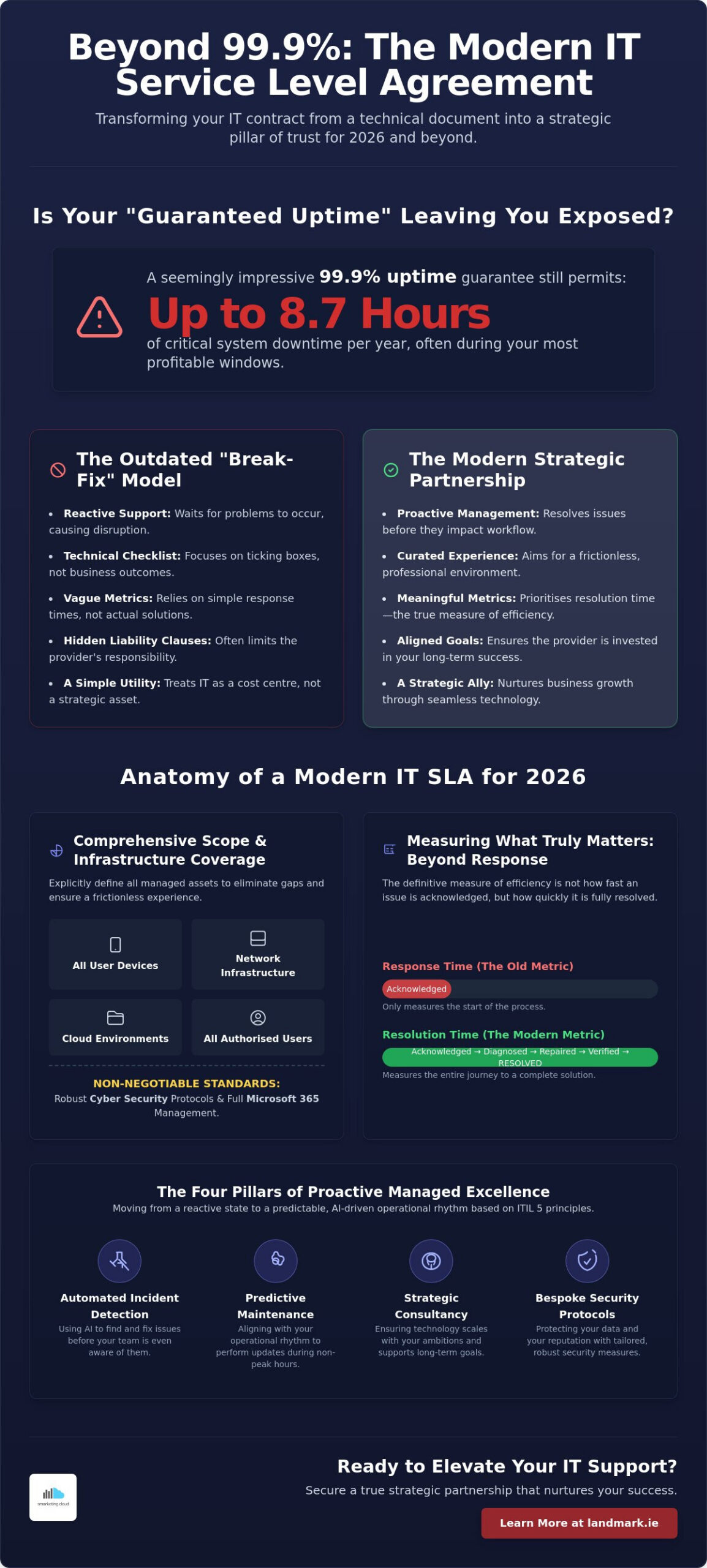
An IT service level agreement is often viewed as a dry, technical necessity. However, for the high-achieving professional, it serves as a foundational pillar of trust between their business and its strategic IT ally. It’s the difference between a workspace that feels chaotic and one that exudes calm efficiency. When considering an IT service level agreement what to include, you must look beyond basic repairs. You’re establishing a Managed IT Support framework that replaces the outdated “break-fix” mentality with a proactive, predictable operational rhythm. This structural clarity reduces executive anxiety, ensuring that your digital infrastructure remains as impeccably organised as your physical boardroom. In the context of ITIL 5, launched in February 2026, the SLA has evolved. It’s no longer just about service delivery; it’s about Digital Product and Service Management in an AI-driven world. This shift reflects a move away from purely technical metrics toward a more holistic brand experience. Proactive managed excellence typically involves:
- Automated incident detection to resolve issues before they impact your workflow.
- Predictive maintenance that aligns with your business’s operational rhythm and peak performance hours.
- Strategic consultancy to ensure your technology scales alongside your ambitions and market shifts.
- Bespoke security protocols that protect your reputation as much as your data.
The Difference Between a Service Level Agreement and a Partnership
Technical compliance is merely the starting point for a refined service experience. Whilst a standard contract might focus on “checking boxes,” a true partnership prioritises nurturing business growth through seamless technology. It’s about creating an atmosphere where success is nurtured. A well-crafted agreement ensures your IT provider acts as a refined host, anticipating needs before they become disruptions. This human-centric approach ensures technology serves the person, not the other way around, fostering a calm and efficient professional atmosphere that mirrors your own high standards.
Aligning IT Objectives with Your National Business Strategy
Your IT infrastructure should reflect the prestige of your brand across Ireland’s competitive landscape. A strategic SLA ensures technical capabilities support your long-term stability and business continuity. This alignment is crucial as businesses navigate new data privacy laws and the integration of AI & Business Automation. When deciding on an IT service level agreement what to include, the focus must remain on prestige and strategic scaling. An IT service level agreement is a strategic framework for operational prestige that guarantees a frictionless professional experience. By aligning these objectives, you transform a simple utility transaction into a curated professional journey.
Essential Components: What to Include in a Modern IT SLA
A well-structured agreement overview serves as the prologue to a successful partnership. It sets the stage for a transparent relationship where expectations are clearly defined and prestige is maintained. When determining an IT service level agreement what to include, you must ensure that the detailed description of services leaves no facet of your digital environment to chance. This clarity ensures that your provider acts as a dedicated strategic ally, managing your infrastructure with the same care you apply to your own clients. By defining the proactively managed excellence you expect, you move away from a simple utility transaction toward a curated professional experience.
Scope of Service and Infrastructure Coverage
Defining the boundaries of your management is essential for a frictionless experience. Your SLA should explicitly detail which devices, users, and cloud environments are under your provider’s care. In 2026, incorporating robust Cyber Security protocols is no longer optional; it’s a non-negotiable standard for any premium workspace. Similarly, ensuring your Microsoft 365 environment is fully managed within the core scope prevents productivity gaps. This granular approach ensures that every touchpoint of your professional life is supported by an impeccably organised system.
Exclusions and Fair Use Policies
Transparency regarding what is not included is just as vital as the service list itself. Establishing clear boundaries through fair use policies prevents scope creep and maintains the high quality of service you expect. These exclusions protect you from unexpected costs, as they differentiate between standard, day-to-day support and bespoke IT Consultancy projects that require a different level of strategic planning. By defining these limits, you clarify the IT service level agreement what to include for your specific business needs, ensuring that your provider’s resources are always focused on maintaining your operational excellence.
Service provider responsibilities should define the proactive behaviours expected of your IT host, such as automated monitoring and regular performance reviews. Conversely, client responsibilities outline the internal prerequisites for a frictionless partnership, such as providing timely access to hardware or notifying the provider of new hires. When both parties understand their roles, the relationship moves at a pace that suggests a well-oiled machine. If you are ready to experience a more sophisticated approach to managed services, ensuring these components are in place is the first step toward absolute reliability.
Measuring What Matters: Metrics Beyond Simple Uptime
The standard 99.9% uptime guarantee is often presented as the gold standard; yet, for a business striving for absolute reliability, it remains merely the baseline. In a high-end professional environment, 99.9% uptime still permits nearly nine hours of downtime annually. For a firm operating during critical market hours, those nine hours can represent a significant loss of prestige and revenue. When refining an IT service level agreement what to include, one must look toward metrics that reflect the actual user experience rather than just the “up or down” status of a server. This shift toward Experience-Level Agreements (XLAs) ensures that your technology supports a calm, efficient atmosphere.
Distinguishing between response time and resolution time is vital for maintaining a frictionless operational rhythm. Whilst it’s reassuring to receive a swift acknowledgement of an issue, the true measure of efficiency is how quickly your strategic ally restores full functionality. A premium service provider doesn’t just answer the phone; they resolve the underlying friction. Furthermore, system performance metrics must account for the nuances of modern work. Ensuring your Business Broadband delivers the speed your team deserves requires monitoring latency and jitter, as these factors often dictate the quality of VoIP and unified communications more than raw bandwidth alone.
Defining Severity Levels for Support Requests
An impeccably organised SLA categorises issues to ensure resources are deployed with professional authority. Severity 1 (Critical) represents a total loss of business-critical functionality, requiring an immediate, all-hands response. Severity 2 (High) covers significant degradation affecting multiple users, whilst Severity 3 (Normal) addresses minor individual requests. This hierarchy ensures that critical disruptions are met with a sense of urgency that reflects their business impact, maintaining the steady, composed flow of your professional environment.
Service Credits and Performance Incentives
Service credits should be viewed as a reassurance of accountability rather than a mere penalty. They signal a provider’s deep commitment to the success of their clients and their confidence in their own service delivery. By 2026, with 51% of businesses operating in hybrid models, the speed of incident resolution has become the primary driver of digital productivity amongst the Irish professional community. Regular performance reviews allow you to move beyond technical reporting, integrating User Satisfaction (CSAT) scores to ensure the human element remains at the heart of your IT strategy. This collaborative approach fosters a partnership that feels like a strategic alliance, where technical excellence and warm hospitality coexist seamlessly.
Negotiating Your SLA: Avoiding Common Pitfalls and Omissions
Negotiating the terms of your engagement is a critical moment for any high-achieving firm. It is here that you ensure your infrastructure remains a curated professional experience rather than a source of hidden frustration. When considering an IT service level agreement what to include, you must look closely at clauses that might limit provider liability excessively. Whilst every contract contains limitations, a premium partnership requires a balanced distribution of risk that reflects the high stakes of your operations. A strategic ally should be willing to stand behind their service with professional authority, especially when managing critical functions like Cyber Security and Cloud Solutions.
In the Irish context, data sovereignty and GDPR compliance are non-negotiable pillars of prestige. With the landscape of data privacy becoming increasingly complex following new regulations in early 2026, your agreement must explicitly address how your data is handled and where it resides. This level of detail ensures that your brand’s reputation for excellence remains untarnished. Additionally, your SLA must provide a robust framework for Business Continuity, ensuring that unforeseen events do not disrupt your operational rhythm. A well-negotiated agreement acts as a silent guardian, providing stability and permanence even during periods of rapid digital transformation.
The Problem with “Generic” SLA Templates
Off-the-shelf templates often fail to capture the unique requirements of a refined professional firm. A bespoke agreement allows you to customise response windows to match your specific business hours, ensuring support is available when you are most active. This tailored approach reflects your brand’s commitment to quality and ensures that the service you receive is as impeccably organised as the rest of your business. When deciding on an IT service level agreement what to include, prioritise language that mirrors your internal standards of craftsmanship and care.
Review and Revision Cycles
An SLA should never be a static document tucked away in a drawer. It must be a living agreement that evolves alongside your ambitions. Quarterly business reviews (QBRs) play a vital role in this process, allowing you to optimise your IT strategy based on real-world performance. These sessions are the perfect time to prepare for the integration of AI & Business Automation, ensuring that the productivity benefits of these technologies are clearly defined and shared. As the global IT outsourcing market reaches $638.65 billion in 2026, the focus has shifted from simple cost reduction to accessing talent and accelerating innovation. If you are seeking a partner that values heritage whilst focusing on modern ways of working, contact our team to discuss a bespoke IT strategy today.
The Landmark Approach: Elevating IT Support to a Strategic Partnership
Landmark Technologies understands that for the high-achieving professional, the workspace is more than just a location; it’s an environment where success is nurtured. We deliver a refined host experience through support that is as impeccably organised as a luxury estate. Our focus on “Frictionless IT” ensures your team remains focused on their core success, entirely unburdened by technical disruptions or service gaps. By integrating Cyber Security and Cloud Solutions into a single, cohesive framework, we provide the absolute reliability you should expect when considering an IT service level agreement what to include. National businesses across Ireland trust our quiet confidence and attentive detail to maintain their operational prestige in an increasingly complex digital landscape.
The Landmark Experience represents our commitment to a holistic brand journey where technology and hospitality meet. We don’t just manage servers; we curate a professional atmosphere that allows your business to flourish. This approach mirrors the structural clarity found in our physical locations, ensuring that your digital tools are as reliable and high-end as your office surroundings. Our team acts as a dedicated strategic ally, moving at a steady and composed rhythm that suggests a well-oiled machine. This level of service elevates the IT function from a simple real estate transaction to a sophisticated professional experience.
Bespoke Solutions for Growing Irish Firms
Every professional environment has its own unique rhythm and requirements. We tailor our managed services to meet these specific needs, balancing a deep respect for heritage with a firm focus on modern, innovative ways of working. This commitment ensures that every technical interaction feels curated and intentional. You deserve to experience the calm efficiency of a partner who values your success as much as you do. Our approach provides a sense of stability and permanence, which is highly attractive to firms looking for a long-term strategic ally rather than a mere utility provider. We emphasise individual agency and tailored solutions to ensure your autonomy is never compromised by your technology.
Taking the Next Step Toward Operational Excellence
Transitioning from a legacy “break-fix” contract to a modern, strategic SLA requires a composed and methodical approach. We recommend a comprehensive IT audit before finalising your agreement to ensure every technical metric and human-centric outcome is addressed. This process identifies the specific components of an IT service level agreement what to include that will most benefit your unique operational structure. By moving beyond technical constraints, you secure a partnership built on professional authority and absolute reliability. To move toward a more sophisticated digital future, contact Landmark Technologies today to discuss your bespoke IT Service Level Agreement.
Securing Your Digital Future with Strategic Intent
A refined IT strategy is the silent engine behind every aspirational workspace. We’ve explored how a modern agreement transcends basic technical metrics to become a foundational pillar of trust. By prioritising resolution times and user-centric outcomes over simple uptime, you ensure your digital environment reflects the prestige of your brand. Mastering the details of an IT service level agreement what to include allows you to reclaim your peace of mind, replacing technical anxiety with a predictable operational rhythm.
Landmark Technologies brings over 20 years of expertise to the Irish market, offering a specialised focus on premium managed IT and cyber security. Our team is dedicated to delivering frictionless business continuity, ensuring your infrastructure remains as impeccably organised as your boardroom. It’s time to move beyond the utility model and embrace a partnership that nurtures your long-term growth. Discover how Landmark Technologies can transform your IT into a strategic asset. Your journey toward absolute reliability is just beginning, and we’re here to guide you with quiet confidence and professional authority.
Frequently Asked Questions
What is the most important part of an IT Service Level Agreement?
The most critical element is the alignment between technical performance and your specific business outcomes. When considering an IT service level agreement what to include, prioritise clear definitions of service availability and resolution times. This ensures your provider acts as a dedicated strategic ally rather than a mere utility, maintaining the frictionless professional experience your team requires to succeed.
How do I know if my current IT SLA is sufficient for 2026?
Your current agreement is likely insufficient if it lacks provisions for AI-driven efficiency and the latest ITIL 5 standards. In 2026, a modern SLA must account for new data privacy regulations and the shift toward Experience-Level Agreements (XLAs). If your contract still relies solely on 99.9% uptime without measuring user satisfaction, it’s time for a strategic revision to match your aspirational goals.
What is the difference between an SLA and a KPI in IT support?
An SLA is the formal commitment between a provider and a client, whilst a KPI is an internal metric used to track progress toward those commitments. Think of the SLA as the host’s promise of a refined experience and the KPI as the behind-the-scenes tool used to ensure every detail is impeccably organised. Both are essential for maintaining a steady, composed operational rhythm.
Can I negotiate the terms of a Managed Service Provider’s SLA?
You can and should negotiate the terms to ensure they reflect your brand’s commitment to quality and operational prestige. A premium provider will welcome the opportunity to tailor response windows and severity levels to your specific business hours. This customisation ensures that the IT service level agreement what to include is perfectly aligned with your infrastructure and long-term stability across Ireland.
What happens if an IT provider fails to meet the SLA targets?
Providers typically offer service credits as a formal reassurance of accountability when targets are missed. These credits act as a sign of their commitment to your success rather than a simple penalty. Repeated failures should trigger a formal performance review or a strategic consultancy session to identify and resolve the underlying friction in your digital environment and restore absolute reliability.
How often should a business review its IT Service Level Agreement?
A business should review its agreement at least annually, though quarterly business reviews are the gold standard for high-achieving firms. These frequent touchpoints allow you to optimise your IT strategy as your team grows or as you integrate new AI and business automation tools. Regular updates ensure your contract remains a living document that supports your evolving professional needs and business continuity.
Does an SLA cover cyber security breaches and data loss?
An SLA defines the response protocols and recovery time objectives following a breach, but it doesn’t replace a comprehensive cyber security policy. It ensures that your provider acts with professional authority to restore business continuity. It’s essential to clarify the specific incident response times and compliance-readiness metrics within the document to protect your reputation and your sensitive data.
Is a 100% uptime guarantee realistic for business IT?
A 100% uptime guarantee is generally considered unrealistic and is often a sign of marketing hyperbole rather than technical reality. Even the most sophisticated global infrastructures require scheduled maintenance windows to remain secure and efficient. A more honest and premium approach focuses on 99.9% or higher, paired with granular definitions of uptime that ensure your most critical business hours are always protected.