
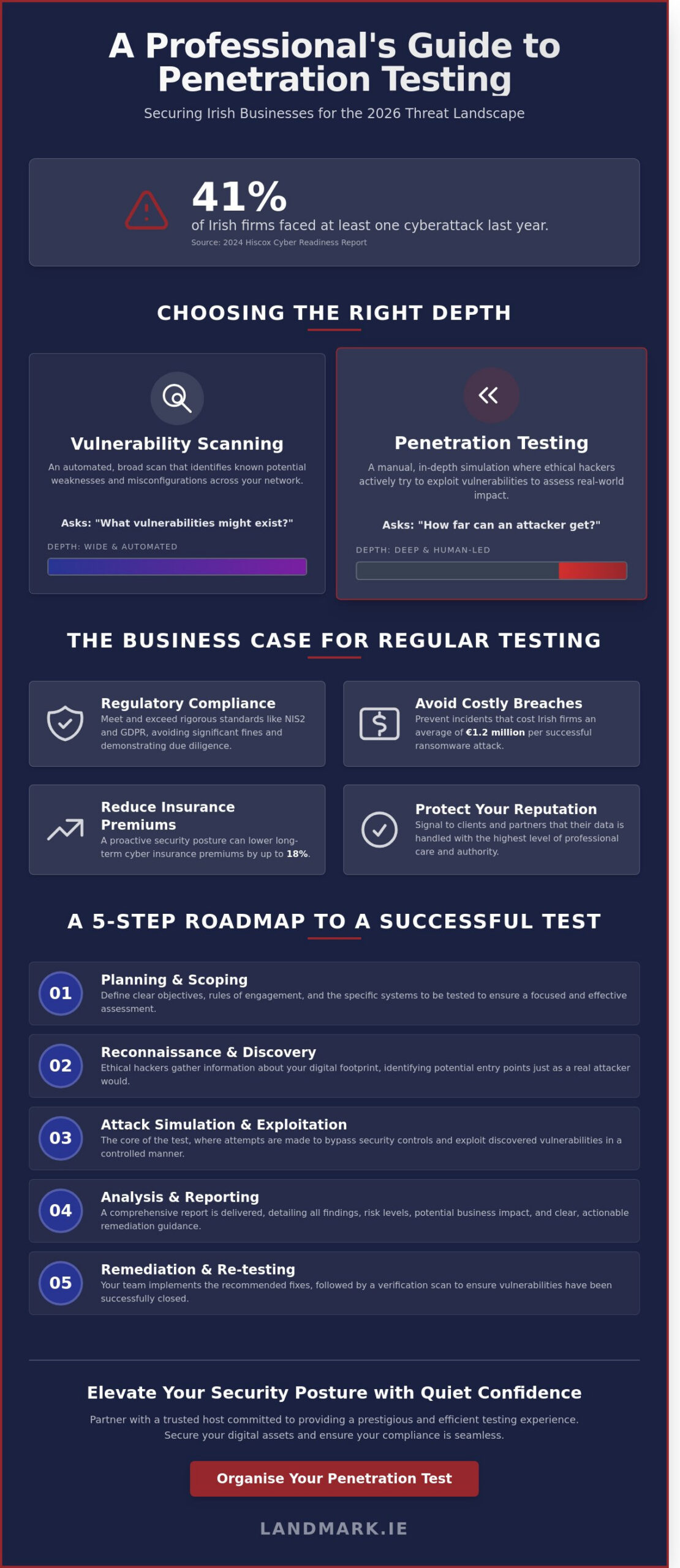
The 2024 Hiscox Cyber Readiness Report reveals that 41% of Irish firms encountered at least one cyberattack last year, highlighting a risk that grows more sophisticated as we move toward 2026. You likely understand that a secure digital perimeter is the bedrock of a prestigious business, yet the technical nuances of penetration testing can often feel opaque. It’s common to feel concerned about potential operational downtime or the weight of meeting rigorous NIS2 and GDPR compliance standards.
We believe that robust security should offer the same calm efficiency as a meticulously designed workspace. This guide shows you how to effectively organise and execute a penetration test to secure your business infrastructure against modern digital threats. You’ll gain a clear roadmap for a successful test, ensuring your compliance is seamless and your digital assets remain protected. We will explore how to transition from simple vulnerability management to a position of quiet confidence in your organisation’s resilience.
Key Takeaways
- Understand why bespoke, human-led simulations are essential for navigating the sophisticated AI-driven threat landscape of 2026.
- Identify the specific areas of your infrastructure that require meticulous attention by choosing between internal and external testing strategies.
- Learn to distinguish between a routine vulnerability scan and a comprehensive penetration testing engagement to ensure your security posture is truly robust.
- Follow a clear, five-step roadmap to organise a frictionless security assessment that ensures visibility and success from start to finish.
- Elevate your security posture by partnering with a trusted host committed to providing a prestigious and efficient testing experience for Irish professionals.
Defining the Gold Standard: What is Penetration Testing in 2026?
Penetration testing is no longer a luxury reserved for global tech giants; it’s the gold standard of digital resilience for every growing firm in Ireland. This practice involves a bespoke, authorised simulated attack on your digital infrastructure to identify exploitable vulnerabilities before malicious actors can find them. For a comprehensive overview of penetration testing, one can see how the discipline has transitioned from simple script-running to a sophisticated, curated art form. In 2026, where AI-driven threats evolve in minutes, relying on basic automated tools alone is a risk that high-achieving professionals simply cannot afford to take.
To better understand this concept, watch this helpful video:
This rigorous process acts as the ultimate validation of your network security. It ensures that the seamless experience you promise your clients is backed by a robust, invisible shield. A single breach can tarnish a prestigious reputation built over decades. Meticulously designed security protocols signal to your partners and clients that their sensitive information is handled with the highest level of care and professional authority.
The Business Case for Regular Testing
Irish businesses now operate within a complex regulatory environment. With the NIS2 Directive fully integrated into Irish law as of late 2024, the stakes for compliance are higher than ever. Regular testing protects intellectual property and sensitive client data from sophisticated ransomware that cost Irish firms an average of €1.2 million per successful breach in 2025. Beyond meeting GDPR requirements, demonstrating a proactive security posture can reduce long-term cyber insurance premiums by up to 18% according to recent industry benchmarks. It’s a strategic investment in your company’s permanence and stability.
Manual vs. Automated Testing
While automated scanners offer efficiency for routine checks, they often miss the nuanced logic flaws that a human expert can detect. Manual testing brings a level of vibrant, creative thinking to the process, simulating the unpredictable behaviour of real-world hackers. These specialists look for the gaps between systems, providing a bespoke level of human oversight that ensures a frictionless experience for your team. Balancing automated speed with human ingenuity creates a curated security strategy that is both modern and innovative. This dual approach provides the quiet confidence that your business is truly protected from every angle.
Categorising Your Requirements: Types of Pen Testing Explained
Defining the scope of your security assessment is the first step toward creating a resilient professional environment. Every organisation has different priorities, and a bespoke approach ensures you aren’t wasting resources on low-risk areas. You’ll need to decide between external testing, which targets your visible digital perimeter, and internal testing, which examines what happens if an intruder gains access to your office network. For many Irish firms in 2024, the primary risk factor is the hybrid work model; it requires a delicate balance between accessibility and rigorous protection.
Simulated phishing attacks are a vital component of this process. They test the strength of your human firewall by mimicking the sophisticated tactics used by modern threat actors. This exercise reveals whether your cyber security awareness training is truly effective or if your team needs more practical experience. It’s about nurturing a culture of collective responsibility, ensuring every staff member feels empowered to act as a guardian of the company’s reputation.
Network and Infrastructure Testing
Evaluating your underlying architecture involves more than just checking firewalls. A comprehensive penetration testing exercise will scrutinise wireless security, internal segmentation, and cloud-based configurations in Azure or AWS. Misconfigurations in cloud environments accounted for 40% of initial attack vectors in 2024 reports. Ensuring your remote work setups are as robust as your physical office centre is paramount for maintaining a frictionless workflow. For a deeper look at the technical methodologies, this industry guide to penetration testing provides an excellent breakdown of how various infrastructure layers are systematically challenged.
Web Application and API Security
Your customer-facing portals and bespoke software interfaces are often the most visible targets. High-achieving businesses rely on seamless digital interactions, yet the OWASP Top 10 list of vulnerabilities remains a favourite checklist for attackers. These flaws can jeopardise sensitive backend data and disrupt the user experience. Key areas of focus include:
- Broken Access Control: Ensuring users cannot access data outside their intended permissions.
- Cryptographic Failures: Protecting sensitive data in transit and at rest with modern encryption.
- Injection Flaws: Preventing malicious code from compromising your database through input fields.
Securing these exchanges is not just a technical requirement; it’s a commitment to the trust your clients place in your brand. If you’re looking for a workspace that matches this level of meticulous detail and professional security, you might consider how working your way in a premium environment can enhance your firm’s operational focus.
Penetration Testing vs. Vulnerability Scanning: Choosing the Right Depth
Many Irish business leaders believe a monthly automated scan provides the same protection as a rigorous penetration testing engagement. It’s a common misconception that can leave your digital assets exposed. Think of a vulnerability scan as a smoke alarm; it’s a vital, broad tool designed to alert you to obvious signs of trouble. It’s efficient, automated, and provides a wide view of your network’s perimeter. Whilst it’s essential for basic hygiene, it lacks the human intuition required to spot complex, bespoke threats.
In contrast, penetration testing is the deep, investigative fire inspection. It doesn’t just detect the smoke; it finds the source, tests the fire doors, and proves whether a fire could actually spread through your specific architecture. A sophisticated security strategy isn’t a choice between one or the other. It’s a harmonious integration where both tools work together to create a seamless shield for your business. The 2024 PwC Irish CEO Survey highlighted that 24% of Irish CEOs feel highly exposed to cyber risks, making the distinction between these two methods more critical than ever.
When to Use Vulnerability Scans
Automated scans are your first line of defence, providing a cost-effective way to monitor rapid changes in a growing infrastructure. They’re particularly useful for:
- Running daily or weekly checks for known, unpatched software flaws across your entire network.
- Maintaining baseline compliance between major annual tests, ensuring you meet the ongoing requirements of GDPR or ISO 27001.
- Identifying common misconfigurations that occur when your team adds new devices or users to the system.
When a Full Penetration Test is Essential
A manual test is required when the stakes are higher and the environment is more complex. This deep dive is essential in the following scenarios:
- Following major network changes, such as a migration to a new cloud solution or a significant office relocation within Dublin’s business districts.
- As part of a strategic partnership to ensure high-end protection that evolves with your business goals.
- When pursuing high-value contracts or prestigious tenders that require documented proof of robust, independent security validation.
By combining the breadth of scanning with the depth of testing, you create a vibrant, secure environment where your team can focus on success without the quiet anxiety of an undetected breach. This dual approach ensures that your security posture is not just a checkbox, but a meticulously designed asset that reflects the prestige of your brand.
How to Organise a Successful Penetration Test: A 5-Step Roadmap
A well-orchestrated penetration test shouldn’t feel like an intrusion. It’s a meticulously planned exercise that mirrors the seamless efficiency of a high-end workspace. By following a structured roadmap, Irish businesses ensure their security assessment provides maximum value without disrupting the daily rhythm of operations. This process turns technical vulnerability into a clear, actionable strategy for professional growth.
Step 1: Scoping and Rules of Engagement
Precision is the hallmark of a successful engagement. You’ll need to define exactly which systems are “in-scope,” whether that’s your client-facing portal or internal database servers. This prevents accidental disruption of critical services. Choosing between a “Black Box” approach, where the tester has no prior knowledge, and a “White Box” approach depends on your specific goals. We recommend scheduling tests during off-peak hours to maintain a frictionless experience for your team and clients alike.
Step 2: Preparation and Internal Alignment
Internal transparency ensures your IT support team stays composed and ready. Notify key stakeholders well in advance and gather all necessary documentation for the testing team. It’s essential to keep your existing defences active, including MFA and firewalls. Testing these tools in their live state allows you to verify their actual effectiveness against a sophisticated simulation. This stage is about creating a controlled environment where success is nurtured through preparation.
Step 3: The Remediation and Debrief Process
The true value of penetration testing lies in the clarity of the results. After the execution phase, a professional debrief translates technical jargon into clear business risks. You’ll receive an executive summary that prioritises fixes based on their severity and impact on operations. Working closely with your Managed Service Provider (MSP) allows for the implementation of bespoke security patches. This isn’t just about fixing bugs; it’s about refining your long-term strategy for resilience.
Once the initial fixes are in place, the final step of the roadmap is verification. A follow-up scan ensures every discovered gap is securely closed and that the remediation hasn’t introduced new vulnerabilities. This commitment to detail provides the peace of mind that your professional environment remains prestigious and protected. With 54% of Irish businesses reporting cyber incidents in 2023, this rigorous verification is a vital component of your annual security calendar. It ensures your penetration testing investment delivers a permanent upgrade to your security posture.
Ready to elevate your security posture and focus on your business goals? Contact Landmark Technologies today to discover how our premium workspaces provide the perfect foundation for your success.
The Landmark Experience: Elevating Your Security Posture
Choosing a security partner is a clear statement of intent for your brand. At Landmark, we treat your digital infrastructure with the same meticulous care we give to our iconic physical locations. We provide a prestigious and efficient environment for your security assessments. Our team acts as a trusted partner, guiding you through technical requirements without the friction often associated with traditional IT audits. We believe that penetration testing should be an empowering process, not a disruptive one.
We look beyond the immediate results of a technical scan. Every vulnerability discovered is an opportunity to refine your wider digital transformation strategy. Irish businesses often face specific challenges, from evolving EU regulatory hurdles to local market pressures. In 2023, the National Cyber Security Centre (NCSC) highlighted that Irish organisations are increasingly targeted by sophisticated phishing and ransomware campaigns. To understand the full scope of these evolving threats, our comprehensive guide to cyber security in Ireland for 2026 provides essential context for leaders navigating this complex landscape. We ensure your security posture supports your ambition, turning technical findings into a clear roadmap for sustained success.
A Holistic Approach to Cyber Resilience
True resilience requires more than a one-off check. We integrate your test results into a wider business continuity plan, ensuring your operations remain robust under pressure. Our proactive support provides continuous monitoring, giving you the confidence that your assets are protected 24/7. We understand the Irish business landscape intimately, from the tech quarters of Dublin to the growing hubs in Cork and Limerick. Our approach focuses on:
- Aligning security protocols with specific Irish and EU regulatory requirements.
- Creating bespoke response strategies for local market threats.
- Ensuring a seamless connection between your physical workspace and digital security.
This local expertise allows us to provide advice that’s relevant, timely, and aligned with your specific growth goals. We don’t just hand over a report; we stay by your side to help you implement the changes that matter most.
Ready to Secure Your Future?
Your journey toward a more secure digital future starts with a single, decisive step. We invite our experts to conduct a preliminary security audit of your current systems, identifying the areas that require immediate attention. Experience the peace of mind that comes with a meticulously designed security strategy, tailored specifically to your organisation’s needs. We’re here to ensure your business thrives in a secure, stable, and inspiring environment.
Enquire about our bespoke Cyber Security solutions today
Future-Proofing Your Firm’s Digital Sanctuary
Navigating the complexities of the 2026 threat landscape requires a partner who understands the unique pulse of the Irish market. You’ve seen how the five-step roadmap transforms security from a reactive chore into a strategic advantage. Distinguishing between automated scans and manual penetration testing is vital for protecting high-value assets and maintaining the seamless efficiency your clients expect. Since 2004, Landmark has delivered this level of precision, blending decades of local expertise with security protocols tailored specifically for high-end professional service firms.
Our approach integrates proactive Managed IT Support with rigorous testing to ensure your infrastructure remains as resilient as it is inspiring. It’s a commitment to excellence that mirrors the meticulously designed environments we provide across Dublin’s most iconic locations. By choosing a strategic path today, you’re not just ticking a compliance box; you’re investing in the long-term stability and prestige of your brand.
Secure your business with a bespoke Cyber Security audit from Landmark
We look forward to helping you cultivate a workspace where your team can thrive with absolute peace of mind.
Frequently Asked Questions
How much does a penetration test typically cost for an Irish SME?
A bespoke penetration test for an Irish SME typically starts from €3,500 and can reach €10,000 depending on the scope. These figures reflect current 2024 market rates for professional security audits in Dublin and Cork. Your final investment depends on the complexity of your network and the number of IP addresses or applications under review. It’s a vital investment in protecting your brand’s prestigious reputation.
Will a penetration test cause downtime or disrupt my business operations?
Professional penetration testing is designed to be seamless and shouldn’t cause any disruption to your daily business operations. Ethical hackers use controlled methods to identify vulnerabilities without crashing systems. You’ll enjoy a frictionless experience whilst your security posture is being meticulously evaluated. Most tests are conducted during standard business hours to ensure your IT team is available if a rare issue arises.
How often should my company perform a penetration test?
You should perform a test at least once every 12 months or whenever you make a major change to your infrastructure. According to the 2023 Cyber Security Breaches Survey, regular testing is a hallmark of resilient Irish businesses. Annual assessments ensure your defences evolve alongside new threats. High-growth companies often schedule quarterly tests to maintain their high-end security standards and protect client trust.
What is the difference between an internal and external pen test?
External tests target your perimeter from the internet, whilst internal tests simulate a threat from someone who already has access to your network. An external audit focuses on your website, email servers, and firewalls. Conversely, an internal test examines what an intruder could do if they bypassed those initial defences or if a staff member’s credentials were compromised. Both are essential for a truly comprehensive security strategy.
Is penetration testing a legal requirement under GDPR or NIS2?
Regular penetration testing is a core requirement for compliance under Article 32 of the GDPR and the new NIS2 Directive. Specifically, NIS2 mandates that entities in essential sectors implement regular security testing to manage risk. These regulations don’t just suggest security; they demand a proactive and documented approach. Failing to conduct these tests can lead to fines of up to €10 million or 2% of global turnover under GDPR.
What kind of report will I receive after the test is completed?
You’ll receive a sophisticated, bespoke report that includes an executive summary for leadership and a technical breakdown for your IT team. The document categorises every finding by risk level using the Common Vulnerability Scoring System (CVSS). It provides clear, actionable steps to remediate weaknesses. This report serves as a prestigious record of your commitment to security and a roadmap for your future technical investments.
Do I need to fix every vulnerability found in the report immediately?
You don’t need to fix every minor vulnerability immediately, but you must prioritise “Critical” and “High” risk findings. These high-priority issues represent 85% of the risk to your business and require urgent attention. Lower-risk items can be scheduled for remediation during your next maintenance cycle. This structured approach allows you to manage resources efficiently whilst maintaining a secure and vibrant professional environment.
Can I perform a penetration test on my own cloud environment?
You can perform a test on your cloud environment, though you must follow the specific rules of engagement set by providers like Microsoft Azure or AWS. Most major providers no longer require prior notification for standard tests, but certain “denial of service” simulations are still restricted. Testing your cloud infrastructure ensures your data remains protected in a shared responsibility model. It’s a vital step for any modern, flexible business.
