
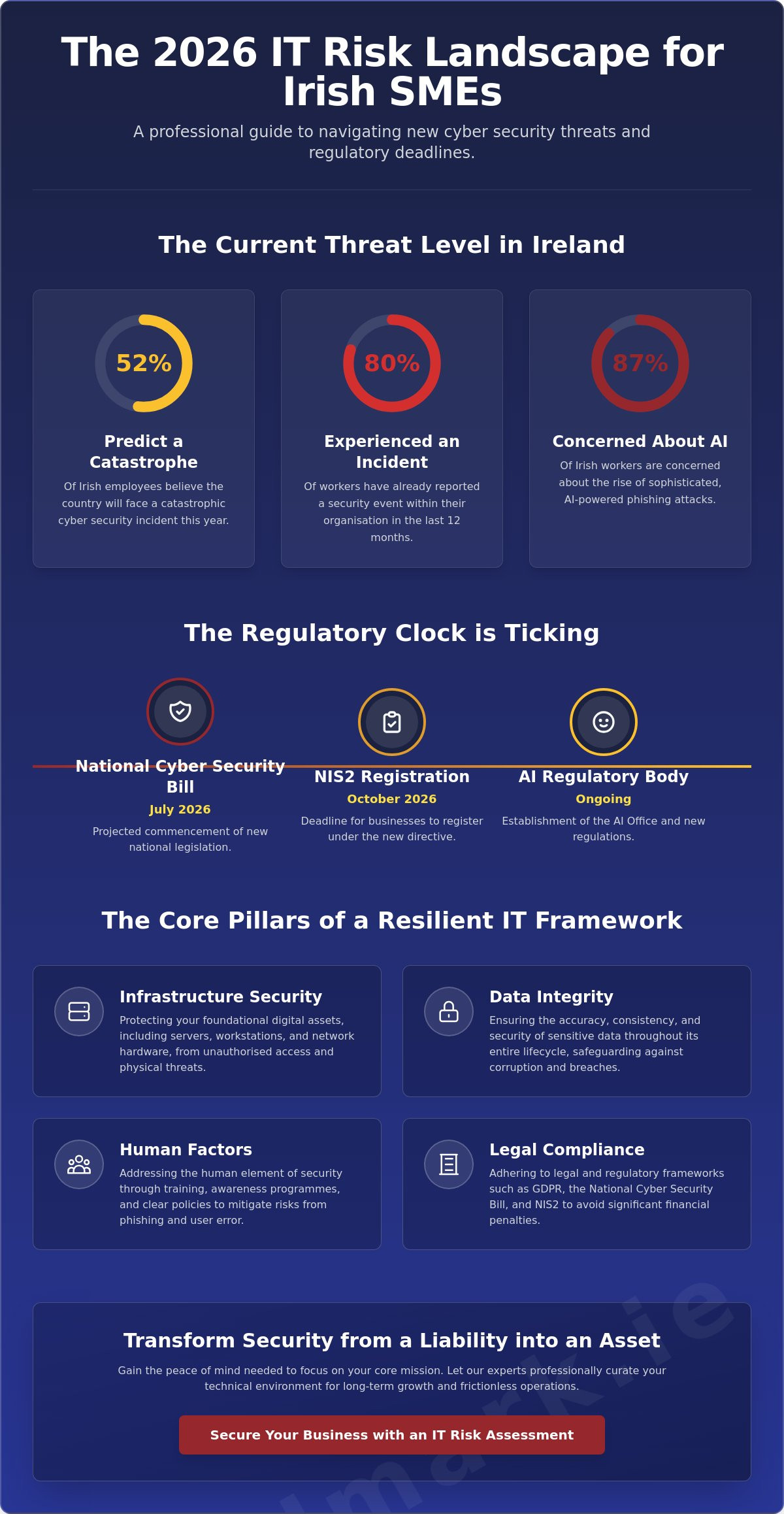
Over 52% of Irish employees believe the country will face a catastrophic cybersecurity incident this year. With 80% of workers already reporting a security event in the past 12 months, the risks to your business continuity are no longer a distant concern; they’re a pressing reality for every growing firm. You likely understand the weight of these figures, perhaps feeling a sense of anxiety regarding GDPR compliance or the upcoming July 2026 commencement of the National Cyber Security Bill. It’s difficult to find clarity amongst competing technical priorities, yet your success depends on a foundation of stability and trust.
This guide provides a definitive IT risk assessment checklist for Irish SMEs, offering a curated framework to identify vulnerabilities and ensure your operations remain frictionless. We’ll provide a professional standard of IT governance that replaces technical confusion with a clear, strategic roadmap. By following this structure, you’ll gain the peace of mind needed to focus on your core mission, whilst ensuring your business is fully prepared for the October 2026 NIS2 registration deadline and the new AI regulatory requirements. We’ll explore how to transform your security from a source of stress into a sophisticated asset that nurtures long-term growth.
Key Takeaways
- Discover why a modern risk assessment serves as a proactive health check, ensuring your professional environment remains a sanctuary of productivity and calm efficiency.
- Understand the critical timelines for the 2026 National Cyber Security Bill and the AI Office establishment to protect your firm from significant regulatory penalties.
- Utilise our definitive IT risk assessment checklist for Irish SMEs to conduct a thorough audit of your digital foundations and existing cyber security protocols.
- Learn how to prioritise vulnerabilities within your network infrastructure to guarantee seamless business continuity and safeguard the integrity of your sensitive data.
- Explore how professional IT consultancy and managed support can elevate your business resilience, allowing you to focus on growth whilst your technical environment is expertly curated.
Table of Contents
Understanding IT Risk Assessment for the Modern Irish SME
A sophisticated Risk assessment is far more than a technical obligation; it’s a proactive health check for your business stability. In the same way a master architect inspects the foundations of a historic Dublin townhouse, an IT risk assessment examines the digital structures supporting your daily operations. It ensures that your growth isn’t just rapid, but also sustainable and secure against the evolving threats of the modern era. By identifying potential points of friction before they manifest as crises, you maintain a professional standard of governance that mirrors the calm efficiency of a high-end workspace.
The year 2026 has introduced a more nuanced landscape for Irish businesses. We’ve moved beyond the era of reactive fixing, where IT was merely something to be "repaired" when it failed. Today, success requires strategic prevention. With the projected July 2026 commencement of the National Cyber Security Bill and the establishment of the AI Office of Ireland, the regulatory environment has become more intricate. An IT risk assessment checklist for Irish SMEs is now a vital tool for staying ahead of these changes, ensuring your firm isn’t just compliant, but truly resilient.
To better understand this concept and how it applies to your organisation, watch this helpful video:
The Business Value of Digital Resilience
Establishing a secure digital environment fosters a sense of prestige and reliability that clients deeply value. When your partners know their data is handled with the utmost care, it strengthens the bond of trust that is so essential in the Irish market. Robust risk management isn’t just a cost centre; it’s a direct investment in long-term profit protection. By avoiding the disruption of a breach, you preserve your reputation and maintain the frictionless experience your clients expect. In a competitive landscape, your commitment to cyber security becomes a distinct advantage that sets your firm apart as a leader in professional excellence.
Identifying Your Core Digital Assets
Before you can protect your business, you must understand exactly what constitutes your digital estate. This involves categorising your hardware, such as servers and workstations, alongside your vital cloud-based software and sensitive datasets. For an Irish SME, critical assets are those digital components whose failure or compromise would immediately halt revenue generation or violate legal compliance obligations. Knowing exactly where your data lives, whether it’s stored on-premise in a local data centre or hosted within a global cloud infrastructure, is the first step in creating a tailored security strategy. This clarity allows you to allocate resources effectively, ensuring that every element of your operation is nurtured and protected.
The Core Pillars of an Effective IT Risk Framework
Building a resilient business requires more than just high-end aesthetic appeal; it demands a robust digital foundation that functions with grace and reliability. An effective IT risk assessment checklist for Irish SMEs must address four essential pillars: infrastructure security, data integrity, human factors, and legal compliance. These pillars work in harmony to create a frictionless environment where your team can thrive without the shadow of hidden vulnerabilities. By viewing security through this holistic lens, you transform technical necessity into a professional standard of excellence.
In 2026, these pillars must also account for the rise of AI-driven threats. Research shows that 87% of Irish workers are concerned about AI-powered phishing attacks, highlighting a significant shift in the risk landscape. To gauge your current standing, utilising a Cyber Resilience risk assessment tool can provide an excellent baseline for your strategic planning. This proactive approach ensures your business continuity is never left to chance, allowing you to maintain the calm efficiency your clients expect.
Infrastructure and Network Vulnerabilities
Your network is the digital perimeter of your professional home. A secure foundation begins with premium business broadband Ireland services that offer built-in protection against external intrusions. As hybrid working becomes a permanent feature of the Irish corporate landscape, managing remote access points is critical. Legacy hardware often acts as a silent anchor, slowing down your operations and creating security gaps that modern software cannot always bridge. Evaluating the age and reliability of your physical equipment is a vital step in maintaining a high-performance environment.
Data Governance and GDPR Alignment
Data integrity ensures your most valuable information remains private, accurate, and accessible to those who need it. In 2026, data encryption is a non-negotiable standard for any business seeking to maintain its prestige. You must also implement strict access controls; it’s essential to define who can see specific information and why. This level of curated access prevents internal accidents and limits the impact of external threats. Managing third-party software providers is equally important, as their security posture directly reflects your own. This is particularly true when integrating AI & Business Automation tools, which require a refined approach to data handling to ensure proprietary information remains secure. If you’re looking to refine your digital governance, our IT consultancy services can help align your technology with your business values.
Compliance remains the final, vital pillar. With GDPR fines potentially reaching €20 million, and the new Regulation of Artificial Intelligence Bill 2026 coming into full effect, the stakes have never been higher. Integrating these legal requirements into your IT risk assessment checklist for Irish SMEs isn’t just about avoiding penalties. It’s about demonstrating a commitment to international standards of professional integrity that resonates with your high-achieving clientele.
The Definitive IT Risk Assessment Checklist for 2026
Actionable clarity is the hallmark of a well-run firm. Transitioning from a high-level framework to a practical IT risk assessment checklist for Irish SMEs allows you to systematically remove friction from your digital environment. This process is not merely a box-ticking exercise; it’s a curated audit of your business’s health and resilience. By following these five strategic steps, you ensure your organisation remains a sanctuary of productivity, even when faced with external volatility.
-
Step 1: Conduct a full audit of all connected devices and software. You cannot protect what you don’t recognise. Document every workstation, mobile device, and cloud application that touches your network.
-
Step 2: Evaluate current cyber security protocols and software updates. Ensure your defensive layers are contemporary and capable of meeting the sophisticated threats of 2026.
-
Step 3: Review user permissions and enforce Multi-Factor Authentication (MFA). Limit access to sensitive data on a "need-to-know" basis to minimise internal exposure.
-
Step 4: Test your backup systems and business continuity response time. Verify that your data recovery processes are not just functional, but fast enough to prevent operational paralysis.
-
Step 5: Assess the impact of new technologies like AI and business automation. Evaluate how these tools interact with your data and whether they introduce new entry points for risk.
Technical Controls and Cyber Hygiene
A pristine digital environment requires constant attention to detail. Unpatched software and "end-of-life" systems are the digital equivalent of an unlocked door in a prestigious office. These vulnerabilities are often the primary targets for automated exploits. Multi-Factor Authentication (MFA) serves as the single most effective deterrent against unauthorised access, creating an essential layer of friction for intruders whilst remaining effortless for your team. Recent research into the Development of a cyber risk assessment tool for Irish small business owners underscores the necessity of these granular controls. For many Dublin firms, this also means refining Microsoft 365 configurations to ensure that default settings aren’t leaving your collaboration suites exposed.
Operational Continuity and Recovery
True resilience is measured by how gracefully you recover from a disruption. It’s vital to define your Recovery Time Objective (RTO), which is the maximum acceptable time your critical systems can be offline before the business suffers significant harm. Whilst a simple backup copies your data, a true Business Continuity plan ensures the entire environment can be restored in a separate, secure location. We recommend testing "what-if" scenarios for common Irish disruptions, such as regional power outages or localised connectivity failures. This level of preparation provides the quiet confidence that your business will remain standing, regardless of the challenges the year may bring.
Turning Assessment into Action: Strategic Implementation
Identifying risks is the first step; resolving them is where true leadership emerges. Your IT risk assessment checklist for Irish SMEs should act as a living blueprint rather than a static document. Prioritising these findings based on their potential impact on your operations ensures that resources are directed where they provide the most value. High-risk vulnerabilities that could halt business continuity deserve immediate attention, whilst lower-impact items can be scheduled for phased improvement. This structured approach mirrors the physical organisation of a premium workspace, where every detail is intentional and every system serves a purpose.
A meticulously maintained Risk Register allows your strategy to evolve alongside your growth. It provides a professional standard of oversight, ensuring no vulnerability is forgotten as your firm scales. Allocating your budget requires a balanced touch. You must weigh the necessity of high-performance hardware against the agility of modern software and the critical need for staff education. Partnering with an expert through IT consultancy Dublin can help professionalise this transition, turning raw data into a sophisticated strategy that nurtures your long-term success.
The Importance of Regular Review Cycles
In the fast-paced market of 2026, an annual review is no longer sufficient. The establishment of the AI Office of Ireland in August 2026 and the July commencement of the National Cyber Security Bill necessitate a more agile approach. You should set triggers for mid-year reviews, such as the onboarding of new senior staff or the implementation of new AI & Business Automation tools. Automating parts of the risk monitoring process can provide real-time peace of mind, allowing you to maintain a steady, composed rhythm of work without constant manual intervention.
Fostering a Culture of Security Awareness
Security is a shared responsibility that thrives on community and engagement. Move beyond "tick-box" training and foster genuine employee involvement by identifying "security champions" within different departments. These individuals act as dedicated strategic allies, promoting best practices and reporting anomalies before they escalate. When communicating risks to non-technical stakeholders, focus on the emotional and operational outcomes: the preservation of prestige, the protection of client trust, and the assurance of a frictionless workspace. If you’re ready to transform your assessment into a resilient action plan, explore our managed IT support solutions to ensure your business remains impeccably organised and secure.
Elevating Your Business Resilience with Landmark Technologies
Landmark Technologies acts as a refined host for your digital infrastructure. We don’t merely provide technical solutions; we curate an environment where success is nurtured and professional excellence is the standard. A professional partnership is the ultimate form of risk mitigation. It transforms the IT risk assessment checklist for Irish SMEs from a periodic obligation into a sophisticated, ongoing strategy that protects your firm’s prestige. By positioning ourselves as your dedicated strategic ally, we ensure your technical foundations are as impeccably organised as a high-end office suite.
Our managed IT support model is designed specifically for high-achieving professionals who require stability and permanence. We understand that your business continuity is a reflection of your commitment to your clients. Integrating AI & business automation into your operations shouldn’t be a source of anxiety. Instead, we frame these innovations as a secure growth path, allowing you to leverage modern efficiency whilst maintaining the highest standards of cyber security. This holistic approach ensures that your digital estate remains a sanctuary of productivity, free from the friction of technical disruptions.
Bespoke Solutions for Growing Irish Firms
We believe that technology should adapt to your ambitions, not the other way around. Our network infrastructure solutions are tailored to match the specific trajectory of your firm, providing the high-quality foundations necessary for long-term growth. The peace of mind provided by proactive, 24/7 monitoring allows your leadership team to focus on high-level goals without the distraction of hidden vulnerabilities. Landmark’s managed services provide a frictionless experience that mirrors the physical organization of a premier workspace, where every detail is attended to with quiet confidence and craftsmanship. This level of care ensures that your cloud solutions and unified communications work in perfect harmony, supporting your team’s best work.
Your Next Steps Toward a Secure Future
Transitioning from a DIY IT risk assessment checklist for Irish SMEs to a professionally managed roadmap is a significant mark of business maturity. It signals to your stakeholders that you value data integrity and operational resilience as core pillars of your brand. We invite you to experience a higher standard of IT support, where technical authority meets warm hospitality. The move toward a more secure future begins with a comprehensive audit of your current systems. By engaging with our IT consultancy services, you gain a clear, strategic roadmap that replaces confusion with professional certainty. Let us help you navigate the complexities of the 2026 regulatory landscape with the grace and efficiency your business deserves.
Securing Your Legacy Through Professional Digital Governance
Navigating the complexities of the 2026 regulatory landscape requires more than just technical awareness; it demands a commitment to professional excellence and operational stability. By moving beyond a simple IT risk assessment checklist for Irish SMEs, you transform your digital environment into a sanctuary of productivity and trust. You’ve explored how to identify core assets, address infrastructure vulnerabilities, and foster a culture of security awareness that protects your firm’s prestige. The transition from a manual checklist to a curated strategic roadmap ensures your business continuity remains frictionless and secure.
Founded in 2004, Landmark Technologies provides specialised cyber security and managed IT expertise that nurtures the growth of high-achieving organisations. Our dedicated Irish helpdesk and technical support team act as your strategic allies, ensuring every detail of your network is impeccably organised. We invite you to secure your business future with a professional IT audit from Landmark Technologies. Embracing this higher standard of IT governance allows you to lead with confidence, whilst we provide the calm efficiency needed to sustain your long-term success.
Frequently Asked Questions
What is the first step in an IT risk assessment for an Irish SME?
The first step is conducting a comprehensive audit of all digital and physical assets within your organisation. This involves documenting every workstation, mobile device, server, and cloud application that interacts with your sensitive information. By establishing this clear baseline, you gain the visibility needed to identify where vulnerabilities might hide, ensuring your security strategy is built on a foundation of total clarity.
How often should a small business in Ireland perform an IT audit?
You should perform a full IT audit at least once a year, though the rapid technological shifts of 2026 suggest more frequent reviews. High-achieving firms often adopt a quarterly approach or trigger a review whenever significant changes occur, such as onboarding new senior staff or implementing new AI & business automation tools. This steady rhythm ensures your defences remain contemporary and aligned with your business ambitions.
Are Irish SMEs legally required to conduct IT risk assessments under GDPR?
Yes, Irish SMEs are legally required to manage technical risk under the GDPR, specifically through Article 32 which mandates appropriate technical and organisational measures to protect data. With the July 2026 commencement of the National Cyber Security Bill, many firms will also face new obligations under the NIS2 framework. Utilising an IT risk assessment checklist for Irish SMEs helps demonstrate your commitment to these professional standards of governance and legal compliance.
What are the most common IT risks facing businesses in Ireland today?
AI-powered phishing attacks and ransomware remain the most prevalent threats facing Irish businesses today. Research indicates that 87% of workers are concerned about cybercriminals using AI to steal company data, highlighting a shift toward more sophisticated, automated scams. Additionally, supply chain vulnerabilities have become a critical focus, as the security posture of your partners can directly impact your own business continuity and professional reputation.
Can I perform an IT risk assessment myself or do I need a consultant?
Whilst you can begin the process using a high-quality internal checklist, a professional IT consultancy provides a level of depth and expertise that is difficult to replicate. A consultant acts as a dedicated strategic ally, identifying subtle vulnerabilities that automated tools might overlook. This professional partnership ensures your risk mitigation strategy is both sophisticated and impeccably organised, providing a higher standard of protection than a DIY approach.
What is the difference between a vulnerability scan and a full risk assessment?
A vulnerability scan is an automated technical process that identifies known security holes, whereas a full risk assessment is a holistic strategic review. The assessment examines how technical gaps interact with your business processes, employee behaviour, and legal obligations. It provides the strategic context behind the data, offering a curated roadmap for long-term resilience rather than just a list of software patches.
How much does a professional IT risk assessment typically cost for an SME?
The investment required for a professional assessment varies depending on the complexity of your network infrastructure and the specific regulatory requirements of your industry. Factors such as the number of remote access points, the volume of sensitive data, and your reliance on cloud solutions will influence the overall scope. It’s best to discuss your unique organisational needs with a specialist to receive a proposal tailored to your firm’s specific scale.
What happens if our business fails to address identified IT risks?
Failing to address identified risks exposes your firm to catastrophic operational downtime, significant GDPR fines, and irreparable reputational damage. Beyond the financial impact, which can reach 4% of annual turnover for data breaches, a security failure disrupts the frictionless experience your clients expect. Proactive mitigation is the only way to ensure the permanence and stability of your professional legacy in an increasingly volatile digital landscape.