
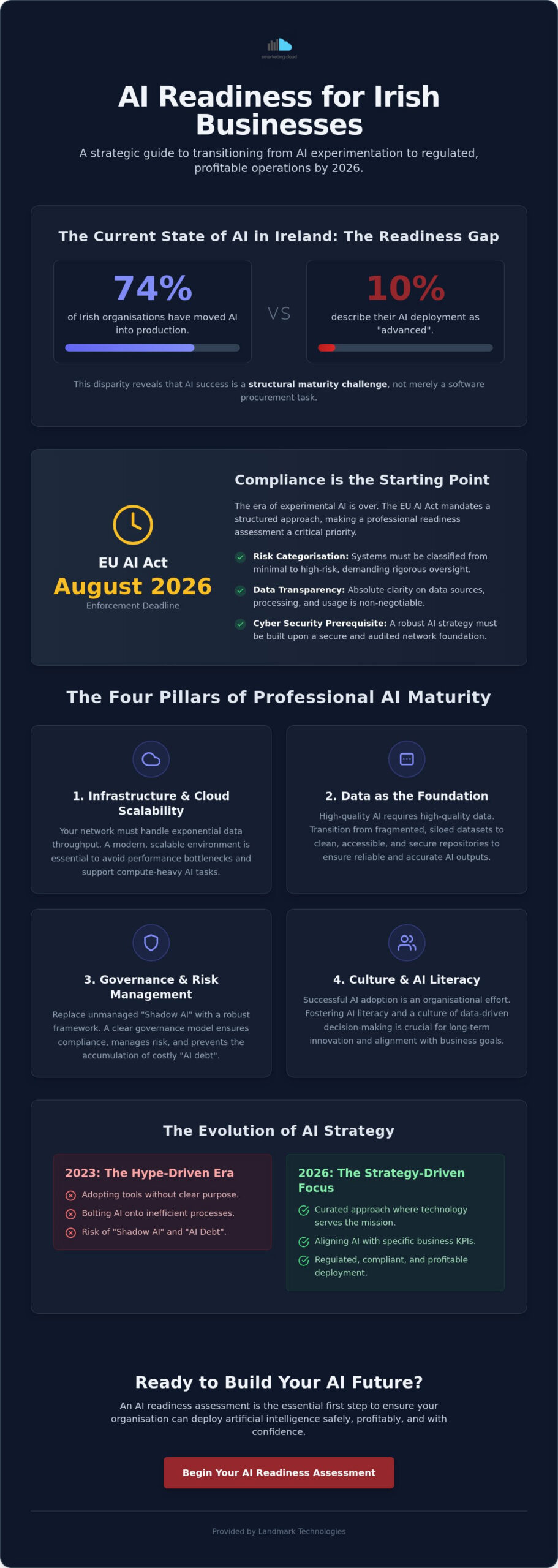
Did you know that 74% of Irish organisations have already moved AI into production, yet only 10% describe their deployment as advanced? This disparity reveals a fundamental truth for the modern leader: AI success is a structural maturity challenge, not a software procurement task. If you’re currently considering an AI readiness assessment for Irish business, the objective is no longer just to experiment. It’s about scaling safely and effectively whilst ensuring your organisation remains a centre of excellence and professional poise.
You likely recognise the pressure of the EU AI Act’s August 2026 enforcement deadline, perhaps whilst wrestling with fragmented data or the mandatory AI literacy requirements that took effect in 2025. It’s natural to seek a path that feels both secure and inspiring. This article promises a clear framework to evaluate your infrastructure, refine your data governance, and align your technology with your most ambitious commercial goals. We’ll preview a strategic roadmap that transforms your data into an AI-ready asset, allowing you to move forward with the quiet confidence that defines a truly prepared enterprise.
Key Takeaways
- Learn why a professional AI readiness assessment for Irish business is the essential first step to transition from experimental tools to a regulated, profitable operation.
- Discover how to transform fragmented data into high-quality, secure assets that serve as the foundation for your organisation’s infrastructure and cloud scalability.
- Uncover the hidden risks of Shadow AI and how to replace unmanaged employee tools with a robust governance framework that ensures long-term compliance.
- Follow a structured five-step roadmap to audit your current IT environment and identify high-value use cases that offer the most immediate return on investment.
- Understand why AI is not a “set and forget” solution and how continuous infrastructure tuning ensures your technology remains optimised and aligned with your business goals.
What is an AI Readiness Assessment for Irish Business in 2026?
In the high-end landscape of Irish commerce, success is rarely accidental. It’s the result of meticulous preparation and a commitment to excellence. An AI readiness assessment for Irish business is the definitive measure of an organisation’s capacity to deploy artificial intelligence both safely and profitably. It moves beyond the superficial lure of new gadgets to examine the core of your operation, ensuring your infrastructure is as refined as the services you provide.
By 2026, the era of experimental AI has concluded. We’ve entered a phase of regulated, operational AI where the stakes are significantly higher than they were just two years ago. A formal assessment acts as your strategic safeguard, ensuring you don’t accumulate “AI debt” through poorly integrated systems or non-compliant data practices. This debt is often more costly to resolve than the initial investment itself. With Ireland’s national AI Office set to open in August 2026, the infrastructure for oversight is already maturing, making a professional evaluation a critical priority for any board of directors seeking a frictionless transition.
The Evolution of AI Readiness
The “hype-driven” frenzy of 2023, where businesses rushed to adopt tools without clear purpose, has evolved into the “strategy-driven” focus of 2026. Bolting AI onto broken or inefficient processes only accelerates failure; it doesn’t solve it. True readiness requires a curated approach where technology serves the mission. This means aligning AI with specific Irish business KPIs, such as enhancing the bespoke service levels expected in Dublin’s legal sector or driving efficiency in Cork’s pharmaceutical hubs. It’s about prestige and performance working in tandem to create a stable, innovative environment for growth.
Regulatory Compliance as a Starting Point
The EU AI Act is the primary catalyst for this shift. With enforcement beginning in earnest on August 2, 2026, compliance is no longer optional. The Act categorises systems by risk, from minimal to high-risk, demanding absolute data transparency and rigorous bias monitoring. Because of these requirements, a comprehensive readiness plan now requires a cyber security audit as a fundamental prerequisite. You cannot build a sophisticated AI strategy on a vulnerable network. Security is the bedrock of trust, and trust is the currency of the modern professional environment. By addressing these regulatory hurdles early, you ensure your organisation remains a leader amongst its peers, protected from the reputational risks of non-compliance.
The Four Pillars of Professional AI Maturity
True sophistication in technology isn’t found in the tools themselves, but in the structural integrity of the organisation using them. To move beyond mere experimentation, a comprehensive AI readiness assessment for Irish business must examine four distinct pillars: Infrastructure, Data, Governance, and Culture. These elements function like the architecture of a heritage building; they provide the strength and character that allow for modern innovation without compromising stability. Without these pillars, even the most advanced algorithms will fail to deliver a premium return on investment.
Infrastructure and Cloud Scalability
Your network is the nervous system of your AI strategy. As you integrate more complex models, the demand for data throughput increases exponentially. It’s essential to evaluate whether your current network infrastructure can handle these loads without friction. Many businesses find that legacy hardware acts as a significant bottleneck, unable to process the compute-heavy tasks required for real-time automation. A hybrid cloud environment often provides the most elegant solution, offering the scalability of the cloud whilst maintaining the security of on-premise systems. This balance ensures your operations remain fluid and responsive, even as your AI needs grow.
Data as the Foundation
The principle of “garbage in, garbage out” has never been more relevant than in the age of Large Language Models (LLMs). If your data is fragmented or poor-quality, your AI outputs will be equally unreliable. A professional assessment focuses on moving your organisation from siloed, messy datasets to clean, accessible, and secure repositories. This process involves centralising your information whilst maintaining strict access controls to ensure that only the right people see the right data. In addition, data anonymisation techniques are no longer just a “best practice”; they’re a legal necessity under the EU AI Act for compliant AI training. Ensuring your data is “AI-ready” is the most significant step you can take towards long-term success.
Beyond the technical, the remaining pillars of Governance and Culture address the human element. Governance involves creating clear policies that dictate how AI is used, preventing the 39% of “shadow AI” usage reported amongst Irish employees by Microsoft and LinkedIn research. Culture, meanwhile, focuses on preparing your workforce for augmented workflows. It’s about fostering a sense of calm efficiency where staff see AI as a dedicated ally rather than a threat. When these four pillars are aligned, your business doesn’t just use AI; it embodies a culture of innovation and prestige.
Identifying the Readiness Gap: Shadow AI vs Governance
A frequent objection raised by leadership teams is the assumption that because their staff are already experimenting with tools, the organisation is “AI-ready.” This is rarely the case. In reality, widespread adoption without structure often points to a significant readiness gap. An AI readiness assessment for Irish business typically reveals that this grassroots usage is actually “Shadow AI”—unmanaged, unvetted, and ultimately risky. True maturity requires moving from accidental usage to intentional governance, transforming a chaotic digital environment into a centre of calm efficiency.
Governance shouldn’t be viewed as a barrier to innovation. Instead, think of it as the refined parameters that allow your team to perform at their best. Just as a well-designed workspace provides the boundaries that nurture focus, a robust governance framework provides the safety net that allows for bold, strategic moves. It ensures that every AI interaction aligns with your brand’s high standards and regulatory obligations under the EU AI Act. It’s about creating a secure environment where success is nurtured through clarity and control.
The Risks of Unmanaged AI
The danger of Shadow AI lies in its invisibility. When employees feed sensitive client information or proprietary strategies into public models, they inadvertently bypass established cyber security protocols. This creates a high risk of intellectual property loss, which can be devastating in Ireland’s competitive corporate landscape. According to research from 2026, 39% of Irish employees admit to using unapproved AI tools, a figure that often rises even in organisations that have explicitly prohibited them. To identify if your firm is at risk, consider this brief checklist:
- Are staff using personal accounts for professional AI tasks?
- Does your IT department lack a central register of approved AI subscriptions?
- Is there a noticeable inconsistency in the quality of AI-generated outputs between departments?
- Have you noticed unauthorised AI-powered browser extensions in use on company devices?
Establishing an AI Governance Framework
Closing the readiness gap starts with defining clear roles. Every organisation needs an individual or committee responsible for AI oversight to ensure accountability. This leadership ensures that the use of technology remains a curated experience rather than a free-for-all. A cornerstone of this approach is the creation of an “Acceptable Use Policy.” This document should clearly outline which tools are permitted, what data can be shared, and the mandatory AI literacy standards required by law since February 2025. Continuous monitoring of AI outputs for accuracy and bias is also essential, ensuring your organisation’s reputation for excellence remains untarnished as you scale your automation efforts.
The AI Readiness Roadmap: 5 Essential Steps
Moving from theory to execution requires a structured, well-oiled process. An AI readiness assessment for Irish business isn’t a one-off event; it’s the start of a clear, five-step journey towards operational excellence. This roadmap ensures your transition is as seamless as the service your clients have come to expect, grounding your innovation in a sense of stability and permanence.
- The Infrastructure and Data Audit: This initial deep dive validates the pillars we discussed earlier, ensuring your network can sustain the weight of modern automation.
- Use Case Definition: Identify specific areas where AI can provide an immediate return on investment, moving beyond the noise of the market to find real value.
- Regulatory Gap Analysis: With the EU AI Act’s enforcement arriving on August 2, 2026, this step ensures every process meets the highest standards of transparency.
- Implementation and Training: Develop a plan that addresses the mandatory AI literacy requirements whilst nurturing a culture of quiet confidence amongst your staff.
- Executive Alignment: Secure the leadership buy-in needed to form a cross-functional task force, ensuring AI isn’t siloed within the IT department.
Prioritising High-Value Use Cases
It’s easy to be distracted by “shiny objects”, tools that look impressive but offer little commercial value. A strategic approach focuses on “low-risk, high-impact” automation. For example, using AI to refine client onboarding or automate routine financial reporting provides immediate efficiency gains without the complexity of high-risk systems. To measure the success of an AI pilot, look for tangible improvements in time-to-delivery or staff satisfaction scores. Success breeds confidence, allowing you to scale with the grace and poise of a market leader.
The Role of Bespoke IT Consultancy
Off-the-shelf readiness templates often fail Irish businesses because they don’t account for the unique heritage and specific regulatory climate of our local market. This is where strategic IT consultancy becomes invaluable. A tailored roadmap integrates AI strategy into your broader digital transformation goals, ensuring technology serves your brand rather than the other way around. If you’re ready to define your path, you can explore our AI and Business Automation solutions to begin your assessment with a dedicated strategic ally.
Strategic Success: Why Managed IT is the Key to AI Longevity
An AI readiness assessment for Irish business is the essential first step, but it’s not the destination. Artificial Intelligence is a living technology; it requires constant tuning and a dedicated ally to ensure it remains aligned with your original vision. Unlike traditional software, AI systems can experience “model drift” where their accuracy degrades over time as they encounter new data. Without proactive oversight, a once-sophisticated tool can quickly become a liability. Managed IT support provides the steady hand needed to maintain the quiet efficiency and high standards your organisation represents.
Managed IT providers ensure that the underlying infrastructure, the cloud scalability and network strength we discussed earlier, remains optimised for the task at hand. AI-driven business processes often operate around the clock, demanding a level of monitoring that internal teams may find taxing. By outsourcing this technical burden, you ensure your automation remains frictionless and secure. Landmark Technologies positions itself as the partner that bridges the gap between that initial diagnostic and daily operation, offering a curated experience that allows you to focus on high-level strategy whilst we handle the technical intricacies.
Proactive Maintenance for AI Systems
Model drift isn’t the only concern. The security burden of AI integrations is significant, as every new connection point must be shielded against emerging threats. Proactive maintenance includes regular technical health checks and the constant refinement of security protocols to protect your proprietary data. Having access to a dedicated helpdesk for AI-related workflow issues is equally vital. It ensures that when your team encounters a hurdle, they receive the same level of premium, attentive service they provide to your own clients. This stability is what allows a growing business to scale without the fear of technical debt.
Partnering for the Future
Choosing a long-term strategic partner is about more than just technical support; it’s about reliability and prestige. As your business grows and the 2026 regulatory environment continues to evolve, having a dedicated ally ensures you’re never caught unprepared by new enforcement rules from the national AI Office. We invite you to move beyond the assessment phase and into a future defined by innovation and stability. Organise your AI readiness assessment with Landmark Technologies today and secure the longevity of your digital transformation.
Securing Your Organisation’s Digital Legacy
The transition to artificial intelligence is a journey that rewards the meticulous and the prepared. By focusing on the four pillars of maturity and addressing the risks of Shadow AI, you position your organisation as a leader in the refined 2026 landscape. Success isn’t merely about adopting the latest tools; it’s about fostering a culture where innovation and stability coexist. A professional AI readiness assessment for Irish business provides the clarity needed to ensure your infrastructure, data, and governance are fully aligned with the high standards of the EU AI Act.
Since 2004, Landmark Technologies has served as a dedicated strategic ally for enterprises across the country. With over two decades of expertise, we specialise in AI and Business Automation, providing comprehensive support that spans from initial network audits to complex 2026 regulatory compliance. We invite you to book your AI readiness assessment with Landmark Technologies to begin your transformation with a partner committed to your long-term success. Together, we can build a future where your technology is as sophisticated and reliable as the service you provide. Your path to a frictionless, AI-driven operation starts here.
Frequently Asked Questions
What is the first step in an AI readiness assessment for an Irish business?
The first step is a meticulous audit of your current IT infrastructure and data governance protocols. This initial phase of an AI readiness assessment for Irish business identifies whether your existing systems can handle the increased throughput of modern automation. It creates a stable foundation, ensuring that any future technological additions feel like a natural extension of your professional environment rather than a disruptive bolt-on.
How long does a typical AI readiness assessment take to complete?
A typical assessment usually requires four to eight weeks to complete, depending on the scale of your operations. This timeframe allows for a deep dive into departmental workflows and a thorough gap analysis against the EU AI Act’s 2026 requirements. It’s a composed process that prioritises accuracy over haste, mirroring the calm efficiency you expect in every other area of your business.
Is my small business too small to need an AI readiness assessment?
No organisation is too small for a strategic evaluation, as the regulatory requirements of the EU AI Act apply to businesses of all sizes. For smaller firms, an assessment is particularly valuable for preventing wasted investment in tools that don’t align with specific commercial goals. It ensures your growth is nurtured through smart, compliant choices rather than trial and error.
How does the EU AI Act 2026 affect my company’s AI adoption?
The EU AI Act introduces mandatory transparency and risk-management obligations that become fully enforceable in August 2026. Your adoption strategy must now account for these legal hurdles, particularly concerning high-risk AI systems. By aligning your technology with these standards early, you maintain your reputation for excellence and avoid the significant penalties associated with non-compliance.
Can I perform an AI readiness assessment internally without outside help?
Whilst internal teams possess deep cultural knowledge, a professional AI readiness assessment for Irish business often requires the specialised perspective of an external ally. Outside experts bring a refined understanding of the 2026 regulatory climate and can identify “Shadow AI” risks that internal audits might overlook. This external validation provides a level of prestige and security that is difficult to achieve alone.
What are the most common “readiness gaps” found in Irish companies?
The most frequent gaps include fragmented data silos that prevent AI from accessing clean information and unmanaged “Shadow AI” usage by staff. Many Irish firms also find they haven’t yet met the mandatory AI literacy standards that took effect in early 2025. Addressing these gaps is essential for creating a frictionless experience as you scale your digital capabilities.
Will an AI readiness assessment help me calculate my potential ROI?
Identifying potential return on investment is a fundamental component of the assessment process. By distinguishing between “shiny objects” and high-value use cases, the framework helps you prioritise projects that offer the quickest ROI. This ensures your technology budget is used to enhance both your operational efficiency and your brand’s prestige.
How often should we re-evaluate our AI readiness?
We recommend a full re-evaluation at least once a year or following any significant change in EU regulatory policy. With the national AI Office opening in August 2026, the pace of oversight is expected to increase. Regular health checks ensure your AI systems remain optimised, secure, and perfectly aligned with your evolving business objectives.