
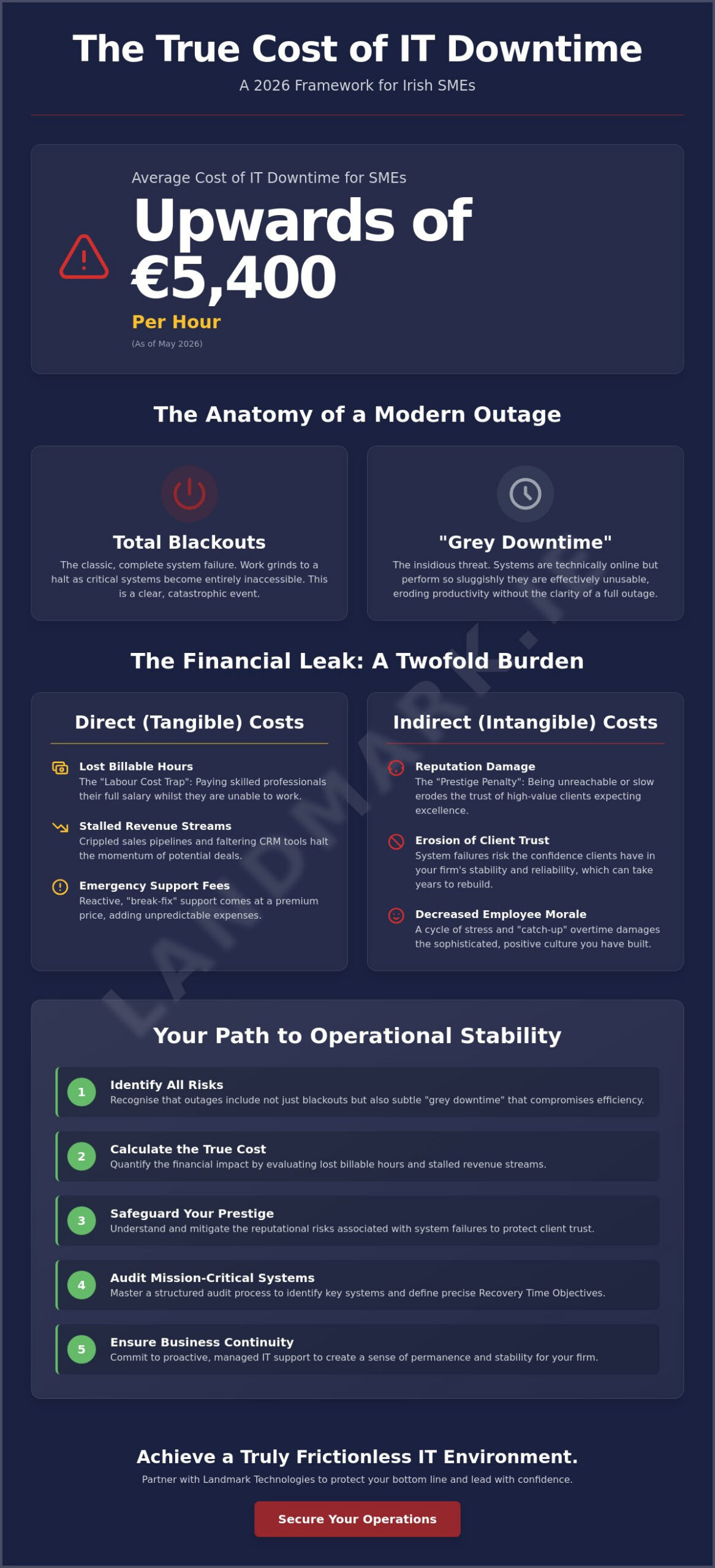
Did you know that as of May 2026, the average cost of IT downtime for SMEs has risen to upwards of €5,400 per hour? For a high-achieving business, this isn’t merely a technical glitch; it’s a direct assault on your hard-earned prestige and your team’s billable hours. When your systems falter, the quiet efficiency of your professional environment evaporates, replaced by the mounting pressure of unpredictable expenses and the quiet concern of your most valued clients.
You likely agree that a workspace should be an environment where success is nurtured, not hindered by technical friction. When your digital infrastructure falters, it doesn’t just halt work; it risks the trust you’ve built with prestigious clients who expect nothing less than excellence. This article promises to help you discover how to calculate and mitigate the financial and reputational impact of system outages whilst protecting your bottom line. We will explore the tangible ROI of proactive IT management and outline the steps to achieving a truly frictionless IT environment, ensuring you can lead with confidence and permanent stability.
Key Takeaways
- Recognise that modern outages aren’t always total blackouts and understand how “grey downtime” subtly compromises your team’s efficiency.
- Learn how to calculate the true cost of IT downtime for Dublin SMEs by evaluating lost billable hours and stalled revenue streams.
- Uncover the reputational risks associated with system failures and how to safeguard the prestige you’ve built with your clientele.
- Master a structured audit process to identify mission-critical systems and define precise Recovery Time Objectives for your business.
- Discover how a commitment to business continuity and managed support creates a sense of stability and permanence for your growing firm.
The Anatomy of an Outage: Why the Cost of IT Downtime for Dublin SMEs is Rising
In the context of the modern, interconnected Irish workplace, an outage is rarely as simple as a flickering light or a blank screen. It’s a profound disruption to the rhythm of professional life. Whilst we once viewed IT downtime as a total system failure, the reality in 2026 is far more nuanced. We now frequently face “grey downtime,” where systems are technically active but perform so sluggishly that they become effectively unusable for high-level tasks. These micro-outages are particularly insidious because they erode productivity without providing the clarity of a complete shutdown.
Understanding the true cost of IT downtime for Dublin SMEs requires looking far beyond the physical server room. The shift from local hardware failures to complex cloud-service disruptions means that a single point of failure in a remote data centre can ripple through your entire organisation in seconds. This erosion of the frictionless experience you promise your high-end clients is where the most significant damage occurs. When your digital tools fail to perform with grace and speed, the sophisticated atmosphere you’ve cultivated for your business begins to fray.
To better understand the nuances of these disruptions, watch this helpful video on the real impact of unplanned outages:
The 2026 Digital Landscape for Irish Firms
The current reliance on AI-driven business automation has fundamentally transformed how Irish firms operate, yet it has also introduced intricate new vulnerabilities. A minor connectivity hiccup or a synchronisation error can halt an entire suite of unified communications, leaving your team unable to collaborate and your clients unable to reach their trusted advisors. Amongst prestigious professional sectors in Dublin, an “always-on” digital environment is no longer a luxury; it’s the baseline expectation for any firm that values its reputation and operational integrity.
Direct vs. Indirect Costs
The financial impact of an outage is a twofold burden on any growing business. You face immediate, tangible leaks such as lost billable hours and the sudden requirement for emergency technical intervention. However, the indirect costs are often far more damaging to your long-term health. The “prestige penalty” of being unreachable or slow to respond during a critical client interaction can result in an erosion of trust that takes years to rebuild. Ultimately, IT downtime is a compound loss of productivity, trust, and future revenue.
Calculating the Financial Leak: Tangible Losses and Billable Hours
Quantifying the cost of IT downtime for Dublin SMEs requires a cold, analytical look at the payroll. The “Labour Cost” trap is the most immediate drain; it’s the reality of paying talented professionals their full salaries whilst they sit idle before unresponsive screens. This isn’t just about a total blackout. In the 2026 environment, where we rely heavily on integrated cybersecurity frameworks for SMEs to keep our AI-driven workflows secure, even a partial slowdown can cripple a sales pipeline. When your CRM or automated outreach tools stutter, the loss isn’t just the minutes of the outage, but the momentum of every potential deal.
Relying on reactive, “break-fix” emergency support introduces another financial burden. These urgent interventions often come at a premium price, as you’re forced to pay for immediate attention in a moment of crisis. This unpredictability is the antithesis of a well-oiled machine. Beyond the invoice, there’s a hidden drain on employee morale. The subsequent “catch-up” overtime required to meet deadlines after systems return creates a cycle of stress and exhaustion that erodes the sophisticated culture you’ve worked hard to build.
The Productivity Multiplier
To truly grasp the impact, consider the “Productivity Multiplier.” A simple calculation involves taking the number of affected employees, multiplying by their hourly rate, and then by the duration of the outage. However, this often misses the “distraction tail.” It takes significant time for a professional to regain deep focus after a technical disruption. For a firm in the heart of Dublin’s professional district, these lost hours represent a direct hit to the bottom line that often goes unrecorded until the quarterly review.
Contractual and Regulatory Penalties
The regulatory landscape of 2026 adds a layer of financial risk that previously felt distant. With the National Cyber Security Bill transposing the NIS2 Directive, senior management now faces direct responsibility for cybersecurity risk. Failure to comply or manage a significant breach could lead to GDPR fines reaching up to €20 million or 4% of global annual turnover. If your systems fail during a critical reporting period or a security incident, the cost of non-compliance can dwarf the immediate repair bill. Ensuring your business has robust Managed IT Support is no longer just a technical choice; it’s a strategic necessity for financial preservation.
Reputation as Currency: The Intangible Costs of Downtime
Trust is the silent engine of every successful Dublin firm. In a city where reputations are built over decades in the boardrooms of the IFSC or the historic offices around the Four Courts, a single day of unresponsiveness can be devastating. Whilst the previous section highlighted the immediate financial leak, the true cost of IT downtime for Dublin SMEs often manifests as a slow erosion of prestige. A client doesn’t just see a technical error; they see a lapse in the meticulous care they’ve come to expect from your brand. This perception of unreliability can be harder to repair than any server.
When systems fail, the promise of a curated professional experience is broken. This is particularly dangerous for firms relying on high-value referrals. A single instance of being unreachable during a critical window can turn a loyal advocate into a silent detractor. Beyond client relationships, potential partners and investors view technical stability as a barometer for operational maturity. Recurring outages signal a lack of foresight, suggesting that the business is not yet ready for the next level of growth or high-stakes collaboration. In the premium market, silence is never golden; it is a signal of disorganisation.
Brand Perception in a Saturated Market
Positioning your firm as a refined host requires every digital touchpoint to feel effortless. Tech failure shatters this illusion, transforming a high-end service into a source of frustration. Whilst you struggle with system recovery, your competitors remain responsive, subtly claiming the ground you’ve lost. The difficulty lies in quantifying the “lost lead.” This is the prestigious prospect who visited your site, found it unresponsive, and moved on to a rival without a second thought. You won’t see this loss on a balance sheet, but you will feel it in your market share.
Internal Culture and Talent Retention
Success is nurtured in environments that value craftsmanship and precision. High-achieving professionals are naturally drawn to firms that provide the tools necessary for excellence. When recurring IT issues become the norm, they breed a culture of frustration rather than calm efficiency. A 2026 survey found that 61% of Irish employees believe staff pose the biggest security risk, often due to workarounds created to bypass failing systems. This friction is a leading contributor to staff burnout amongst the city’s top talent. If your infrastructure feels unreliable, your most innovative minds will eventually seek a professional home where their productivity is respected and supported by modern, stable systems.
The SME Downtime Audit: A 2026 Framework for Irish Businesses
Moving from the abstract threat of reputation loss to a concrete strategy requires a meticulous audit of your digital environment. Every refined professional space relies on an invisible layer of technology that must function with absolute reliability. To accurately assess the cost of IT downtime for Dublin SMEs, you need a structured framework that moves beyond guesswork. This audit allows you to transition from a reactive posture to one of calm, calculated efficiency.
- Step 1: Identify “Mission Critical” Systems. List the tools your team cannot function without for more than thirty minutes. In 2026, this typically includes your VoIP systems, Cloud CRM platforms, and AI-driven business automation tools.
- Step 2: Determine Your Recovery Time Objective (RTO). Decide on a specific, realistic timeframe for each system to be restored. How long can your prestigious clients wait before the silence becomes a problem?
- Step 3: Calculate the “Cost per Hour.” Factor in the direct payroll losses, lost revenue opportunities, and potential regulatory fines. Use the current Irish benchmark of €5,400 per hour as a starting point for your internal calculations.
- Step 4: Assess Risk Probability. Evaluate the likelihood of various disruptions. A January 2026 survey found that 80% of Irish employees experienced a cybersecurity incident in the past year, making cyber threats a high-probability risk compared to simple hardware failure.
- Step 5: Compare Costs. Contrast your potential annual risk cost against a comprehensive Managed IT Support package. Often, the investment in prevention is a fraction of the cost of a single major outage.
Defining Your RTO and RPO
Your Recovery Time Objective (RTO) defines the duration you can afford to be offline, whilst your Recovery Point Objective (RPO) determines how much data your business can afford to lose. Balancing these two metrics is essential for crafting a bespoke Business Continuity Plan. It’s about deciding whether you need a system that recovers in minutes or if an hour is acceptable, ensuring your infrastructure matches the pace of your professional ambitions.
The ROI of Proactive Monitoring
The “break-fix” model is inherently chaotic and unpredictable. In contrast, proactive monitoring identifies potential failures before they manifest as downtime, maintaining the steady, composed rhythm of your operations. To truly understand the ROI, one must contrast the fixed cost of support with the volatile cost of IT downtime for Dublin SMEs that occurs when systems are left to chance. This shift is where Strategic IT Consultancy proves its value. By aligning your technology with your long-term goals, you ensure that your IT environment remains a nurtured space for success. If you’re ready to secure your firm’s operational grace, contact our team to begin your bespoke audit today.
Landmark Technologies: Your Partner in Operational Grace
At Landmark Technologies, we believe your digital infrastructure should be as impeccably organised as your physical workspace. We don’t view IT as a series of disconnected technical tickets; instead, we treat it as a curated professional experience designed to support your highest ambitions. Whilst the cost of IT downtime for Dublin SMEs remains a significant threat to profitability and prestige, it’s a risk that can be elegantly managed with the right partner by your side. We position ourselves as your strategic ally, ensuring your technology acts as a foundation for growth rather than a source of friction.
Our approach to managed support and business continuity is rooted in a deep understanding of the Irish market. We provide a dedicated helpdesk that recognises the specific nuances and pressures facing Dublin’s professional sectors. By seamlessly integrating robust Cyber Security protocols with advanced AI automation, we build resilience directly into your daily workflows. This proactive stance allows us to identify and resolve potential issues before they ever reach your desk, maintaining the calm efficiency your clients expect.
A Bespoke Approach to Continuity
We understand that every firm has a unique heritage and a specific set of growth ambitions. Our solutions are never off-the-shelf; they’re tailored to align with the prestige of your brand and the autonomy of your team. We move beyond the basic concept of “support” to provide genuine operational stability. This creates a sense of permanence and peace of mind, allowing you to focus on nurturing success whilst we handle the complexities of your digital environment. It’s about providing a reliable, long-term home for your business operations.
Eliminating Friction, Nurturing Success
The Landmark promise is one of effortless functionality. Our proactive monitoring creates a frictionless environment where your team’s talent is never hindered by sub-par tools or unexpected outages. We take immense pride in the level of craftsmanship involved in our service delivery, ensuring every aspect of your network infrastructure is optimised for performance. This commitment to detail mirrors the high-end atmosphere of the city’s most prestigious landmarks. If you’re ready to eliminate the unpredictable cost of IT downtime for Dublin SMEs and secure your firm’s future, contact us today for a Strategic IT Audit. Let us help you transform your technology into a true asset for operational grace.
Securing Your Firm’s Future in a Frictionless Digital Era
Understanding the intricate landscape of modern outages is just the beginning. We’ve explored how technical friction erodes both your balance sheet and your carefully nurtured prestige. By calculating the true cost of IT downtime for Dublin SMEs, you’ve already taken the first step toward operational resilience. Moving from a reactive posture to a state of permanent stability requires more than just technical maintenance; it demands a dedicated strategic ally who values your firm’s heritage as much as its innovation.
Landmark Technologies has been a pillar of the Irish business community since 2004. With over two decades of local expertise and national coverage, we provide a premium, concierge-style service model that treats your infrastructure with the craftsmanship it deserves. As strategic partners in AI and business automation, we ensure your systems don’t just stay online, but actively nurture your success. It’s time to replace technical anxiety with the quiet confidence of a well-oiled machine.
Secure your business continuity with Landmark’s bespoke IT support and reclaim your focus for the high-level work that defines your firm. Your journey toward a frictionless, high-achieving professional environment starts with a single, confident decision.
Frequently Asked Questions
What is the average cost of IT downtime for an SME in Ireland?
The average cost of IT downtime for Dublin SMEs has risen to upwards of €5,400 per hour according to reports from May 2026. This figure accounts for immediate payroll losses and missed revenue opportunities, but it often excludes the long-term financial impact of reputational damage. For high-achieving firms, even a single hour of disruption can represent a significant hit to the annual bottom line.
How can I calculate my specific business downtime costs?
You can determine your specific loss by multiplying the number of affected staff by their hourly rate and the duration of the outage. It is vital to include a “distraction tail” of at least 20 minutes per employee to account for the time needed to regain deep focus. You should also factor in lost transactional revenue and any premium fees paid for reactive, emergency technical support.
Does a Business Continuity Plan really prevent downtime?
A Business Continuity Plan acts as a strategic roadmap that minimises the duration and impact of an outage rather than preventing every possible glitch. It ensures your team can maintain a level of operational grace and client service whilst technical restoration is underway. By providing clear protocols, it prevents a minor technical hiccup from cascading into a full-scale professional crisis.
Is Managed IT Support more expensive than hiring an in-house technician?
Managed IT Support typically offers a more predictable and scalable investment than the salary, benefits, and training costs of a full-time in-house professional. It provides your firm with access to a broad team of specialists in cyber security and AI automation rather than relying on one person’s limited bandwidth. This model ensures a steady, composed rhythm of support that grows alongside your business ambitions.
What are the most common causes of IT outages for Irish firms in 2026?
The primary drivers of disruption in 2026 are AI-powered phishing attempts and security vulnerabilities on mobile devices. A January 2026 survey revealed that 80% of Irish employees experienced at least one cybersecurity incident in the previous year. Human error continues to be a significant factor, with 61% of workers identifying internal staff behaviour as the greatest risk to their organisation’s stability.
How does downtime impact my GDPR compliance status?
Downtime can lead to severe GDPR penalties if it stems from a security breach or prevents your firm from notifying the Data Protection Commission within the mandatory 72-hour window. Current regulations allow for fines of up to €10 million or 2% of global annual turnover for failure to implement appropriate security measures. Ensuring system availability is a core requirement for maintaining the trust of both regulators and prestigious clients.
Can proactive monitoring catch threats before they cause an outage?
Proactive monitoring identifies technical anomalies, such as failing hardware or unusual traffic patterns, before they escalate into a total system failure. This “always-on” vigilance allows for quiet, behind-the-scenes resolutions that preserve the frictionless experience promised to your clientele. It is the technical equivalent of a dedicated host ensuring every detail of an environment is perfect before a guest arrives.
What is the difference between Disaster Recovery and Business Continuity?
Disaster Recovery is a technical process focused on restoring specific IT systems and data after a failure has occurred. Business Continuity is a more holistic strategy that outlines how your entire firm will continue to function and communicate during a disruption. Whilst Disaster Recovery fixes the tools, Business Continuity protects the permanence of your operations and the integrity of your professional relationships.