

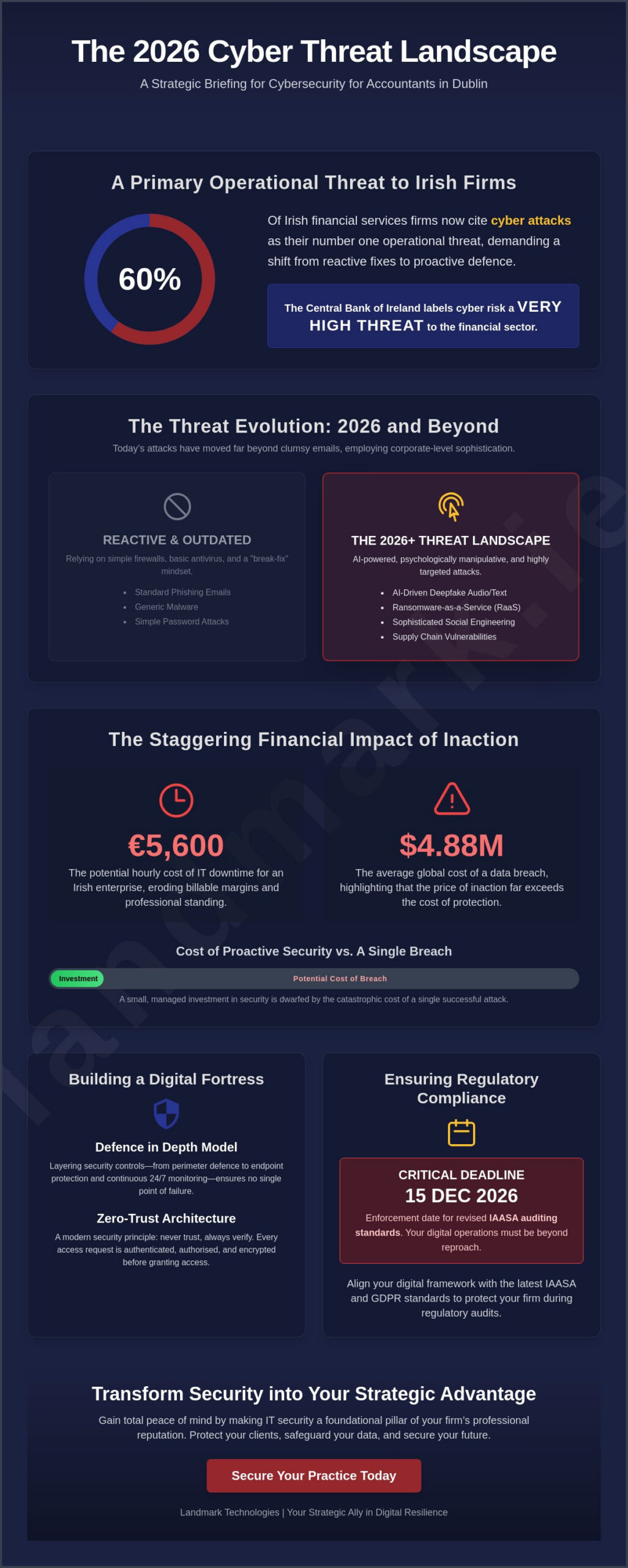
Did you know that 60% of Irish financial services firms now cite cyber attacks as their primary operational threat? For any practice prioritising cybersecurity for accountants Dublin, the landscape has shifted from simple firewalls to a sophisticated battleground of AI-driven deepfakes and automated phishing. You understand that your reputation is your most valuable currency, yet the rising cost of professional indemnity insurance and the complexity of IAASA compliance can feel like an endless climb. It’s a challenge to maintain that signature sense of calm efficiency when the Central Bank of Ireland labels cyber risk a very high threat to the sector.
You deserve a digital environment that feels as secure and refined as a premier professional suite. This article will show you how to safeguard your firm against 2026 threats whilst ensuring total regulatory compliance and deep client trust. We’ll examine the critical 15 December 2026 deadline for revised auditing standards, the €5,600 hourly cost of IT downtime, and how adopting a zero-trust architecture turns your security spend into a measurable strategic advantage for your practice.
Key Takeaways
- Identify the mechanics of AI-enhanced social engineering and Business Email Compromise to protect your firm from sophisticated 2026 financial fraud.
- Master the “Defence in Depth” model for cybersecurity for accountants Dublin, ensuring your practice benefits from continuous, 24/7 managed detection.
- Align your digital operations with the latest IAASA and GDPR standards to ensure your practice remains beyond reproach during regulatory audits.
- Explore how a bespoke, managed security strategy creates a frictionless environment that nurtures success whilst safeguarding your client’s most sensitive data.
- Gain total peace of mind by transforming your IT security from a technical necessity into a foundational pillar of your firm’s professional reputation.
The Critical Importance of Cybersecurity for Accountants in Dublin and Ireland
In the sophisticated environment of Dublin’s financial district, cybersecurity has transcended its origins as a mere IT requirement. By 2026, it has become the very foundation of professional prestige. For local firms, cybersecurity for accountants Dublin is no longer about fixing a broken laptop; it’s a proactive commitment to safeguarding the fiduciary bond between advisor and client. Accountants are high-value targets because they sit at the intersection of wealth and sensitive data. You hold the keys to personal identifiable information (PII) that cybercriminals find irresistible. Transitioning from a reactive “break-fix” mindset to a model of managed security isn’t just a technical upgrade. It is an investment in Digital Trust, a core asset that distinguishes a premier practice from its competitors.
The Evolving Role of the Accountant as a Data Custodian
The rapid digital transformation across Irish practices has expanded the attack surface significantly. Every cloud-based ledger and automated tax filing represents a potential entry point for sophisticated actors. High-net-worth clients expect their financial details to be handled with the same level of care as a physical vault in a heritage bank. Relying on basic antivirus software is an outdated approach that fails to meet modern information security audit standards. A robust defence signals to your peers and clients that you are a dedicated strategic ally, impeccably organised and attentive to the finest details of their digital safety. Prioritising cybersecurity for accountants Dublin ensures that your firm remains a sanctuary for client data in an increasingly volatile landscape.
Economic Impacts of Cyber Incidents in the Financial Sector
The financial repercussions of a breach extend far beyond the immediate technical recovery. In 2026, the cost of unplanned IT downtime for Irish enterprises can reach upwards of €5,600 per hour, a figure that quickly erodes billable margins and damages professional standing. There’s also the matter of Professional Indemnity (PI) insurance. Insurers in Ireland now scrutinise security protocols with unprecedented rigour, often rewarding firms that demonstrate digital resilience with more favourable premiums. According to the 2026 Cybersecurity Pricing Guide, the average cost of a data breach globally has climbed to $4.88 million, making it clear that the price of inaction is far higher than the cost of a curated security experience. Investing in business continuity and managed protection isn’t a cost; it’s a strategy for long-term stability.
Navigating the 2026 Threat Landscape: Beyond Standard Phishing
The digital threats confronting cybersecurity for accountants Dublin have moved far beyond the era of clumsy, misspelled emails. In 2026, the landscape is defined by precision and psychological manipulation. Cybercriminals now operate with the efficiency of a high-end enterprise, utilising Ransomware-as-a-Service (RaaS) to launch sophisticated attacks against Irish SMEs. This shift means that even smaller practices are targeted with the same intensity once reserved for global banks. Protecting your firm requires more than just a defensive wall. It demands a deep understanding of how modern fraud exploits the very human elements of your practice. It’s a challenge that requires constant vigilance and a strategic approach to digital safety.
AI-Driven Fraud and Deepfake Technology
The most unsettling development in recent years is the rise of AI-enhanced social engineering. Attackers now use generative AI to create deepfake audio and text that perfectly mimics the tone and cadence of a firm’s partners. A fraudulent request for a wire transfer can arrive in a voice note that sounds exactly like your colleague. This level of deception bypasses traditional visual checks and preys on the culture of efficiency within a busy office. To maintain integrity, firms must adopt rigorous verification protocols that go beyond the digital realm. It’s about ensuring that every significant transaction is met with a human touchpoint, blending modern technology with traditional professional caution.
Supply Chain Vulnerabilities and Third-Party Risk
Your firm’s digital perimeter is only as strong as its weakest connection. Most Dublin practices now rely on a web of integrated cloud accounting software and automated API feeds. Whilst these tools offer effortless functionality, they also introduce supply chain risks. If a third-party vendor is compromised, your client data is at risk. Adhering to the DPC’s data security obligations requires a thorough vetting of every digital partner you invite into your ecosystem. We often find that a professional IT consultancy session can reveal hidden “Shadow IT” risks where unauthorised AI tools are being used by staff for data analysis, inadvertently exposing sensitive PII to the public web.
Essential Components of a Premium Cyber Defence Strategy
A premium approach to cybersecurity for accountants Dublin treats digital safety as a bespoke architectural project rather than a simple checklist. To achieve true resilience, your firm must adopt a “Defence in Depth” model. This strategy layers multiple security controls so that if one fails, others stand ready to protect your sensitive financial data. It’s about creating a frictionless yet impenetrable environment where your team can focus on client success without the constant shadow of digital risk. This multi-layered framework ensures that your practice remains a sanctuary for financial integrity.
At the heart of this strategy lies Managed Detection and Response (MDR). This service provides 24/7 oversight, acting as a dedicated strategic ally that monitors your network for anomalies that automated tools might miss. Whilst Multi-Factor Authentication (MFA) remains the non-negotiable baseline in 2026, many high-achieving firms are now transitioning to a Zero Trust Architecture (ZTA). This model operates on the principle of “never trust, always verify”, ensuring that every user and device is authenticated regardless of whether they are working from a prestigious Dublin office or a remote home environment. This shift reflects a modern understanding of the hybrid workplace as a secure extension of your physical headquarters.
Securing the Human Element: Awareness Training
Your staff are your strongest line of defence when properly equipped. We’ve moved beyond the era of boring annual seminars. Modern firms foster a continuous, gamified security culture that empowers employees to spot AI-driven phishing attempts with ease. You can explore Landmark’s cyber security guide for broader context on how this culture integrates into a wider business strategy. By investing in awareness, you transform potential vulnerabilities into a vigilant community of professionals who take pride in protecting client confidentiality.
Business Continuity and Disaster Recovery (BCDR)
True peace of mind comes from knowing your practice can withstand any disruption. Business Continuity and Disaster Recovery (BCDR) is the difference between a simple backup and a guaranteed return to operations. An untested backup is merely a wish; a true BCDR plan involves regular, rigorous testing to ensure rapid restoration. This commitment to readiness creates the “calm efficiency” your clients expect. It ensures that even in the face of a cyber incident, your firm’s professional service delivery remains uninterrupted and your reputation stays beyond reproach.
Regulatory Compliance: GDPR and IAASA Standards for Irish Firms
Compliance in the modern era is far from a passive exercise. For those overseeing cybersecurity for accountants Dublin, the regulatory bar has reached a new height of sophistication. The Irish Auditing & Accounting Supervisory Authority (IAASA) now demands a level of digital operational resilience that matches the precision of your own financial reporting. Crucially, the revised Ethical Standard for Auditors (Ireland) 2025 becomes effective for audit periods beginning on or after 15 December 2026. This isn’t merely a legal checklist. It is a call to align your professional duty of confidentiality with the rigorous technical requirements of GDPR. From implementing robust Data Processing Agreements (DPAs) with cloud providers to ensuring end-to-end encryption, your firm must treat data protection as a core element of its fiduciary responsibility.
The intersection of these regulations creates a framework where security and professional ethics are inseparable. In 2026, the Central Bank of Ireland continues to identify cyber risk as a very high threat, making it clear that standard protections are no longer sufficient. Adopting a proactive stance on encryption and statutory data obligations doesn’t just satisfy a regulator; it reinforces the prestige of your practice. It signals to your clients that their financial integrity is being managed by a dedicated strategic ally who values detail and discretion above all else.
Audit Trails and Forensic Readiness
Detailed audit trails are the digital heartbeat of a transparent practice. Maintaining these logs is essential for regulatory reporting, as it allows you to prove that “technical and organisational measures” were active and effective at all times. This forensic readiness ensures that if a query arises, you can respond with the calm efficiency of a firm that is impeccably organised. Seeking expert IT consultancy Dublin is a strategic move to prepare for compliance reviews, ensuring your digital records are as disciplined as your accounting standards.
Managing Client Data in the Cloud
Transitioning to a cloud-first model requires careful attention to data residency and jurisdiction. For firms utilising Microsoft 365, ensuring that client data stays within the appropriate EU boundaries is a non-negotiable compliance pillar. Regular vulnerability assessments and penetration testing act as a high-end service for your digital infrastructure, identifying potential weaknesses before they can be exploited. This proactive stance nurtures a sense of stability and permanence for your clients. To ensure your firm meets every statutory obligation whilst maintaining a frictionless workflow, contact Landmark today for a comprehensive security and compliance review.
Landmark Technologies: Your Strategic Ally in Digital Resilience
Landmark Technologies serves as a refined host for your firm’s digital infrastructure. We understand that cybersecurity for accountants Dublin requires more than just technical precision; it requires a deep respect for the rhythm of a high-achieving practice. Our approach is bespoke, designed to blend seamlessly with your existing workflows whilst providing an invisible layer of elite protection. We take pride in being a dedicated strategic ally, ensuring that your digital environment remains a place where success is nurtured and financial integrity is absolute. By choosing a partner that values heritage and modern innovation in equal measure, you ensure your practice remains a sanctuary of professional excellence.
Our support is rooted in a blend of professional authority and warm, Irish-based hospitality. We don’t just provide services; we curate a professional experience that mirrors the high standards you set for your own clients. This quiet confidence allows you to focus on your fiduciary duties, knowing that the complexities of 2026 threats are being managed by an entity that is impeccably organised and attentive to every detail. It’s about providing a sense of stability and permanence in a digital world that often feels hurried and volatile.
A Partnership Built on Trust and Excellence
The “Landmark Experience” is defined by a frictionless and impeccably organised approach to technology. We align our IT strategy with your firm’s long-term growth goals, ensuring that your infrastructure evolves alongside your ambitions. Whether your practice is situated amongst the prestigious landmarks of St. Stephen’s Green or the modern hubs of the Grand Canal, we provide a stable digital foundation that respects your local heritage. This commitment to the Irish accounting community ensures that your firm isn’t just secure, but positioned as a leader in digital resilience. We treat your workspace as an environment where success is nurtured through effortless functionality and high-end support.
Next Steps: Securing Your Firm’s Future
Moving from technical anxiety to strategic confidence begins with a comprehensive Cyber Security Audit. This curated process evaluates your current posture against the sophisticated 2026 threat landscape, providing a clear roadmap for your digital defences. It’s an opportunity to organise your security spend with a clear ROI, ensuring total peace of mind regarding client confidentiality and regulatory compliance. We invite you to move beyond basic protection and embrace a tailored solution that reflects the prestige of your practice. Contact the Landmark team today for a private briefing to begin your journey towards total digital resilience.
Securing the Legacy of Your Practice
The landscape of 2026 requires more than technical vigilance; it demands a fundamental shift in how your firm views its digital identity. We’ve explored the rise of AI-driven fraud and the critical necessity of zero-trust architectures to protect the density of your client data. Meeting the 15 December 2026 deadline for revised auditing standards isn’t just about compliance. It is about reinforcing the trust that defines your professional reputation. By treating security as a pillar of your firm’s prestige, you turn a technical requirement into a competitive advantage.
Prioritising cybersecurity for accountants Dublin ensures that your firm remains a sanctuary for financial integrity in an era of unprecedented digital disruption. With over 20 years of experience supporting Irish professional services, Landmark Technologies acts as your dedicated strategic ally. Our Dublin-based helpdesk provides the calm, expert assistance your team needs to maintain peak efficiency. As strategic partners in AI and business automation for the financial sector, we’re uniquely positioned to help you navigate this transition with grace and precision.
Now is the time to move from technical anxiety to a position of strategic confidence. Secure your practice with a bespoke Cyber Security Audit from Landmark Technologies and ensure your digital infrastructure reflects the high standards of your firm. Your journey towards total resilience is a path we’re honoured to walk beside you.
Frequently Asked Questions
What are the most common cyber threats facing Irish accountants in 2026?
The primary threats include sophisticated AI-generated deepfakes and state-sponsored digital disruption. With Ireland holding the presidency of the Council of the European Union in 2026, local firms face increased exposure to espionage and disinformation campaigns. These attacks often target a firm’s high density of sensitive financial records, making traditional defences inadequate against automated, high-velocity threats that specifically exploit the trust inherent in professional relationships.
How does GDPR compliance differ for accounting firms compared to other SMEs?
Accounting practices handle a significantly higher volume of sensitive PII and financial data than the average SME. This concentration of data triggers stricter “technical and organisational” requirements under GDPR, as a breach carries a higher risk of identity theft or corporate fraud. Your firm must balance these legal obligations with a professional duty of confidentiality, necessitating a more nuanced approach to data encryption, access controls, and retention policies.
Is cloud-based accounting software more secure than on-premise servers?
Cloud solutions generally offer superior security due to the continuous monitoring and high-end encryption provided by global vendors. However, this security is only effective if your firm manages data residency correctly and enforces strict identity management. Whilst on-premise servers offer physical control, they often lack the sophisticated 24/7 managed detection and response capabilities that modern cloud environments provide to counter the sophisticated threats of 2026.
How often should our accounting firm conduct cybersecurity awareness training?
Annual seminars are no longer sufficient to combat the rapid evolution of digital deception. Your firm should adopt a model of continuous, bite-sized training delivered monthly to keep security culture at the forefront of the practice. This regular engagement ensures that staff remain vigilant against the latest AI-driven social engineering tactics whilst maintaining the calm efficiency required in a busy professional environment.
What is the role of IAASA in dictating cybersecurity standards for auditors?
IAASA sets the benchmark for professional ethics and operational resilience through the “Ethical Standard for Auditors (Ireland) 2025”. This framework mandates that auditors maintain robust digital defences to protect the integrity of the audit process. Effective for periods beginning on or after 15 December 2026, these standards ensure that cybersecurity for accountants Dublin is treated as a core component of your firm’s professional fiduciary duty.
Can cybersecurity measures actually improve my firm’s daily efficiency?
Robust security protocols often lead to a more streamlined and frictionless digital environment. By implementing single sign-on (SSO) and automated identity verification, you reduce the time staff spend managing multiple passwords and credentials. These measures foster an impeccably organised workflow, allowing your team to focus on high-value advisory work rather than technical hurdles, effectively turning security spend into a driver of productivity.
What should be the first step if we suspect a data breach has occurred?
Your immediate priority is to isolate affected systems and activate your formal Business Continuity and Disaster Recovery (BCDR) plan. This swift action prevents the lateral movement of threats across your network. Once the perimeter is secure, you must begin a forensic investigation to meet your mandatory notification windows under GDPR, ensuring your response is as composed and professional as the high-end service your clients expect.
How does Managed IT Support help in reducing professional indemnity insurance costs?
Insurers increasingly reward firms that can demonstrate a proactive and documented approach to risk management. By partnering with an expert provider for cybersecurity for accountants Dublin, you provide underwriters with proof of 24/7 monitoring and forensic readiness. This evidence of robust protection often leads to more favourable premiums, as it significantly reduces the statistical likelihood and potential financial impact of a successful cyber attack.