
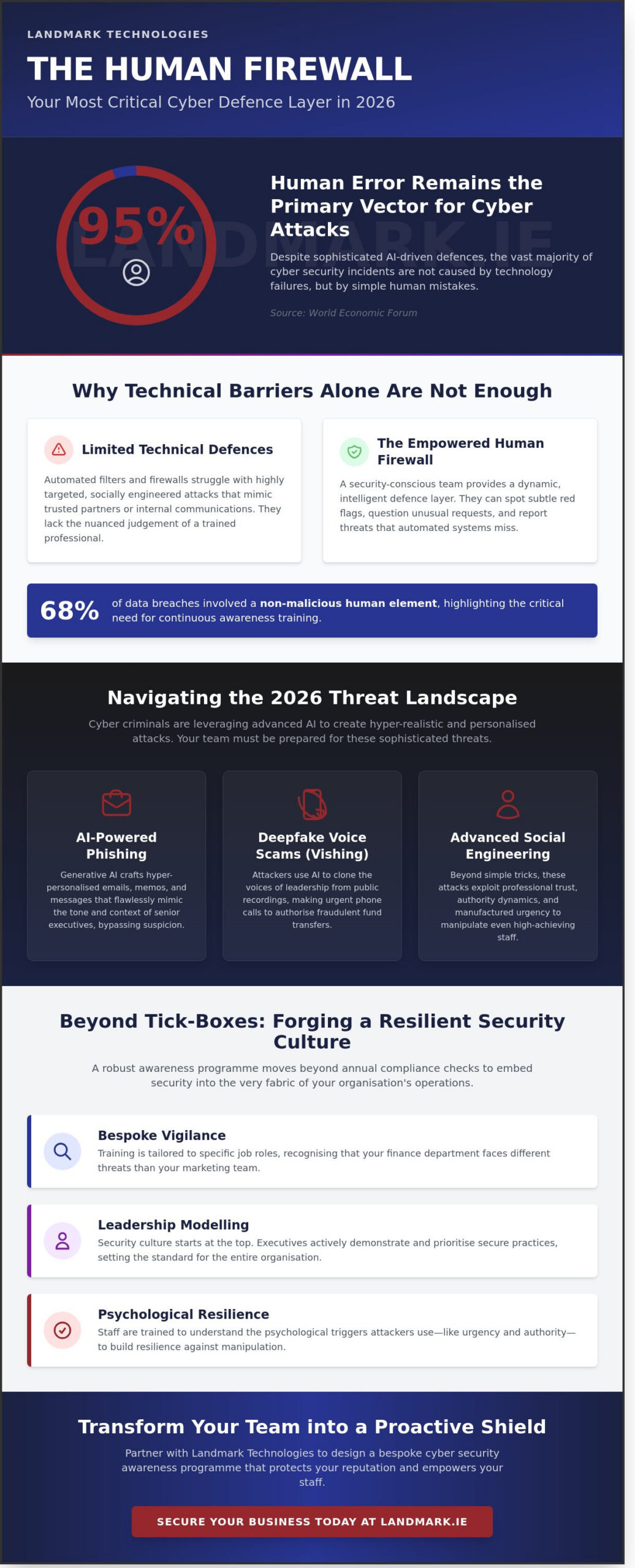
Did you know that despite 2026’s sophisticated AI-driven defences, the World Economic Forum reports that 95% of cyber security issues are still traced back to human error? It’s a sobering thought for any Irish business leader striving for excellence. Whilst technology evolves at a rapid pace, your primary vulnerability remains the person sitting at the desk. Developing robust cyber security awareness isn’t just about avoiding a data breach. It’s about fostering an environment where every team member feels empowered to protect your firm’s hard-earned reputation with the same care they bring to their daily work.
We understand that the complexity of modern threats can feel overwhelming, especially when traditional “tick-box” training fails to engage your talented staff. You deserve the peace of mind that comes from a resilient, security-conscious culture that mirrors the high standards of your professional workspace. In this guide, you’ll learn how to transform your workforce into a sophisticated, proactive shield that ensures seamless compliance with Irish and EU regulations. We’ll explore the specific strategies needed to move beyond mere checklists and build a truly prestigious digital defence for your business.
Key Takeaways
- Understand why a sophisticated human firewall is the most critical layer of your 2026 security stack, moving beyond basic knowledge to proactive behaviour.
- Learn to identify emerging AI-driven threats, including deepfake technology and hyper-personalised scams that bypass traditional digital filters.
- Discover how to transform cyber security awareness into a strategic business driver that enhances operational efficiency and safeguards your reputation in the Irish market.
- Implement a bespoke five-step framework to assess your current baseline and deliver tailored, role-specific training that resonates with every department.
- Partner with a meticulously organised host to ensure your IT infrastructure remains a calm, secure, and prestigious foundation for your business growth.
What is Cyber Security Awareness in the Modern Enterprise?
In the sophisticated world of modern commerce, where established principles meet cutting-edge innovation, the definition of safety has evolved. Cyber security awareness represents far more than a basic understanding of passwords; it’s the strategic fusion of staff knowledge, constant vigilance, and proactive behaviour. For a business to thrive in 2026, its team must become a “human firewall,” acting as the most resilient layer in a multi-faceted security stack. The concept of Security awareness is often misconstrued as a simple compliance box-ticking exercise, yet it’s actually the pulse of a secure organisation.
To better understand how these threats manifest in a professional environment, watch this helpful overview:
Modern enterprises are shifting away from reactive “don’t click” rules that only surface during annual reviews. Instead, they’re cultivating a continuous culture where threat recognition is second nature. This transition ensures that security isn’t an occasional hurdle but a seamless part of the daily workflow, much like the effortless service expected in any premium professional environment.
The Pillars of a Security-Conscious Culture
Social engineering isn’t just a technical glitch; it’s a calculated psychological tactic. Sophisticated threats target high-achieving professionals by exploiting trust, urgency, and authority. Leadership must model digital hygiene from the top down, ensuring that secure practices are as integrated into the workday as a morning meeting in any prestigious boardroom. Cyber security awareness is the strategic alignment of human intuition with technical safeguards.
- Bespoke Vigilance: Recognising that different roles face unique risks.
- Leadership Modelling: Executives prioritising security protocols to set the standard.
- Psychological Resilience: Understanding how attackers use emotional triggers to bypass logic.
Why Technical Barriers Alone Are No Longer Sufficient
While robust network security remains a vital foundation, it cannot stand alone in an era of bespoke cyber attacks. Industry data from the 2024 Verizon Data Breach Investigations Report indicates that approximately 68% of breaches involved a non-malicious human element, while other longitudinal studies place human error as a factor in nearly 90% of successful infiltrations. Automated filters often struggle with highly targeted spear-phishing attempts that mimic the specific tone of a trusted partner or industry supplier.
Awareness fills the critical grey areas where software lacks the nuance to make a judgement call. A machine might not flag a slightly unusual request for a bank transfer from a known contact, but a trained professional will notice the subtle shift in language. This human intuition provides a vibrant, flexible layer of protection that no algorithm can replicate. Complementing this human layer with regular penetration testing for your Irish business ensures that both your people and your technical defences are validated against real-world attack scenarios.
Navigating the 2026 Threat Landscape: Beyond Basic Phishing
The digital environment for Irish enterprises has shifted dramatically. It’s no longer enough to simply scan for poorly spelled emails or generic suspicious links. By 2026, the challenge has become one of hyper-personalisation. Cyber criminals now utilise advanced generative AI to craft messages that mirror the precise linguistic nuances and professional tone of a Dublin-based executive. This isn’t just about email integrity; it’s about the security of every digital interaction within your organisation. Comprehensive cyber security awareness training must evolve to address these synthetic threats before they find a way to breach your perimeter. Understanding the full scope of these risks is essential, and our cyber security guide for businesses in Ireland provides a detailed overview of the evolving 2026 landscape.
AI and the Sophistication of Social Engineering
Attackers now employ deepfake audio to conduct high-stakes “Vishing” attacks with startling accuracy. By cloning the voice of a senior partner from a public keynote or a media interview, fraudsters can authorise urgent fund transfers over a brief, seemingly routine phone call. These clones are often indistinguishable from the actual person, which makes traditional trust markers obsolete. To combat this, your team should adopt a culture of verifying any unusual financial request through a pre-agreed, secondary secure channel. Resources shared during Cybersecurity Awareness Month highlight that human intuition, backed by rigorous verification protocols, remains the most effective shield against AI-driven deception.
Protecting the Hybrid Workspace
As professionals move between prestigious Dublin offices and home environments, the attack surface naturally expands. The risks are diverse, ranging from insecure domestic Wi-Fi to the physical threat of “juice jacking” at transport hubs like Heuston or Connolly station. Maintaining a seamless security posture requires a shift in mindset amongst all staff members. Many employees turn to “Shadow AI” tools to boost productivity, often without realising they are feeding proprietary Irish client data into public models. Implementing MFA acts as a critical backstop in these scenarios, ensuring that even if a password is compromised, the intruder’s progress is halted immediately.
Ransomware remains a persistent threat, but its entry point is rarely a technical exploit; it’s almost always a human lapse. By fostering a deep culture of cyber security awareness, you empower your staff to recognise the subtle signs of an initial foothold before it escalates into a crisis. At Landmark, we believe a secure workspace is the foundation of a productive one. If you are looking to organise your team within an environment that values both elegance and digital safety, choosing a meticulously managed space can provide that necessary peace of mind.
The Strategic Business Value of Enhanced Awareness
Viewing security as a mere cost centre is a perspective that modern Irish leaders are rapidly outgrowing. In the prestigious business districts of Dublin, from the heritage of Merrion Square to the innovation of the Silicon Docks, reputation is the most valuable currency a firm possesses. Investing in cyber security awareness transcends basic risk mitigation. It elevates your brand, signalling to clients and partners that their data is handled with the same meticulous care you apply to every other facet of your professional service.
The financial argument for prevention is undeniable. According to IBM’s 2023 research, the average cost of a data breach globally reached approximately €4.07 million; however, these figures often underplay the long-term erosion of client trust within the tight-knit Irish market. Businesses that prioritise proactive education see a measurable return on investment through reduced insurance premiums and the avoidance of catastrophic remediation fees. Leveraging ISACA cybersecurity resources helps firms align their internal cultures with global standards, ensuring that security becomes a pillar of growth rather than a hurdle to it.
Compliance as a Competitive Advantage
For firms aiming to secure high-value contracts, demonstrating a robust security culture is a powerful differentiator. As we approach the 2026 enforcement of updated EU security directives, Irish businesses must meet stringent duty of care requirements that go beyond simple tick-box exercises. Whilst compliance represents the essential floor of your operations, true cyber security awareness is the ceiling of your business resilience. This proactive stance ensures you’re not just meeting NIS2 and GDPR mandates but exceeding them to win the confidence of sophisticated global partners who value discretion and safety. A structured penetration testing strategy is an increasingly important component of demonstrating that compliance to auditors and enterprise clients alike.
Reducing the “Friction” of Security
A common misconception is that tighter security inevitably slows down work. In reality, a team that’s well-versed in digital safety operates with greater fluidity and confidence. When staff understand the logic behind protocols, they navigate systems more efficiently, which can lead to a 30% reduction in unnecessary IT support tickets. We believe in fostering a “blame-free” reporting culture where suspicious incidents are flagged instantly without hesitation. This transparency is a core component of the Landmark Experience, where security is integrated so seamlessly into the daily rhythm that it feels like a natural extension of your professional excellence. It creates a calm, focused environment where your team can innovate without the shadow of digital uncertainty.
Designing a Bespoke Awareness Programme: A 5-Step Framework
Creating a resilient culture requires more than a generic checklist. It demands a strategy as meticulously designed as a premium boardroom in Dublin 2. According to the 2023 PwC Irish CEO Survey, 72% of leaders in Ireland identify cyber risks as a top threat to their growth. To mitigate this, businesses must transition from passive compliance to active cyber security awareness through a structured, five-step framework.
- Assess the baseline: Begin with non-punitive phishing simulations and surveys to understand current vulnerabilities. This isn’t about catching people out; it’s about identifying where your team needs the most support.
- Tailor the content: A bespoke approach ensures relevance. Your finance team handles wire transfers whilst your marketing team manages social credentials. Their training should reflect these distinct realities.
- Prioritise micro-learning: Respect the demanding schedules of high-achieving professionals. Deliver five-minute modules that offer immediate value without disrupting the working day.
- Simplify reporting: Establish a frictionless, one-click process for reporting “near misses.” When employees feel safe reporting a suspicious email, they become your most effective firewall.
- Track behaviour: Move beyond simple quiz scores. Measure success by the decrease in click-through rates on simulations and the increase in proactive reporting.
From Simulations to Real-World Vigilance
The most effective simulations are “kind” yet realistic. They aim to educate rather than embarrass, providing just-in-time feedback the moment a mistake occurs. If an employee clicks a simulated link, a helpful prompt should immediately explain the red flags they missed. This creates a powerful learning moment in a safe environment. Landmark believes in a rhythmic approach to excellence; therefore, training should move away from annual events. A monthly communication flow keeps security at the forefront of the professional mind, ensuring vigilance becomes a natural habit rather than a forced chore.
Role-Specific Threat Intelligence
Generic training often fails because it lacks context. Your finance department requires deep dives into invoice redirection and “whaling” attacks, which target high-value transactions. Conversely, creative teams might face risks through malicious file attachments or font downloads. Executive targeting remains a critical concern for Irish firms, as C-suite members are often the primary targets for sophisticated social engineering. Integrating this cyber security awareness into the onboarding process for every new hire ensures that every member of your team understands their role in protecting the business from their first day in the office.
A secure business environment allows you to focus on your next big breakthrough with total peace of mind. Discover how our prestigious workspaces in Dublin provide the professional foundation your growing team deserves.
Landmark Technologies: Your Partner in Professional Resilience
Landmark acts as the perfect host for your digital infrastructure. We believe that managed security should feel like a premium concierge service: sophisticated, calm, and meticulously organised. Instead of overwhelming your team with technical jargon, we provide a curated environment where safety is a standard, not a struggle. We integrate cyber security strategies with continuous cyber security awareness, ensuring your staff are as resilient as your firewall. Our approach is designed to mirror the elegance of a high-end workspace, where every detail is handled with quiet confidence.
The Landmark Advantage
We don’t believe in one-size-fits-all templates. Your business has its own rhythm and prestige, so we build bespoke solutions that reflect your specific professional stature. Having a dedicated Irish helpdesk means you aren’t just a ticket number in a global queue. You’re speaking with local professionals who understand the Dublin business context and the specific regulatory pressures faced by Irish firms. We manage the technical complexity behind the scenes. This allows you to focus on your core success whilst we maintain a vigilant, invisible shield around your data. Our service includes:
- Proactive monitoring that identifies threats before they reach your inbox.
- Bespoke training modules tailored to your specific industry risks.
- Direct access to senior Irish consultants who prioritise your uptime.
Securing Your Future Success
Our managed services create a frictionless environment where security supports growth rather than hindering it. Data from the 2023 Hiscox Cyber Readiness Report suggests that Irish firms face a high volume of attacks, yet many lack a cohesive response plan. We help you move from a state of reactive fear to one of proactive, inspired security. By fostering a deep culture of cyber security awareness, your team becomes your strongest asset rather than your greatest vulnerability. It’s time to experience a higher standard of protection that feels as seamless as it is robust. We invite you to step into a partnership where your digital safety is handled with the same care as your most valued client relationships.
Ready to elevate your protection? Enquire about a bespoke cyber security audit for your firm and discover the Landmark standard of professional resilience.
Cultivating Resilience in a Sophisticated Digital Age
The 2026 threat landscape demands a transition from reactive measures to a culture of constant vigilance. By adopting a bespoke five-step framework, your firm transforms cyber security awareness from a tick-box exercise into a strategic asset that protects both your reputation and your bottom line. Success in this era isn’t just about the latest software; it’s about empowering your team to act as a sophisticated first line of defence whilst maintaining the seamless flow of your daily operations.
Since 2004, Landmark has provided over two decades of specialised Irish IT expertise to the country’s most prestigious firms. We understand that high-achieving professionals require more than just support; they need a partner that offers proactive 24/7 monitoring and advanced threat detection as standard. Our approach blends technical precision with the warm hospitality of a trusted partner, ensuring your digital environment remains as refined and secure as your physical workspace. It’s time to elevate your protection and focus on what you do best.
Discover the Landmark Experience in Cyber Security
Frequently Asked Questions
What is the most common cyber threat for Irish businesses in 2026?
AI-powered phishing remains the primary threat for Irish firms in 2026. According to recent industry projections, 85% of successful breaches involve some form of social engineering. These sophisticated attacks use generative AI to mimic the tone and style of senior executives with startling accuracy. It’s essential that your team stays ahead of these evolving tactics through regular cyber security awareness sessions.
How often should our staff undergo cyber security awareness training?
Your staff should engage in training at least once every quarter to maintain peak vigilance. While annual refreshers were once the standard, the 2025 Cyber Ireland Skills Report suggests that knowledge retention drops significantly after 90 days. We recommend a continuous learning model. This approach ensures security remains a vibrant part of your company culture rather than a once-a-year box-ticking exercise.
Is cyber security awareness training a legal requirement under NIS2?
Yes, cyber security awareness training is a mandatory requirement under the NIS2 Directive for all essential and important entities in Ireland. Since the October 2024 transposition deadline, Irish businesses in sectors like energy, transport, and digital providers must prove their staff are trained. Failure to comply can result in administrative fines of up to €10 million or 2% of total global annual turnover.
Can awareness training really prevent AI-driven deepfake attacks?
Awareness training is your most effective defence against AI-driven deepfake attacks. By teaching employees to verify unusual requests through secondary channels, you create a human firewall that technology alone cannot provide. In 2025, 40% of Irish firms reported encountering deepfake attempts. Training empowers your team to spot the subtle inconsistencies in audio and video that signal a fraudulent interaction.
How do we measure the success of our security awareness programme?
You measure success by tracking the reduction in phishing simulation click rates and the increase in proactive reporting. A healthy programme should aim for a click rate below 5% and a reporting rate above 70% within the first twelve months. These metrics provide a clear, data-driven picture of your organisation’s resilience. It’s about moving from vulnerability to a state of calm, collective confidence.
What should an employee do if they think they have clicked a malicious link?
An employee should immediately disconnect their device from the network and contact the IT helpdesk if they suspect a malicious click. Speed is vital; reporting an incident within the first 15 minutes can reduce the cost of a breach by 40% on average. We encourage a no-blame culture where staff feel supported. This transparency allows our team to isolate the threat and protect your prestigious business assets.
Is small business cyber security awareness different from that of large corporations?
Small businesses face the same sophisticated threats as large corporations but often with fewer defensive resources. Statistics show that 60% of small Irish firms go out of business within six months of a major cyber attack. Whilst the scale of the infrastructure differs, the need for a bespoke cyber security awareness strategy is identical. Every professional deserves a secure environment to grow, regardless of their company’s headcount.
How does Landmark Technologies support businesses with limited internal IT resources?
Landmark Technologies acts as your dedicated partner by providing a seamless, fully managed security training platform. We understand that growing businesses often lack the luxury of a large internal IT department. Our team handles the scheduling, delivery, and reporting of all training modules. This allows you to focus on your core objectives while we ensure your digital workspace remains as secure and inspiring as your physical one.