
What if your technology spend was no longer viewed as an operational burden, but as the most significant driver of your firm’s prestige and growth? As we navigate 2026, many leaders are discovering that understanding how to calculate IT support budget requirements is essential for maintaining a competitive edge. You may have experienced the frustration of unpredictable invoices or the quiet anxiety that underfunding your digital infrastructure leaves your legacy vulnerable. These pains often stem from a lack of alignment between your high-level business objectives and your daily technical requirements.
Mastering this financial discipline is the first step toward reclaiming a sense of calm efficiency within your organisation. This guide provides a comprehensive framework for building a growth-orientated budget that eliminates volatility whilst nurturing success. We will explore the essential components of a modern tech stack, the strategic advantages of an operating expenditure model, and a step-by-step audit process designed to ensure your infrastructure remains as polished and reliable as the service you offer your own clients.
Key Takeaways
- Shift from reactive “break-fix” models to a proactive strategy that fosters operational calm and reinforces your professional prestige.
- Discover how to calculate IT support budget allocations through a structured framework involving comprehensive asset audits and alignment with strategic milestones.
- Explore the financial advantages of an Operating Expenditure (OpEx) model to achieve a predictable monthly spend whilst accessing premium Managed IT Support.
- Optimise your technology lifecycle by planning for hardware refresh cycles and the transition to sophisticated Microsoft 365 and cloud ecosystems.
- Learn how a strategic ally can provide bespoke IT consultancy to eliminate budget volatility and ensure your investments are perfectly tailored to your growth objectives.
Beyond the Spreadsheet: Why IT Budgeting in 2026 Requires a Strategic Lens
Modern business success is increasingly defined by the quality of the digital experience you provide to your employees and clients alike. When you evaluate how to calculate IT support budget parameters, you are essentially defining the calibre of the environment in which your team operates. A well-structured plan replaces the chaotic energy of “break-fix” spending with a sense of curated, professional prestige. This transition allows for a more composed approach to growth, ensuring every digital touchpoint reflects the high-end standards of your firm. It’s about creating a workspace where technology isn’t just a tool, but a frictionless extension of your professional identity.
Underfunding technology often leads to a cycle of expensive, reactive interventions that disrupt the rhythm of your business and erode trust. Effective Information technology management involves aligning your spend with a three-year growth plan rather than merely reacting to immediate hardware failures. By investing proactively, you eliminate the friction that leads to lost productivity and ensure your infrastructure acts as a reliable foundation for your long-term vision. The cost of inaction is rarely just a repair bill; it’s the cumulative loss of momentum and the prestige of a well-oiled machine.
To better understand the strategic importance of getting your project scope right, watch this helpful video:
The Evolving Role of Technology in Business Success
Technology now serves as a core strategic pillar, acting as a silent partner in the boardroom to drive innovation. A well-funded environment provides a significant psychological benefit to your team, fostering a sense of stability and confidence that they can meet any challenge. This frictionless experience is essential for high-achieving professionals who require their tools to be as refined and efficient as their physical workspace. When systems work flawlessly, employees feel valued and empowered, which naturally nurtures a culture of success and high performance.
Avoiding the Pitfalls of Traditional Budgeting
Relying on the “last year plus five per cent” formula is a dangerous strategy for 2026 as it ignores the rapid evolution of digital threats and opportunities. This outdated approach fails to capture the hidden costs of “shadow IT”, where departments purchase software independently, often leading to redundant spending and security gaps. It is vital to integrate cyber security from the very beginning of your financial planning. Identifying these leaks early allows you to reclaim agency over your spend and ensures your technology remains a source of pride rather than a point of operational drain.
The Essential Components of a Modern Business Technology Budget
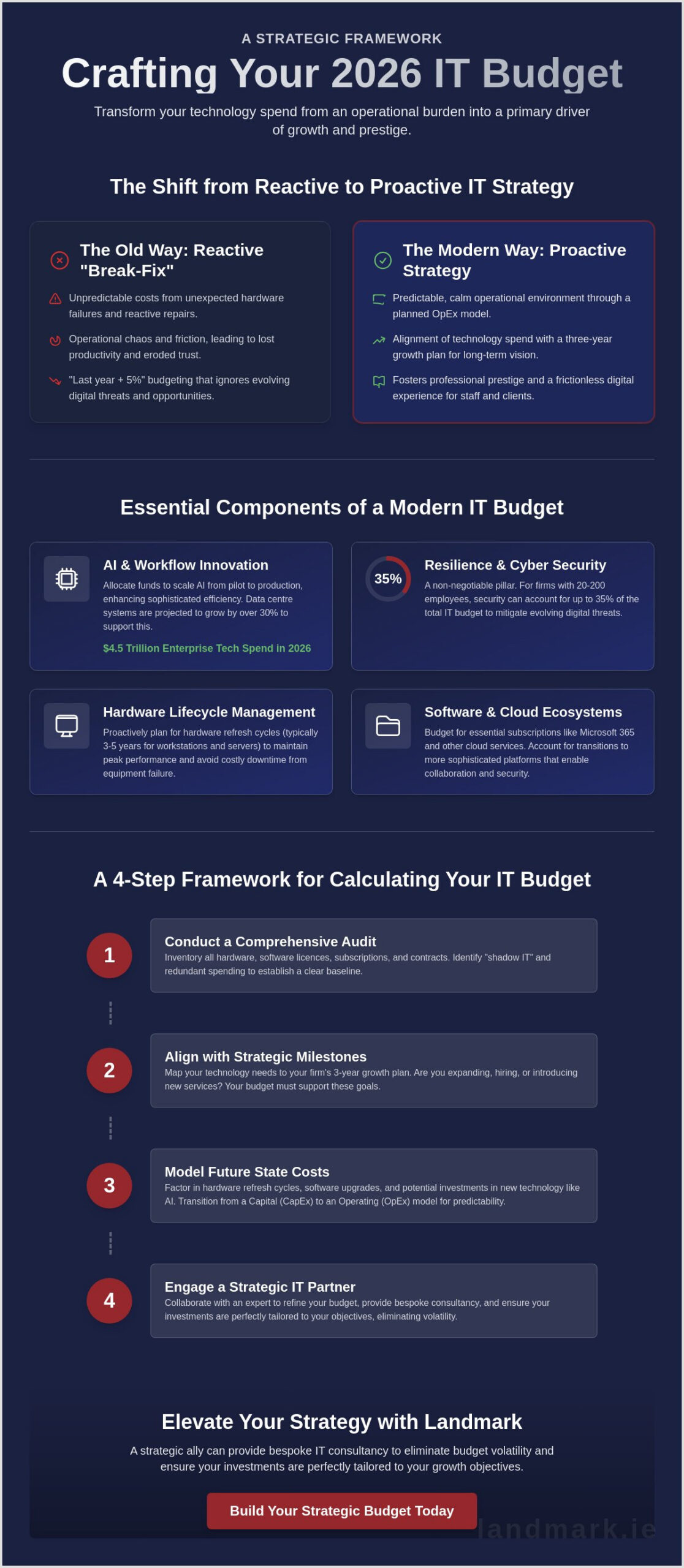
Building upon the strategic lens established in the previous section, we must now identify the specific pillars that sustain a premium digital environment. When determining how to calculate IT support budget requirements for 2026, the focus must shift toward high-growth segments like AI infrastructure. HG Insights projects that enterprise organisations will spend $4.5 trillion on technology this year, with a significant portion dedicated to scaling AI from pilot programs to production. This isn’t just about software; it’s about the data centre systems, expected to grow by over 30%, that provide the horsepower for these innovations. Allocating funds for workflow innovation ensures your team isn’t just working harder, but working with a level of sophisticated efficiency that sets you apart.
Resilience is another non-negotiable pillar. For a typical company with 20 to 200 employees, cybersecurity and risk reduction can account for as much as 35% of the total IT allocation. This investment acts as a safeguard for your reputation, protecting the high-end experience you’ve built for your clients against increasingly sophisticated threats. By treating these components as essential pillars rather than afterthoughts, you create an environment where success is nurtured and risks are elegantly managed. If you’re unsure how to balance these competing priorities, our IT consultancy service provides the tailored clarity needed to ensure your budget is both lean and robust.
Hardware Refresh Cycles and Maintenance
Maintaining premium performance requires a disciplined approach to hardware. Industry standards recommend a refresh cycle for laptops and desktops every three to four years to maintain peak performance. Neglecting this cycle leads to a subtle erosion of productivity and increased maintenance costs for legacy systems. Additionally, as cloud operations become the standard, investing in high-speed business broadband is essential to handle the increased data throughput without friction, ensuring your network infrastructure remains as reliable as your physical workspace.
Software, Cloud, and Licensing Management
Managing the transition to SaaS and Microsoft 365 ecosystems requires a meticulous approach to licensing. It is vital to ensure your model reflects your actual headcount and usage to avoid waste. When Calculating Internal IT Support Costs, consider the value of consolidating subscriptions to eliminate redundant software spend. This prevents the fragmentation of your digital toolkit and ensures your team works within a unified, high-quality ecosystem that scales gracefully as your firm expands its reach.
By addressing these essential components with precision, you create a steady, composed rhythm for your business. It removes the guesswork from your monthly spend and replaces it with a predictable, growth-orientated framework. Mastering how to calculate IT support budget allocations in this way ensures your technology remains a source of pride rather than a point of operational drain.
Operating vs Capital Expenditure: Navigating the Shift to Managed Services
Navigating the financial architecture of a growing business requires a keen eye for both immediate liquidity and long-term stability. When determining how to calculate IT support budget requirements, the choice between Capital Expenditure (CapEx) and Operating Expenditure (OpEx) is perhaps the most significant decision a leader will make. CapEx involves heavy upfront investments in physical assets, such as on-premise servers and networking hardware. Whilst these assets sit on the balance sheet, they also introduce the risk of “bill shock” when systems inevitably fail or require urgent upgrades.
Transitioning to an OpEx model through Managed IT Support offers a more refined approach to financial planning. By treating technology as a monthly subscription, you transform unpredictable repair bills into a fixed, predictable line item. This shift fosters a sense of operational calm; it allows you to allocate capital toward strategic growth rather than emergency hardware replacements. In the Irish market, the cash flow benefits of this model are particularly attractive. OpEx costs are generally fully deductible in the year they are incurred, providing a more immediate tax advantage than the multi-year depreciation schedules associated with physical assets.
The Case for Managed IT Support
Building a prestigious in-house IT department is a significant undertaking that often carries a heavy price tag in recruitment, training, and benefits. In contrast, an outsourced model provides access to a breadth of expertise that a small internal team simply cannot match. You gain the collective intelligence of specialists in cyber security, cloud architecture, and automation. Engaging in high-level it consultancy ensures a higher return on investment than relying on ad-hoc help. It moves your business from a state of “making do” to one of curated, professional excellence.
Total Cost of Ownership (TCO) Analysis
A common pitfall in traditional budgeting is focusing solely on the “sticker price” of hardware. Research suggests that the initial purchase price usually accounts for only 20% of a server’s total cost over its lifetime. The remaining 80% is hidden in power consumption, cooling requirements, physical floor space, and the continuous labour required for management and patching. A thorough TCO analysis often reveals that cloud-based infrastructure is not just more flexible, but more cost-effective. By understanding how to calculate IT support budget totals through the lens of TCO, you can justify the move to modern, scalable solutions that mirror the frictionless experience of a premium workspace.
This strategic shift ensures your technology spend is always aligned with your business objectives. It removes the burden of managing legacy hardware and replaces it with a steady, composed rhythm of service. By embracing the OpEx model, you position your firm as a forward-thinking entity that values agility and fiscal intelligence in equal measure.
A Step-by-Step Framework for Calculating Your IT Support Requirements
Designing a technology financial plan requires a methodical yet inspired approach. It is about more than merely listing line items; it is about orchestrating a symphony of tools that support your firm’s unique rhythm. When you begin the process of how to calculate IT support budget needs for the coming year, you must move through a structured framework that balances current stability with future innovation. This ensures your investment is not just a cost, but a curated foundation for your team’s success.
The first step involves a comprehensive audit of every digital asset within your organisation. From there, you must align your technology requirements with upcoming business milestones, such as office expansions or new service launches. Categorising your costs into “Run”, “Grow”, and “Transform” buckets allows for a clearer view of where your capital is working hardest. Finally, factoring in a 10-15% contingency for emerging security threats provides the reassurance needed to navigate an evolving digital landscape with grace. If you require assistance in refining this roadmap, our team is ready to provide expert Managed IT Support tailored to your vision.
The Audit: Mapping Your Current Landscape
A successful budget starts with absolute clarity. You must catalogue the age of all hardware, the versions of your software, and the current status of all warranties. This process often reveals security vulnerabilities that require immediate funding to protect your professional prestige. By interviewing department heads, you can uncover the subtle “pain points” in their daily workflows that technology could elegantly resolve. This level of detail ensures that no hidden costs or legacy systems are left to drain your operational budget in secret.
Prioritisation: Distinguishing Needs from Wants
In 2026, the ability to rank projects by their potential for business automation and return on investment is a hallmark of sophisticated leadership. Use a risk-based approach to prioritise cyber security investments; this protects your most valuable data assets before allocating funds to “nice-to-have” features. The “Transform” budget serves as the essential engine for competitive advantage in 2026 by funding the AI and automation initiatives that set your firm apart. By focusing on these high-impact areas, you ensure that every pound spent is an investment in your company’s long-term excellence.
Following this framework allows you to approach how to calculate IT support budget requirements with quiet confidence. It moves the conversation away from spreadsheets and toward strategic growth. By partnering with a dedicated ally to review and refine your plan, you ensure your technology remains as polished and reliable as the service you provide to your own clients.
Elevating Your Strategy with Landmark’s Managed IT Solutions
Landmark operates as more than a service provider; we act as a dedicated strategic ally for firms that value prestige and calm efficiency. We understand that your technology infrastructure should be as polished and reliable as the physical environment where you host your clients. When you determine how to calculate IT support budget allocations, you are essentially deciding on the level of stability your business deserves. Our approach blends impeccable organisation with high-end technical expertise to ensure your digital environment remains frictionless and inspiring.
Our bespoke support packages are designed to eliminate the volatility often associated with technology spending. By transitioning your infrastructure to a managed model, you replace the anxiety of unpredictable invoices with a steady, composed rhythm of service. We use proactive monitoring and AI & Business Automation to identify potential issues before they disrupt your workflows. This level of attention to detail creates an atmosphere where success is nurtured and your team can focus on high-value objectives without the distraction of technical debt.
Predictability Through Partnership
Our transparent, fixed-fee Managed IT Support provides the financial clarity required for sophisticated planning. We help you forecast future requirements with precision, ensuring you avoid the “budget shocks” that often plague growing firms. You will work with a dedicated account manager who takes the time to understand the unique heritage and goals of your business. This partnership ensures your IT Consultancy is always relevant and that your investments in Network Infrastructure or Cloud Solutions scale gracefully alongside your headcount. It is a relationship built on trust, designed to provide a sense of permanence and reliability.
Next Steps: Securing Your Digital Future
Refining your approach to how to calculate IT support budget needs is most effective when conducted with an expert audit. We invite you to engage with the Landmark team to map your current landscape and identify opportunities for strategic growth. To prepare for your first consultation, it is helpful to have a list of your current software subscriptions and an overview of your hardware age. This allows us to provide a tailored roadmap that aligns with your specific milestones. Our goal is to move your business toward a state of effortless functionality where every tool serves a curated professional purpose.
Experience the calm of professional IT management with Landmark Technologies and discover how a strategic approach to technology can elevate your entire business operation.
Designing Your Resilient Digital Roadmap
Mastering how to calculate IT support budget requirements is more than a fiscal exercise; it is a declaration of your commitment to excellence. By transitioning from reactive spending to a proactive OpEx model, you ensure your infrastructure remains a silent partner in your firm’s growth. You now have the framework to categorise investments into “Run”, “Grow”, and “Transform” buckets, allowing AI and business automation to act as your engine for competitive advantage in 2026. This strategic clarity creates a sense of stability that is attractive to clients and employees alike.
Since 2004, Landmark has provided decades of Irish market expertise to high-growth firms seeking premium, proactive support that eliminates downtime. We specialise in AI and business automation, helping you navigate complex technical transitions with quiet confidence. It is time to replace unpredictable invoices with the calm efficiency of professional financial planning. Partner with Landmark for a Strategic IT Audit to secure your digital future and enjoy the prestige of a perfectly managed technology landscape. We look forward to being your dedicated strategic ally as you nurture your company’s ongoing success.
Frequently Asked Questions
How much should a small business spend on IT support per employee?
Small to midsize businesses typically allocate between $100 and $250 per employee each month for comprehensive technology care. This benchmark ensures your team operates within a frictionless environment where productivity is nurtured. When you refine how to calculate IT support budget requirements, this per-user figure provides a reliable starting point for maintaining a prestigious level of service whilst avoiding “bill shock”.
What is the difference between CapEx and OpEx in an IT budget?
Capital Expenditure (CapEx) involves large upfront investments in physical assets like servers, whilst Operating Expenditure (OpEx) covers ongoing monthly fees for managed services. Transitioning to an OpEx model fosters operational calm by providing a predictable monthly spend. This shift allows you to preserve capital for strategic growth rather than tying it up in depreciating hardware.
How often should I review and update my IT budget?
A quarterly review is ideal to ensure your financial plan remains aligned with the rapid pace of technological change in 2026. With global IT spending projected to grow by 13.5% this year, regular assessments allow you to adjust for scaling AI initiatives and emerging security threats. These frequent check-ins ensure your technology roadmap remains as agile and refined as your business objectives.
Should cyber security be a separate budget line or part of IT support?
Cyber security should be an integrated component of your overall technology plan, yet it requires its own clearly defined allocation. For a typical firm with 20 to 200 employees, security and risk reduction can account for as much as 35% of the total IT spend. Identifying these costs separately helps you justify the investment in protecting your professional reputation and digital assets.
Can business automation really reduce my overall operational costs?
Yes, business automation reduces costs by removing the friction and human error associated with repetitive manual tasks. By scaling AI from pilot programs to production-level deployments, you allow your team to focus on high-value, strategic work. This investment acts as a catalyst for efficiency, ensuring your organisation operates with a level of sophisticated rhythm that legacy processes cannot match.
Is it cheaper to hire an in-house IT person or use a managed service provider?
Managed service providers often offer a higher return on investment by providing a breadth of expertise that a single in-house employee cannot replicate. You gain access to a dedicated team of specialists in cloud solutions and cyber security for a fixed monthly fee. This outsourced model eliminates the recruitment and training costs associated with internal staff, providing a more stable and composed financial outlook.
What are the hidden costs of IT that most businesses miss?
Shadow IT, or software purchased by departments without official approval, is a major hidden expense that can consume 30% to 40% of a firm’s technology spend. Other often-overlooked costs include the total cost of ownership for legacy hardware, such as the electricity and cooling required for ageing servers. Understanding how to calculate IT support budget totals correctly requires a thorough audit to uncover these silent drains on your resources.
How do I justify a technology budget increase to the board?
Frame the increase as a strategic investment in growth and resilience rather than a mere operational expense. Use the “Run, Grow, Transform” model to demonstrate how additional funds will fuel competitive advantage through AI and business automation. By showing that modern infrastructure acts as a silent partner in achieving business milestones, you position the budget as an essential pillar of your firm’s future success.